
The Cheap Motorcycle That Cruises At 80 MPH Effortlessly
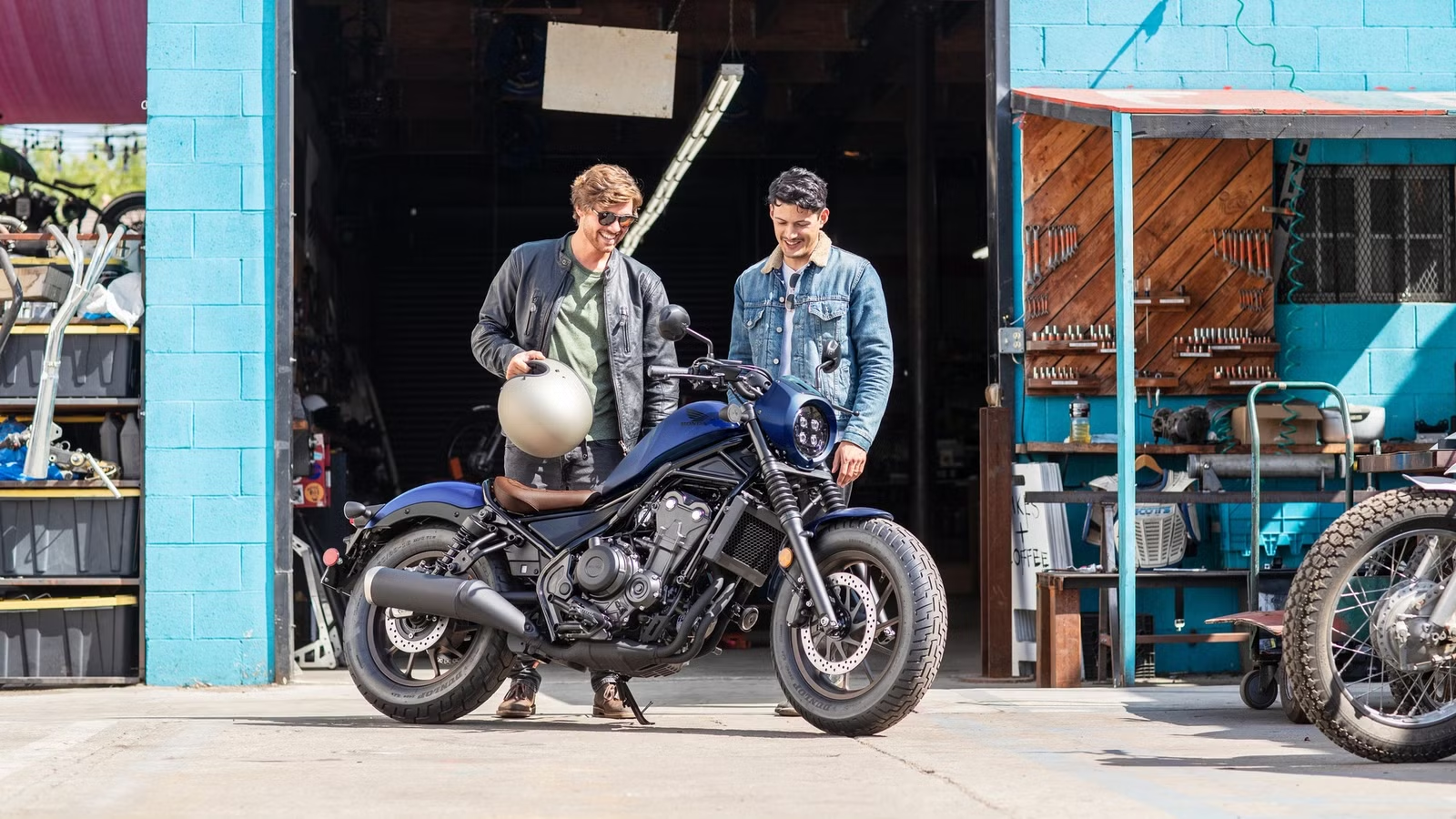
Motorcycle marketing focuses heavily on big engine sizes and loud styling, but frequent highway riding needs practical engineering instead. Showroom displays push heavy machines that look great parked, yet feel exhausting after two hours on the highway. Real long-distance commuting demands low vibration, manageable curb weight, and relaxed highway gearing. If that’s what you want on a budget, there’s one such bike tucked away in the middleweight class with a modest parallel twin that skips the flashy chrome, quietly attracting riders who simply want easy 80 MPH cruising without extra bulk.
Why Most Entry-Level Cruisers Run Out Of Breath On Interstates

The flaw in the entry cruiser motorcycle class is that styling trends usually take priority over functional engineering. Manufacturers design these bikes to mimic classic heavyweight customs, giving them raked-out front forks, ultra-low seat heights, and forward-swept footpegs purely for aesthetics. While this low-and-long stance looks the part, it makes highway commuting remarkably uncomfortable.

Stretched front ends wander and deflect over highway rain grooves and are slow to steer in traffic, while short-travel rear shocks hammer road imperfections directly into your spine. Pair that compromised ride with an engine tuned strictly for low-rpm stoplight pulls, and the bike quickly runs out of breath once traffic accelerates past 65 MPH. Buyers end up paying for retro cruiser aesthetics, only to discover they have bought a machine poorly equipped for modern highway travel.
The Little Things Help Tame Open-Road Turbulence

Fixing this problem requires smart frame balance rather than chasing looks or pure weight. A stiff steel frame and a low center of gravity will keep any motorcycle stable in highway wind. Placing the footpegs in the middle lets the rider lean naturally into the wind instead of acting like a parachute. Underneath, an engine with low vibrations and no strong resonance points will reduce fatigue. Honda has built reliable, practical parallel twins for decades, perfecting small engines that hold highway speeds all day without straining or overheating. This engineering gives riders a calm, planted highway ride without the penalty of a giant chassis.

The Honda Rebel 500 Offers Real Interstate Stamina

Case in point is the Honda Rebel 500. It proves an affordable commuter can handle fast highway speeds with ease, and its versatility is one of the reasons riders end up keeping it for years. Its 471 cc parallel twin makes 46 horsepower, using a tall sixth gear to cruise comfortably at 80 MPH without buzzing. The low 27.2-inch seat and centered footpegs fit both new riders and large adults without feeling cramped. It tracks straight in crosswinds, sips fuel, and is cheap to maintain, making effortless fast-lane travel accessible to anyone on a budget.
Standard ABS And A $6,799 MSRP Cement The Rebel’s Fast-Lane Value

The Rebel 500 is priced at $6,799 for 2026, a $300 increase over the price last year. This is easily explained by the addition of standard ABS, which was a $300 option in 2025. There is also the Rebel 500 SE available at $6,999. That edition brings you better looks in the form of a color-matched headlight cowl, fork gaiters, a diamond-stitched seat, and an exclusive colorway. Aside from that, the costs of running and ownership are extremely low because this is a mature platform and is well known for its reliability, which makes it worth buying even as a used bike.
A 471cc Parallel Twin Brings Proven Smoothness

The Rebel 500’s parallel-twin engine is a large part of why it is the budget Japanese cruiser that can do it all. It is well known and has been around for a very long time in models like the NX500 and the CB500X before it. It has a reputation for being bulletproof, which is why there will be no hesitation in doing long 80 MPH runs frequently. It has a 180-degree firing order, is liquid-cooled, and has a DOHC head with four valves per cylinder. It displaces 471 cc, has an almost square bore and stroke, a compression ratio of 10.7:1, and generates 46.9 horsepower at 8,500 RPM and 31.8 pound-feet at 6,000 RPM.

This is sent through a six-speed manual gearbox and a final drive chain to the wheel. There is a slipper clutch, which reduces effort at the lever, but the other Rebels in the lineup offer interesting transmission options. The Rebel 300 has the E-Clutch system, whereas the Rebel 1100 has the optional dual-clutch automatic transmission. Still, the Rebel 500’s rev-happy little twin makes it a joy to get to highway speed, and then it can sit there without stress or much vibration indefinitely.
Plump Tubeless 16-Inch Tires Add Cushion To A Bare-Bones Suspension Setup

The Rebel 500 uses a modern steel diamond frame, but it keeps the suspension simple, which makes it the most practical commuter for daily commuting, whether that is in the city or on the highway. It runs 41 mm telescopic forks at the front and twin rear shocks with five-step preload adjustment at the rear. The travel available is 5.5 inches at the front and 3.7 inches at the rear.

Things are equally simple with the braking hardware. There is a 296 mm disc at the front with an axial two-piston floating caliper and a 240 mm disc at the rear with a single-piston caliper. These are mounted on 16-inch alloy wheels with tubeless tires. This is a pretty odd tire choice, but the small rims and tall tires help take a little bit of the slack out of the rear suspension’s small travel. Standard dual-channel ABS should help with confident, quick stops.
The 414-Pound Weight Boosts Accessibility
The Rebel 500 is a fairly compact motorcycle, but at the same time is large enough to be stable for highway runs. It is 86.8 inches long, 31.9 inches wide, and has a wheelbase of 58.6 inches. A ground clearance of 5.4 inches and a seat height of just 27.2 inches are also notable figures. Finally, the entire package weighs 414 pounds ready to ride with its three-gallon tank fueled up. All of these are very friendly numbers compared to something like the Royal Enfield Super Meteor 650.
Simple Features Explain The Price

The Rebel 500 has a basic feature set that makes other bikes feel overcomplicated; this is an intentional choice by Honda, and it fits what the Rebel 500 intends to be in its segment. It has a reverse LCD up top that provides a good deal of information, including the speed, fuel level, a clock, the odometer, trip meters, and a gear position indicator. The circular design is not a common choice for the segment. A four-pod LED headlight sits under the LCD.

There are quite a few accessories that you can add to the Rebel. They include luggage and luggage mounting points, and nearly all the elements that distinguish the Rebel 500 SE from the regular Rebel 500 are available as individual items on the accessories list. Neither the SE nor the base variant has a pillion seat as standard fitment, but it is on the options list.
There Are A Few Asian Alternatives To The Rebel 500

The Rebel 500’s natural enemy is the Kawasaki Eliminator, another budget cruiser that is a great deal. Unlike the Rebel, it is available with a non-ABS variant as well, but comparing apples to apples, it is available for the exact same price as the Rebel 500. The difference is that it offers pillion accommodation as standard, has an 18-inch front wheel which bodes well for highway stability, and has Bluetooth connectivity. It has very similar displacement, power, and torque as the Rebel 500, and tall riders will find its Ergo-Fit system, which offers different seat heights, more comfortable.

If you are willing to spend a little more money, then the Royal Enfield Super Meteor 650 has a case for being the best beginner-friendly bike for riding 80 MPH all day for $7,999. Unlike the Kawasaki or Honda, this has an air/oil-cooled 270-degree parallel twin with oodles of torque, inverted front forks, and a small TFT display with navigation. The Celestial variants also offer a touring seat with better padding for long hours in the saddle and a bolt-on windshield, which can make highway touring much more comfortable.
Source: Honda PowerSports

Related posts
Latest Post


No Comments