
2027 Harley-Davidson ST Baggers First Look: Road King, Road Glide, And Street Glide
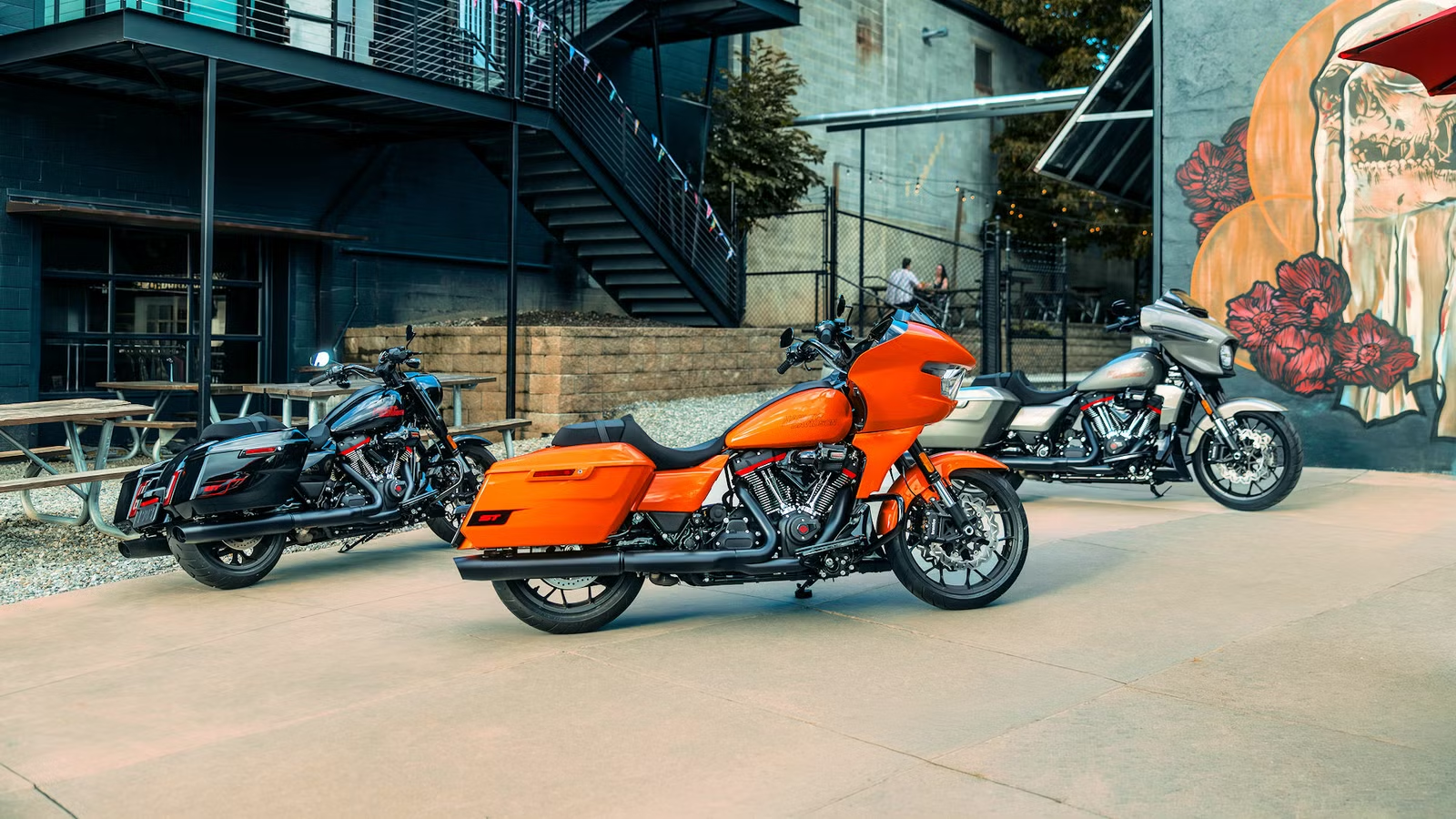
Harley-Davidson is giving its Grand American Touring lineup a performance-oriented makeover for 2027 with three new ST models. The Road King ST, Street Glide ST, and Road Glide ST share the same engine, suspension, and braking upgrades, but each approaches the performance bagger concept differently. The result is a choice between an unfaired touring motorcycle and two familiar fairing configurations, all built around a common mechanical package. The three models join Harley-Davidson’s 2027 lineup with four available colors: Vivid Black, Oxblood Metallic, Sunlit Steel, and Baja Orange.
The biggest change is the introduction of the Milwaukee-Eight 117 High Output engine, which produces a claimed 117 horsepower and 133 pound-feet of torque. Harley-Davidson also revised the final-drive gearing, added a performance-oriented camshaft and Screamin’ Eagle Heavy Breather intake. On the chassis front, the three bikes take big steps forward compared to their standard sibling, equipping all three motorcycles with Showa inverted forks and Brembo radial-mounted brakes. These aren’t simply standard touring models with ST badges and different paint. There are meaningful mechanical changes intended to give the motorcycles a broader performance envelope.
Engine: Milwaukee-Eight 117 High Output Takes Center Stage
The Milwaukee-Eight 117 High Output is the defining mechanical feature of the new ST lineup. It retains the 117-cubic-inch (1,923cc) displacement but receives several changes intended to improve performance at higher engine speeds. Harley-Davidson rates the engine at 117 horsepower at 4,900 rpm and 133 pound-feet of torque at 3,750 rpm. That’s a 12 percent horsepower increase over the standard Milwaukee-Eight 117 featured in the base 2027 Street Glide and Road Glide.

The engine has a 4.075-inch bore, 4.50-inch stroke, and 10.3:1 compression ratio. Harley-Davidson recommends 91-octane fuel. While the displacement remains familiar, the intake, camshaft, and gearing changes give this version a different performance character.
Heavy Breather Intake And Performance Camshaft

The forward-facing Heavy Breather intake is more than a styling exercise. Its exposed filter element is designed to maximize airflow, while the intake’s tuning length helps improve cylinder charging efficiency and peak torque. It also produces a more pronounced intake sound when the rider opens the throttle.
The SE8-511 camshaft is another important part of the package. Its profile builds additional horsepower beginning around 3,500 rpm and continues doing so toward the engine’s upper operating range. Harley-Davidson also installed Screamin’ Eagle high-capacity lifters to accommodate the increased engine speeds and valve lift.
Together, these changes are intended to let the engine breathe more effectively and continue making power higher in the rev range rather than concentrating its output primarily at lower engine speeds.

Harley-Davidson also changed the final-drive ratio from 32/68 (2.125:1) to 30/68 (2.27:1). That might look like a minor numerical adjustment, but the higher ratio provides more mechanical advantage at the rear wheel. In practical terms, the shorter gearing helps the motorcycle accelerate from a stop and improves the thrust available through the midrange.
The engine’s rpm intervention limit also increases from 5,600 rpm to 5,900 rpm. That gives the rider another 300 rpm of operating range before intervention, complementing the camshaft’s ability to produce additional horsepower at higher engine speeds.
Chassis, Suspension, And Braking: Built For Performance

More engine performance is useful only if the chassis can make it manageable. Harley-Davidson addresses that with SHOWA 47mm inverted front forks and rear shock absorbers with adjustable rebound damping and remote hydraulic preload adjustment.
While the Showa inverted fork is a notable step forward for the ST lineup, it still lacks suspension adjustment. However, the twin Showa units in the rear feature a convenient remote preload adjuster in addition to rebound damping adjustment. The remote preload adjuster is particularly useful on a touring motorcycle where you might accommodate passengers or loaded bags during a given ride.

The braking system gets a corresponding upgrade with dual front discs, radially mounted four-piston Brembo calipers, and 320mm floating wave-style rotors. The high-performance braking components give the rider more substantial hardware to work with when slowing a motorcycle that combines touring weight with increased engine performance.
All three models use seven-spoke cast-aluminum wheels, measuring 19 inches at the front and 18 inches at the rear. Their design also helps reduce unsprung weight, which is the portion of the motorcycle’s mass that the suspension must control as the wheels move over the road.
Three Different Riding Positions And Fairing Designs

Although the mechanical package is shared, the three motorcycles have different approaches to rider ergonomics and wind protection.
The Road King ST is the unfaired option, retaining the open-air riding experience associated with the Road King. Its new moto-style handlebar sits on a six-inch-tall cast-aluminum riser, putting the rider in a more upright position. The handlebar can also be rotated to fine-tune the fit.
Harley-Davidson reports that the Road King ST weighs approximately 20 pounds less than the . Some of that reduction comes from the redesigned headlamp nacelle, which is 4.2 pounds lighter. Another 5.3 pounds comes from the forged-aluminum triple clamps. Removing 9.5 pounds from the front end is particularly relevant because weight concentrated near the steering assembly can influence how much effort is required to turn the handlebars, especially at low speeds.

The Road Glide ST takes a different approach. Its “shark-nose” fairing mounts directly to the frame rather than the front fork assembly. That means the fairing doesn’t turn with the handlebars, reducing the additional steering effort associated with a fork-mounted fairing during tight, low-speed maneuvers. The new six-inch riser is 2.2 inches taller than the standard Road Glide riser, and its flatter handlebar bend takes inspiration from flat-track motorcycles.
The Street Glide ST retains the fork-mounted batwing fairing. Unlike the Road Glide arrangement, the fairing moves with the handlebars as the motorcycle turns. Its new performance handlebar is approximately 1.6 inches wider and two inches taller than the standard Street Glide handlebar. Riders therefore get a different combination of steering feel, wind protection, and riding position depending on which model they choose. Traditionally, the Street Glide has offered a different front-end feel than the Road Glide by opting for handlebars that draw the rider closer to the front of the motorcycle. Additionally, the touchscreen infotainment system is easier to manipulate, as it rests closer to the rider than the Road Glide.
Rider Safety Enhancements And Selectable Ride Modes

All three ST models receive Harley-Davidson’s Rider Safety Enhancements package. The equipment includes straight-line and cornering ABS, electronically linked braking, traction control, and drag torque slip control. Vehicle Hold Control and Tire Pressure Monitoring are also included.
These systems address different situations. ABS helps prevent wheel lockup during braking, while traction control manages rear-wheel slip during acceleration. Drag torque slip control addresses excessive rear-wheel slip during deceleration, and electronically linked braking coordinates brake application between the wheels. The cornering functions account for the additional demands of braking and acceleration while the motorcycle is leaned over.
Riders can also select Road, Sport, or Rain modes. Road Mode provides balanced everyday operation, while Sport Mode delivers full power with quicker throttle response. Rain Mode moderates performance for situations where traction is limited. The Street Glide ST and Road Glide ST add Custom Mode, allowing riders to configure performance characteristics through the touchscreen.
Skyline OS And Instrumentation

The Street Glide ST and Road Glide ST receive Harley-Davidson’s Skyline OS infotainment system, displayed on a 12.3-inch color TFT touchscreen. The screen replaces the traditional analog instrumentation and most physical switches. The system also supports over-the-air software updates when connected to a Wi-Fi network.
Both models include a Rockford Fosgate audio system with a four-channel, 200-watt amplifier and two 6.5-inch fairing-mounted speakers. Additional speaker and amplifier upgrades are available through Harley-Davidson Genuine Motor Parts & Accessories.

The Road King ST takes a simpler approach to instrumentation. A four-inch-diameter instrument mounted above and forward of the handlebar combines an analog speedometer with a multifunction LCD display. All lighting is LED, including the seven-inch headlamp and integrated rear brake, tail, and signal lighting.
Touring Comfort And Practical Equipment

The three motorcycles also share a two-piece Sport Touring seat with a raised rear bolster. The removable passenger section allows the owner to convert the motorcycle from a two-up configuration to a solo setup without replacing the entire seat. Laden seat height measures 27.6 inches on the Road King ST and 27.1 inches on both the Street Glide ST and Road Glide ST.
Other shared equipment includes adjustable-reach front brake levers, two prewired connections for heated riding gear, and hard-shell locking saddlebags with a combined capacity of 2.4 cubic feet (68 liters). Tubular-steel engine guards provide limited cosmetic protection during a low-speed tip-over.
The Road King ST also has optional detachable Wind Splitter windshields and fork-mounted wind deflectors. The available vented windshields feature an adjustable center vent intended to reduce turbulence behind the screen, which can help limit helmet buffeting and neck fatigue on longer rides.
Pricing And Availability

Harley-Davidson lists the 2027 Road King ST at $24,999, the Street Glide ST at $29,999, and the Road Glide ST at $30,999. All three models are offered in Vivid Black, Oxblood Metallic, Sunlit Steel, and Baja Orange, although color availability may vary by market.
All three motorcycles get the same engine, suspension, and braking upgrades, but they approach performance touring from different directions. The Road King ST keeps things simple with an exposed handlebar and traditional, unfaired layout, while the Street Glide ST and Road Glide ST offer the added wind protection and technology of their respective fairings. The choice comes down to how much touring comfort and equipment a rider wants, and which riding position and fairing design suit them best.
2027 Harley-Davidson Road King ST, Street Glide ST, and Road Glide ST First Look Photo Gallery
2027 Harley-Davidson Road King ST, Street Glide ST, and Road Glide ST Specifications
Engine:
|
Type |
Milwaukee-Eight® 117 High Output, four-stroke, V-twin |
|
Displacement |
117 cubic inches (1,923cc) |
|
Bore x stroke |
4.075″ x 4.50″ |
|
Maximum horsepower |
117 horsepower @ 4,900 rpm |
|
Maximum torque |
133 lb-ft @ 3,750 rpm |
|
Compression ratio |
10.3:1 |
|
Valvetrain |
Pushrod-operated, overhead valves with hydraulic, self-adjusting lifters; four valves per cylinder |
|
Fueling |
Electronic Sequential Port Fuel Injection (ESPFI), 91 octane |
|
Exhaust |
2-1-2 dual exhaust |
|
Transmission |
6-Speed Cruise Drive® |
|
Clutch |
Mechanically actuated 10 plate wet, Assist and Slip |
|
Final drive |
Belt, 30/68 ratio (2.27:1) |
Chassis:
|
Frame |
Mild steel, square-section backbone with twin downtubes |
|
Front suspension; travel |
SHOWA® 47mm inverted forks; 4.60 inches (117 mm) |
|
Rear suspension; travel |
SHOWA® rear shock absorbers with adjustable rebound damping and remote hydraulic preload adjustment; 3.0 inches (76 mm) |
|
Wheels |
Gloss Black 7-Spoke cast aluminum |
|
Front wheel |
19 x 3.5 inches |
|
Rear wheel |
18 x 5 inches |
|
Tires |
Dunlop® Harley-Davidson Series, bias blackwall front and rear |
|
Front tire |
D408F 130/60B19 M/C 61H |
|
Rear tire |
D407T 180/55B18 M/C 80H |
|
Front brake |
Dual front disc brakes, radially mounted four-piston Brembo® calipers, Performance Dual Floating wave-style 320 mm rotors |
|
Rear brake |
Single axial mounted, fixed 300 mm rotor |
|
ABS |
Standard |
|
Electronic rider aids |
Straight Line/Cornering Electronically Linked Brakes (ELB/C-ELB), Straight Line/Cornering ABS (ABS/C-ABS), Straight Line/Cornering Traction Control (TEC/C-TCS) with modes, Straight Line/Cornering Drag Torque Slip Control (DSCS/C-DSCS), Vehicle Hold Control (VHC), Tire Pressure Monitoring (TPMS), Ride Modes: Road Mode, Sport Mode, Rain Mode, Custom Mode (Street Glide ST and Road Glide ST models only) |
Dimensions & Capacities:
|
Model |
Road Glide ST |
Street Glide ST |
Road King ST |
|
Length |
94.9 in. (2,410 mm) |
||
|
Width |
36.2 in. (920 mm) |
38.6 in. (980 mm) |
37.6 in. (955 mm) |
|
Height |
50 in. (1,270 mm) |
52.2 in. (1,325 mm) |
46.8 in. (1,190 mm) |
|
Wheelbase |
64 in. (1,625 mm) |
||
|
Rake |
26 degrees |
||
|
Trail |
6.7 in. (170 mm) |
||
|
Seat height |
27.1 in. (688 mm) Laden, 28 in. (710 mm) Unladen |
27.6 in. (688 mm) Laden, 28 in. (710 mm) Unladen |
|
|
Ground clearance |
5.1 in. (130 mm) |
||
|
Lean angle |
32 degrees, left and right |
||
|
Fuel capacity |
6 gal. (22.7 l) with 1 gal. (3.8 l) reserve |
||
|
Estimated fuel consumption |
44 mpg (5.3 l/100 km) |
||
|
Curb weight |
804 lb. (365 kg) dry, 840 lb. (381 kg) curb |
780 lb. (354 kg) dry, 818 lb. (371 kg) curb |
750 lb (340 kg) dry, 787 lb (357 kg) curb |
Price & Warranty:
|
Model |
Road Glide ST |
Street Glide ST |
Road King ST |
|
Website |
harley-davidson.com |
||
|
Price |
$30,999 MSRP |
$29,999 MSRP |
$24,999 MSRP |
|
Warranty |
24 months (unlimited mileage) |
||
|
Service interval |
First 1,000 miles (1,600 km), every 5,000 miles (8,000 km) thereafter |
||
|
Color |
Vivid Black (base), New Oxblood Metallic, New Sunlit Steel, Baja Orange |
||
Source: Harley-Davidson

Related posts




Latest Post


No Comments