
This Ultra-Rare Small-Block Corvette Is So Discreet It Passes As A Plain LT1
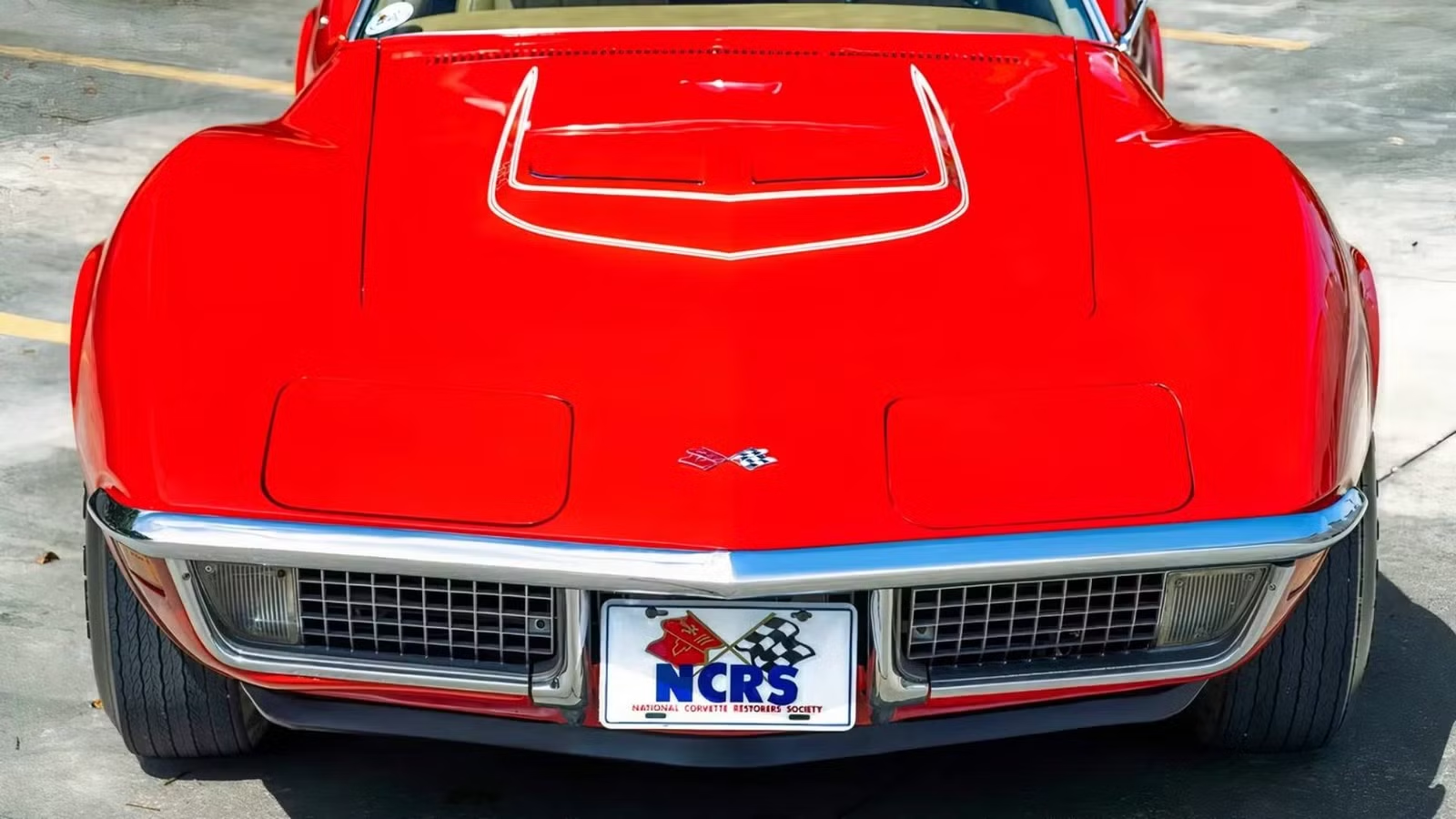
Prince gave us “Little Red Corvette”, but Chevrolet once built a Corvette you couldn’t even order with a radio to play it on. From the sidewalk, this 1970 small-block looked much like an ordinary LT1. Underneath, it carried brakes and cooling equipment with serious racing ancestry. You could admire the paint, recognize the engine, and still miss what made the car special.

That’s an unusual trick in the Chevrolet Corvette family, where special editions can make their identity obvious. The 1996 Grand Sport’s distinctive appearance, for example, gives an enthusiast something to spot across a parking lot. This earlier factory race package demanded a closer look. Corvette Fever described a car whose identity emerged during a brake job years after purchase. The clue was a brake pad. Imagine going out for replacement parts and coming home knowing your car belongs to a tiny production run.
The Familiar LT1 Appearance Hid A Factory Race Package
Full side profile of the 1970 Corvette LT-1, highlighting the C3’s long hood, short rear deck, fender vents, and otherwise familiar LT-1 appearance.

Bring a Trailer
Calling an LT1 “plain” needs a little perspective. It was already the sort of Corvette an enthusiast would stop to inspect. The hidden package’s disguise worked because Chevrolet retained the familiar LT1 hood treatment and didn’t give it a distinct exterior package badge. Someone looking for a different body shape or an obvious extra emblem could walk straight past the evidence.
Its distinguishing equipment was largely mechanical: Chevrolet’s most extreme factory small-block Corvette package for 1970 came without an equally dramatic visual announcement. We’re accustomed to discovery stories involving a forgotten C3 Corvette under years of accumulated dirt. Here, the interesting part could remain hidden even after somebody bought the car and understood that it was an LT1. Knowing the engine was only the start. The brakes, transmission, cooling system, and original order paperwork could tell a much more specific story.

A brake job gave one owner his first clue. In a reported owner discovery, originally published by Corvette Fever and now hosted by MotorTrend, Darrell Boettger thought his Bridgehampton Blue 1970 coupe was a regular LT1 until a mid-1980s brake overhaul sent him to a Corvette shop with its pads, where SCCA racer Rick Stark recognized the unusual J56 dual-pin brake equipment and suspected the rare factory package. Not bad for a brake pad: checks of the engine stamping, component dates, and tank sticker then helped establish the car’s identity. Anyone can spot a missing badge, but recognizing an obscure brake application takes more homework, which is why an old Corvette’s underside deserves as much attention as the polished bodywork—and why a seller can correctly identify the engine while still missing what Chevrolet installed around it.
The Missing Comforts Exposed Its Hidden Racing Purpose
The order restrictions were a stronger hint than the bodywork. Buyers couldn’t specify a radio, air conditioning, power steering, or a rear window defroster with this package. Chevrolet was catering to competition, where equipment had to justify its weight and complexity. Still, an empty radio opening alone doesn’t authenticate anything; other Corvettes could be ordered without a radio, and the 1970 LT1 already excluded air conditioning. The meaningful evidence is the complete combination.
Chevrolet drew on lessons and equipment from L88 racing Corvettes, bringing serious big-block-era preparation to a small-block car. A documented example’s factory racing hardware includes J56 heavy-duty brakes, an aluminum radiator with an expansion tank and steel fan shroud, transistor ignition, a Muncie M22 “Rock Crusher” heavy-duty close-ratio four-speed, and special suspension equipment. Those parts address the repeated demands of a road course: stopping, shedding heat, transmitting power, and controlling the chassis through successive corners. Their value doesn’t depend on adding another impressive number to the engine’s advertised output.

Bring a Trailer
One documented owner account describes a 4.56:1 Positraction rear axle and roughly 3,800 rpm at 70 mph in that particular car. That’s one example, not a universal specification or a factory test. Other documented cars used different ratios; Mecum’s Cortez Silver convertible, for instance, was listed with 3.70:1 Positraction. With similar transmission gearing and tires, the numerically higher ratio makes the engine turn more revs at the same road speed while also multiplying torque more strongly at the axle. That helps explain why a racer might accept the highway compromise. At 70 mph, the engine in that example was already turning at a speed many drivers would associate with accelerating, and it stayed there. Tire diameter and the exact drivetrain still affect the real figure, so the 4.56:1 setup tells us about that car’s priorities, not every car in the production run.
The 1970 Corvette ZR1 Was A Rare 25-Car Racing Package

Bring a Trailer
The disguise finally comes off here: ZR1. Chevrolet’s Special Purpose Engine Package, developed under Zora Arkus-Duntov with SCCA road racing in mind, was the opening chapter in the ZR1’s wider history. It was a factory competition option built around the high-compression, 350-cubic-inch LT1 rather than a larger big-block. For 1970, Chevrolet advertised that small-block at 370 horsepower and 380 lb-ft of torque.
Those figures come with a period-correct asterisk: they’re SAE gross ratings, not modern SAE net figures or power measured at the wheels. Chevrolet’s period factory specification manual provides the 1970 numbers, and the year matters because LT1 compression dropped for 1971. More important, this package was about making the engine and chassis work on a road course, not simply stuffing in a bigger engine for straight-line speed. A documented early car described by the Corvette Action Center was prepared for George Lynch’s SCCA competition with help from Dick Guldstrand.

Bring a Trailer
And Chevrolet built almost none of them. Just 25 ZR1-equipped Corvettes were produced for 1970, followed by eight in 1971 and 20 in 1972—53 across the full three-year run. The 25-car figure belongs to 1970 alone. That’s extraordinary scarcity, but it still doesn’t establish an all-time small-block rarity record; NCRS records just 43 race-prepared 1957 Airbox Corvettes. The original ZR1 doesn’t need extra mythology. The real production numbers are already wild enough.
Factory Paperwork Matters More Than ZR1 Folklore

Start with the car’s original order evidence, then see if the hardware agrees. A tank sticker can identify factory options, while an original purchase order or other contemporary documents can strengthen the case. Then compare those papers with the engine application codes, stampings, component dates, brakes, cooling equipment, and transmission. The NCRS identification guidance warns that both documents and engine markings can be reproduced, so a plausible-looking code is a clue, not proof.
Pricing needs the same caution. Corvette Story lists a 1970 option price of $968.95, another history cites a different package price of $1,010, and Chevy Hardcore gives a third published figure of $1,221. Model year and what each source includes in the charge still need checking, so those numbers shouldn’t be treated as interchangeable prices for the same 1970 order. The idea that the mandatory LT1 engine cost explains the gap remains a hypothesis, not a settled reconciliation.
The name is just as slippery. “Zora’s Racers” survives as enthusiast lore, while another account says ZR1 was a randomly generated RPO code later made famous by fans. RPO means Regular Production Option. Neither explanation is proven, and if you’re judging a car, establishing what Chevrolet actually built matters more than winning the argument over what the letters mean.
For Collectors, Its Hidden Identity Can Mean Six Figures

Once that identity is established, things can get expensive quickly. A Monza Red 1970 ZR1 coupe reached a winning bid of $217,500 on November 2, 2024. The listing backed up the badge with an NCRS Top Flight award from 2014, a tank sticker, judging material, and a shipping-data report, plus a reproduction window sticker clearly identified as such. That distinction matters: an original document and a reproduction aren’t the same evidence. Paperwork isn’t glamorous until bidders start adding zeros. And the $217,500 bid still represents one particular car, not an automatic value for every ZR1—or the buyer’s total cost after applicable fees.

A separate 1970 convertible brought a reported $155,000 hammer price at Mecum Indy on May 18, 2024. Keep the two sales separate. They don’t establish an average, a price floor, or a guaranteed premium; condition, originality, documentation, and the particular sale still matter. Compare that subtle 1970 car with today’s modern C8 ZR1 hardware, where Chevrolet’s twin-turbo LT7 produces a manufacturer-rated 1,064 horsepower. The modern car doesn’t exactly specialize in keeping a low profile.

Rear three-quarter view of the 1970 Corvette ZR1 showing its four round taillights, Rally wheels, removable roof panels, and rectangular exhaust outlets.
That contrast is part of the original ZR1’s appeal. Its value comes from rarity, racing purpose, and knowing what you’re looking at when somebody else sees an LT1. If an old car has unusual brakes, serious cooling hardware, and an oddly bare option list, check the evidence before dismissing it. Match the claimed options against the physical parts, and have a knowledgeable Corvette specialist investigate anything that doesn’t add up. The owner may already know exactly what’s in the garage. But the best clue could still be hiding behind a wheel instead of shouting from the fender.
Sources: MotorTrend, Mecum, Corvette C3, Corvette Action Center, NCRS, Corvette Story, Hagerty, Chevy Hardcore, Bring a Trailer, Classic.com, Chevrolet

Related posts






Latest Post


No Comments