
15 Luxury Cars That Are Notoriously Reliable Yet Crazy Cheap
Finding a luxury car that won’t bleed you dry at the repair shop has always felt like chasing a unicorn — but the used market is hiding some genuine gems if you know where to look. A surprising number of prestige vehicles have aged into bargain territory without surrendering the comfort, performance, or build quality that made them desirable in the first place.

From the understated Toyota Cressida to the unexpected inclusion of the Porsche 911, these vehicles rank among the most reliable luxury cars you can buy on a budget. Despite their accessible asking prices, each one delivers an ownership experience that punches well above its cost, challenging the assumption that luxury and long-term reliability are mutually exclusive.
While the automotive market is full of options that promise luxury but fall short on reliability, this curated list unveils a roster of vehicles that not only deliver on the promise of luxury but do so without draining your bank account with endless repairs.
From timeless classics to underappreciated gems, each car on this list has earned its place through a combination of exceptional craftsmanship, durable engineering, and a commitment to providing a luxury driving experience at a low cost of ownership. Whether you’re a discerning enthusiast seeking affordable luxury or a pragmatic buyer in search of a reliable daily driver, these cars offer the perfect blend of prestige and peace of mind.

1988-1995 Toyota Cressida
Reason For Ranking: Quiet Luxury With Toyota Dependability
Starting out our list, the X80-generation Toyota Cressida is a deceptively impressive machine. Its 3.0-liter straight-six 7M-GE engine produces 190 horsepower at 6,000 rpm and 185 pound-feet of torque at 4,400 rpm, delivering a refined and smooth driving experience. Drawing inspiration from its sibling, the Supra, the Cressida incorporates modified versions of its mechanical components, most notably a double-wishbone rear suspension that ensures superior handling and ride comfort.
Standard features such as power windows and locks, cruise control, a tilt-telescoping steering wheel, and a four-speed automatic transmission elevate the driving experience, while optional amenities like anti-lock brakes, a power driver’s seat, leather upholstery, a power moonroof, and a CD player further enhance the luxury quotient.
Despite its impressive array of features and luxurious appointments, the 1988–1995 Toyota Cressida remains an accessible choice, with clean examples often available in a surprisingly modest price range, under $15,000. This affordability underscores the Cressida’s true value, offering buyers an opportunity to indulge in luxury motoring without breaking the bank.
Moreover, the Cressida’s reputation for Toyota dependability ensures that even at this price point, owners can be confident they’re investing in a vehicle renowned for its reliability and longevity. With its combination of refined comfort, robust performance, and unbeatable value, the Toyota Cressida stands out as a top choice for those seeking luxury on a budget.
Pros
- Smooth 3.0-liter six-cylinder
- Comfortable interior and suspension
- Loads of space throughout interior
Cons
- Head gasket failure
- Aging interior for hotter climates
- Automatic transmission failure on long trips
1980-2000 Rolls-Royce Silver Spirit
Reason For Ranking: It Is More Reliable Than You Would Expect

The Rolls-Royce Silver Spirit, spanning from 1980 to 2000, defies conventional wisdom by offering a level of reliability that exceeds expectations for a luxury vehicle of its era. The Silver Spirit II and Silver Spur II, introduced in 1989, marked a refinement of the original models, showcasing advancements such as the introduction of “Automatic Ride Control,” a groundbreaking system that automatically adjusted dampers on all four wheels in real time for optimal ride quality.
The adoption of a General Motors four-speed transmission in 1991, alongside other mechanical improvements including an increased fuel tank capacity, further solidified the Silver Spirit’s reputation for reliability, ensuring a smooth and refined driving experience that exceeded expectations.
Despite the perception of Rolls-Royce vehicles as temperamental luxury cars, the Silver Spirit series proved to be a beacon of dependability throughout its production run. Even as the model evolved with the introduction of the Silver Spirit III and Silver Spur III in 1993 — featuring engine enhancements and cosmetic updates — Rolls-Royce maintained a focus on engineering excellence and durability.
Although not as plentiful as others on this list, some models of Silver Spirit can be found well under $10,000, making it a phenomenal choice for budget luxury. The decision to end Silver Spirit production in 1997, with final vehicles rolling off the assembly line through the year 2000, speaks to Rolls-Royce’s commitment: the chassis survived production for 20 years and will continue to roam the streets for many more.
Pros
- Massive 6.75-liter V8
- GM 4L80E automatic is used by many drag racers for durability
- Rolls-Royce luxury for a fraction of newer luxury vehicles
Cons
- Air-ride suspension may need to be replaced
- Limited production due to high MSRP
- Rare to find for sale as many hold on to their Spurs
1989-2002 Mercedes-Benz SL
Reason For Ranking: Convertible Luxury Without A Headache

The Mercedes-Benz SL, spanning from 1989 to 2002 with the R129 generation, epitomizes convertible luxury without the headaches typically associated with open-top motoring. Upon its introduction in 1989, the R129 made waves as the first Mercedes to feature a fully automatic, hydraulically operated fabric convertible top, providing effortless roof operation and a seamless transition from open-air driving to enclosed comfort.
Powered by a range of V8 and later V12 engines, the R129 delivered an exhilarating driving experience synonymous with the Mercedes-Benz brand. Safety innovations such as projector-lens HID headlamps, introduced in 1995, and an automatic roll bar that self-deployed in rollover events added further peace of mind.
Furthermore, the availability of manual gearbox options — a rarity in the luxury convertible segment — offered enthusiasts a more engaging driving experience, solidifying the SL’s reputation as a driver’s car. Throughout its production, the R129 SL continued to evolve, introducing advancements such as optional V12 engines and official AMG variants, including the renowned SL 60 AMG and SL 73 AMG.
While some examples may require more attention than others, a good R129 can be found for roughly $10,000. With its blend of luxury, performance, and innovative features, the Mercedes-Benz SL R129 remains a timeless icon, offering convertible enthusiasts a compelling package of style, comfort, and reliability.
Pros
- Stout V8 engine
- Convertible top or removable hard top
- Manual transmission option
Cons
- Leather seat cracking pre-1998
- Common head gasket leak from lack of maintenance
- Catalytic converters breaking up internal material
2005-2017 Aston Martin V8 Vantage
Reason For Ranking: Supercar Performance On A Sports Car Budget

The Aston Martin V8 Vantage, spanning from 2005 to 2017, redefined the concept of a sports car by offering supercar performance at a fraction of the cost typically associated with exotic automobiles. As the leanest and most agile car in Aston Martin’s lineup, the V8 Vantage was designed to compete directly with revered sports cars like the Porsche 911 while maintaining the luxury and refinement for which Aston Martin is renowned.
Powered by a hand-built 4.7-liter V8 engine producing an exhilarating 420 horsepower and 347 pound-feet of torque in its initial iteration, the V8 Vantage delivered blistering acceleration and a top speed of 175 miles per hour. While still holding its value well on the second-hand market, patient shoppers can find a V8 Vantage in the $35,000–$40,000 range for the early models (pre-2010)— a phenomenal amount of car for the money.
Aston Martin’s meticulous attention to detail was evident in every aspect of the V8 Vantage’s engineering. From its unique race-style dry-sump lubrication system to its front mid-mounted engine configuration, every decision was made with both performance and long-term durability in mind.
The Aston Martin V8 Vantage garnered widespread acclaim for its performance capabilities and driver-focused design, becoming the most successful model in Aston Martin’s storied history. From its handcrafted engine components to its dynamic driving character, the V8 Vantage offers luxury-conscious buyers a compelling alternative to traditional supercars at a surprisingly accessible price point.
Pros
- 400 horsepower V8 with instant torque
- Hand-crafted luxury inside and out
- Diabolical looks for a “cheap” luxury car
Cons
- One of the most expensive on our list
- Rare in the United States
- Manual transmission options are hard to find
2003-2010 Audi A8
Reason For Ranking: Long Wheelbase All-Wheel Drive

The Audi A8, spanning from 2003 to 2010, epitomizes luxury and performance with its long wheelbase and all-wheel-drive capabilities. Offering both standard and long-wheelbase variants, the A8 L provided an additional 4.7 inches of rear legroom, elevating passenger comfort to exceptional levels.
With its Quattro all-wheel-drive system and a sophisticated ZF 6-speed Tiptronic automatic transmission, the A8 delivered exceptional traction and stability across a variety of road conditions, ensuring a confident and composed driving experience. Under the hood, the Audi A8 offered a range of potent engine options, including a 4.2-liter V8 that produced a respectable 315 horsepower and 302 pound-feet of torque.
The A8’s adaptive air suspension further enhanced its driving dynamics, offering adjustable ride height and damping characteristics to suit varying driving preferences and road conditions. While it may not seem like the most obvious reliable choice, a well-maintained example with a documented service history will prove to be one of the most luxurious yet dependable vehicles you can find at this price point.
Meticulously kept examples fetch around $15,000 — given the performance on offer, that price is hard to argue with. With its combination of luxurious appointments, advanced technology, and spirited performance, the Audi A8 remains a formidable contender in the used luxury sedan segment, offering unparalleled comfort and versatility.
Pros
- Plethora of innovative features that still impress today
- V8 power and all-wheel drive
- Possible W12 engine if you can find one
Cons
- The Volkswagen Phaeton sister car can be had for cheaper if you find it
- Timing chain issues if maintenance was not kept up on
- Many optional extras can be missed for second-hand cars
2003-2009 Mercedes-Benz E-Class
Reason For Ranking: Forgotten Generation Of Top Tier Luxury

The Mercedes-Benz E-Class W211, spanning from 2003 to 2009, represents a forgotten generation of top-tier luxury that often goes overlooked in discussions of Mercedes-Benz’s illustrious lineup. Despite its larger dimensions, the 2003 E-Class offered less interior space — particularly in the estate version — than the W210 it replaced, yet it compensated with a wealth of advanced features and engineering innovations.
Mercedes-Benz’s commitment to efficiency was evident in the redesigned model, with claims of reduced fuel consumption compared to its predecessor, thanks in part to innovations like the electrohydraulic braking system marketed as Sensotronic Brake Control (SBC), which became standard equipment across the E-Class lineup.
While many buyers would shy away from an older luxury vehicle, the W211 earns a pass — at least in lower-specification form — having demonstrated the ability to surpass 200,000 miles across multiple documented examples. Options such as multi-contour front seats and the dual-control air suspension system marketed as Airmatic DC further elevate the driving experience, though these can become sources of expense on used examples.
Transmission options include five- or seven-speed automatic or six-speed manual, while a range of engine choices — including V6, V8, inline-four, and supercharged inline-four variants, or even the brutal AMG versions — catered to varying performance demands. With all that in mind, picking up a W211 E-Class for under $10,000 is genuinely hard to beat.
Pros
- Host of innovative features
- Sub $10,000 price point depending on options
- Available six-speed manual transmission in a luxury car
Cons
- Higher option features can fail
- Lower-option engines are slow
- Automatic transmissions don’t hold well past 200,000 miles
1994-2003 Jaguar XJ
Reason For Ranking: Value And Reliability

The Jaguar XJ, spanning from 1994 to 2003 with the X300 and X308 generations, stands out for its combination of value and reliability in the luxury sedan segment. The X300 was a stylistic homage to the more curvaceous Series XJ models, featuring a redesigned front with four individual round headlamps that harked back to Jaguar’s iconic design heritage.
Despite its connection to Ford’s ownership of Jaguar during this period — which influenced certain design elements and component sourcing — the X300 represented a successful evolution of the XJ lineage, blending luxury, performance, and reliability. Powered by either a refined inline-six or a potent V12, the X300 can now be found for under $15,000, an absolute steal given the features and performance on offer.
The subsequent X308 generation, introduced in 1997, continued the XJ’s legacy of value and reliability while incorporating refinements to styling and technology. Retaining the distinctive design cues of its predecessor — including the rounded four-headlamp bonnet and sloping tail — the X308 brought updates such as rounded exterior lights and revised interior trim.
Mechanical improvements included the introduction of the new AJ-V8 engine, available in either 3.2-liter or 4.0-liter displacements and offering a supercharged variant with the XJ-R. With its reputation for reliability, refined driving dynamics, and timeless design, the Jaguar XJ of the X300 and X308 generations remains a standout choice for those seeking a luxurious and dependable sedan for under $9,000.
Pros
- The V12 engine option is as reliable as the inline-six
- Violently British luxury design that still holds up today
- Long wheelbase options to provide even more passenger room
Cons
- Electrical faults for certain climate situations
- Center console buttons can get gummy or sticky
- Leather seating in early models could be overly worn
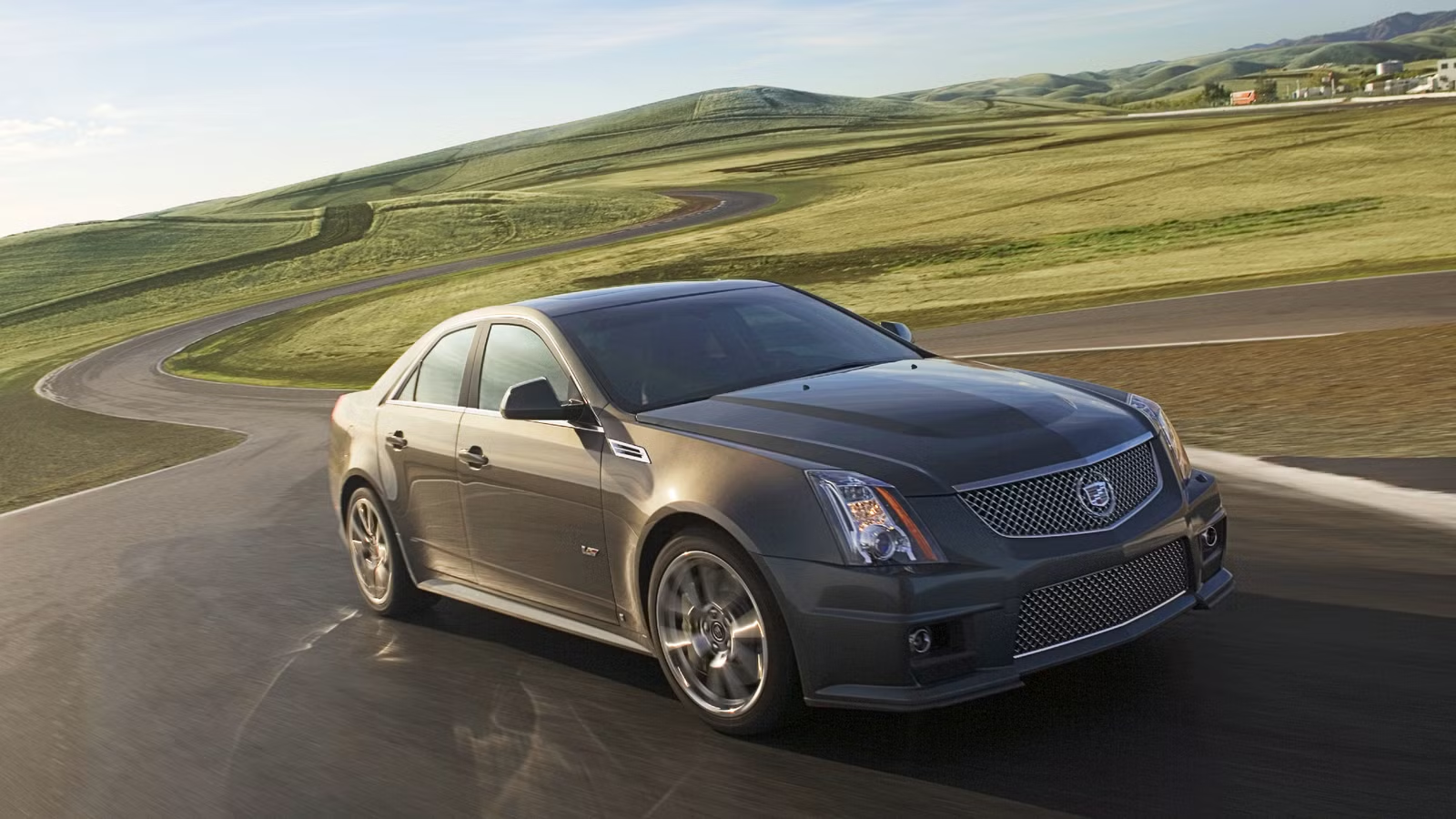
2008-2014 Cadillac CTS
Reason For Ranking: Americanized Luxury Is Back

The Cadillac CTS, spanning from 2008 to 2014, marked a resurgence of Americanized luxury with its bold design, refined performance, and advanced technology. The second-generation CTS boasted a wider and longer profile than its predecessor, incorporating design cues such as a larger grille, slimmer headlights and taillights, and sleek side air extractor vents.
Under the hood, the CTS offered a choice of potent engines, including a 3.6-liter V6 with direct injection technology delivering up to 304 horsepower and 273 pound-feet of torque — plenty of performance without putting undue stress on the drivetrain. Features such as a Bose 5.1 surround sound system, GM’s StabiliTrak ESC system, and a navigation system with real-time traffic and weather data made the CTS a complete package that was equally easy to live with day to day.
Over the years, updates such as revised front grille designs and increased engine output contributed to the CTS’s ongoing appeal, reinforcing its position as a standout choice in the competitive luxury sedan market. With its combination of style, performance, and advanced features, the Cadillac CTS became a popular vehicle among the quiet luxury crowd.
For those who want more, the “V” model brings a screaming yet reliable V8 engine. As original owners upgrade, well-cared-for examples are increasingly available for under $15,000 with respectable mileage — and being U.S.-market cars, parts are plentiful should anything need attention. Not bad for a car that originally approached six figures.
Pros
- Overbuilt V6 that can run for 200,000+ miles
- Recliner chair comfort throughout the interior
- The performance “V” model can be had for slightly more money
Cons
- Polarizing exterior design
- Not as many options as others on the list
- Somewhat slow in comparison to others
1998-2004 Porsche 911
Reason For Ranking: Surprisingly Cheap For An “Ugly” Generation

The Porsche 996 911, spanning from 1998 to 2004, introduced a new era for the iconic 911 model, incorporating a water-cooled engine and a more streamlined body design. Developed alongside the Porsche Boxster, the 996 shared components and platforms with its roadster counterpart, contributing to its cost-effective development.
Despite initial criticism of its unconventional “fried egg” headlamps, the 996 delivered remarkable performance and handling, cementing its status as a coveted luxury sports car. Powered by a 3.4-liter flat-six capable of producing up to 300 horsepower, the 996 was offered in both coupe and cabriolet variants with rear-wheel drive initially, later expanding to include all-wheel drive options.
Despite the transition away from the air-cooled engines of previous generations, the 996 maintained the driving dynamics and reliability characteristic of the 911 lineage. The base model 996 Carrera remains remarkably affordable in the pre-owned market, giving enthusiasts the opportunity to experience Porsche’s legendary craftsmanship without the hefty price tag.
Manual-transmission examples of the base Carrera can be found starting from low-$20,000s, making the 996 an alluring option for drivers seeking the blend of luxury, performance, and reliability that defines the Porsche experience.
Pros
- Porsche build quality is nearly unrivaled
- Fast, fun, and reliable luxury sports car
- Costs less than a new Toyota Camry
Cons
- 1% of cars are affected by a bearing issue that is remedied whenever the clutch is replaced
- Some of the interior buttons peel with age
- Polarizing design compared to other 911’s
1990-2000 Lexus LS400
Reason For Ranking: Epitome Of Cheap Reliable Luxury

The Lexus LS400, produced from 1990 to 2000, stands as a testament to meticulous engineering and uncompromising luxury. Born out of Toyota’s ambitious F1 project, the LS400 was crafted to surpass its American and European counterparts in every measurable way. Its groundbreaking 4.0-liter 1UZ-FE V8 engine delivered 242 horsepower and 258 pound-feet of torque with an uncanny smoothness. An independent double-wishbone suspension — with optional passive air suspension — ensured a ride quality that embarrassed far more expensive rivals.
The LS400’s cabin was a sanctuary of opulence, adorned with California walnut and leather trim, power-adjustable seats, and cutting-edge technology including an automatic tilt-and-telescoping steering wheel and an electrochromic rearview mirror. With over 300 technological innovations — including fluid-damped cabin fixtures and vibration-insulating rubber mounts — the LS400 delivered a level of sophistication and tranquility unmatched by its rivals.
Beyond its luxurious amenities, the LS400 built an enduring reputation for exceptional reliability. Automotive journalist Matt Farah famously drove a Lexus LS400 past the one-million-mile mark, a remarkable demonstration of its durability. Used examples can be found for as little as $4,000, making the LS400 an extraordinary value proposition in the luxury car market.
Even museum-quality examples command only around $25,000 — a testament to the LS400’s lasting appeal and timeless design. In short, the Lexus LS400 represents the pinnacle of affordable, reliable luxury, combining quality, comfort, and longevity in a package that is still difficult to beat.
Pros
- Unrivaled luxury vehicle longevity
- Modern technological advancements for a car of its age
- Abundance of models available
Cons
- Fuel efficiency leaves something to be desired
- No manual transmission option
- No interesting color options
2007-2012 Lincoln MKZ
Reason For Ranking: Return Of The Zephyr

The Lincoln MKZ was originally known as the Zephyr, the name given to a brand of luxury vehicles produced by Lincoln in the late 1930s and early 1940s. However, it didn’t keep the name for long. A year after the model’s debut, Lincoln replaced Zephyr with MKZ, in line with the automaker’s new car-naming nomenclature. Lincoln also introduced a slew of visual and mechanical updates to the model.
For instance, the MKZ featured restyled 17-inch wheels and Ford’s 3.5-liter Duratec 35 V6, which produced 42 more horsepower than the outgoing engine. The change meaningfully improved performance, with the 0–60 mph time dropping from 7.5 to 6.8 seconds. Lincoln also made AWD an option on the MKZ.
Though these revisions enhanced performance, they didn’t transform the MKZ into a sporty car. Features like a cushy suspension system, supportive seats, and a quiet exhaust made clear that the model remained firmly biased toward passenger comfort. The MKZ was quite tech-savvy for its era, featuring a hands-free infotainment interface developed by Microsoft and Ford and an optional voice-activated navigation system. Lincoln eventually revived the Zephyr name, placing it on the trunk lid of a sedan sold in China.
2005-2011 Cadillac DTS
Reason For Ranking: The Cadillac DeVille In Disguise

Cadillac retired its super-successful DeVille nameplate in 2005. However, the model continued on under a different name: DeVille Touring Sedan (DTS). The DTS’s styling reflected Cadillac’s new design philosophy. While the model shared a platform with the Buick Lucerne, it was longer and wider, translating to more passenger and cargo room. A Northstar V8 sat up front.
Despite the DTS already offering generous interior room, Cadillac built a DTS-L variant that stretched the body a further eight inches. Inside, the DTS carried five or six passengers and featured equipment designed to coddle its occupants. Both front and rear passengers sat on heated seats, a power rear sunshade shielded rear occupants from the sun, and a Bose audio system kept audiophiles entertained.
The DTS Magnetic Ride Control suspension continuously adjusted damping to guarantee optimum comfort. Though the interior could have benefited from better styling and more premium materials, the DTS was a genuinely comfortable car to travel in. The original DTS was marketed to buyers who were unlikely to abuse them, which improves the odds of finding a well-preserved example today. That said, be on the lookout for the electrical issues that can plague Northstar engines.
Pros
- Quiet and spacious interior
- Comfortable ride
- It marks the end of the DeVille nameplate
Cons
- Polarizing exterior styling
- Lackluster performance and handling
- Northstar engine reliability gremlins
2009-2014 Acura TL
Reason For Ranking: A Menacing Demeanor And Excellent V-6

Acura surprised the automotive world with the 2009 Acura TL, which represented a sharp and welcome departure from the less visually cohesive Acura models that came before it. Muscular and featuring a menacing grille, the Acura TL demanded attention. The 2009 model made exactly the statement Acura hoped it would, announcing the brand’s ‘Keen Edge Dynamic’ design language to the world.
The base TL featured a 3.5-liter V6 sending power to the front wheels via a five-speed automatic. Motivating the SH-AWD (Super Handling All-Wheel Drive) model — which replaced the previous generation’s Type-S — was a 3.7-liter V6 producing 305 horsepower. Both models featured steering-wheel-mounted shift paddles.
The SH-AWD was the superior model in many ways. It featured technology that directed power to the outside wheels during cornering, enhancing traction and handling. Furthermore, the previous model’s hydraulic steering was replaced by an electric system with improved feedback.
As was common in Acura models of the era, the TL packed the latest technology, including Bluetooth and iPod connectivity. An optional Technology package added navigation, adaptive climate control, and a surround sound system. One downside of the TL is that its interior, though well crafted, lacked the premium feel of rivals like the Cadillac CTS.
2005-2011 Audi A6 C6
Reason For Ranking: Audi’s Prominent Grille Debuts

The most striking feature of the Audi A6 C6 was its massive trapezoidal grille, which first appeared in 2003 on the Nuvolari Quattro concept. Novel at the time, it attracted most of the attention — almost obscuring the fact that the more substantial A6 was also better-looking than its predecessor.
The C6 came with either a V6 or a V8, both of which transferred power to all four wheels via Audi’s Quattro system. Buyers who wanted a sportier edge went for the V8, while those seeking a composed, go-anywhere luxury sedan opted for the V6. The Sport package offered with the eight-cylinder sharpened the Audi’s handling and stability at the cost of some ride comfort.
Inside, the Audi A6 featured one of the best interiors in the segment. Quality materials — including leather, aluminum, and wood — filled the expertly assembled cabin. Audi offered tech features including a Bose Surround Sound system, a DVD-based navigation system, and voice control. Examples that commanded a premium when new can now be found for around $16,000. Opt for the base trims and you will find examples in the whereabouts of $5,000.
Pros
- Audi’s Quattro AWD system
- Impressive interior
- Potent V-8 engine
Cons
- Polarizing exterior styling
- No manual transmission available
- V-6 lacks enough low-end torque
1992-1999 Mercedes-Benz S-Class W140
Reason For Ranking: An Over-engineered Gem

The development of the W140 was marked by internal tension between designer Bruno Sacco and the engineering team. Sacco wanted an aerodynamic car, but the engineers prevailed, producing a vehicle that was taller and wider than Sacco had envisioned. Nevertheless, it was a magnificent car built to be the best in its segment — Mercedes reportedly spent $1 billion developing the W140.
The W140 boasted an opulent interior and features that were extensively tested by Mercedes to guarantee their reliability. Innovations like self-leveling suspension, the Electronic Stability Program, and a sonar-based reversing system set the W140 apart from other offerings in the segment. Mercedes offered a range of W140 engines, including a 2.8-liter inline-six and a monstrous 6.0-liter V12 that was arguably the crown jewel of the lineup.
Most W140s on the market are sedans. If you are fortunate enough to find a coupe in good condition, it is well worth spending your money on — it is widely regarded as a future classic with the potential to appreciate significantly in value.
Sources: OEMs, Edmunds, KBB. CarFax, Classic.com

Related posts


Latest Post


No Comments