
10 Suzuki Motorcycles That Deserve More Respect
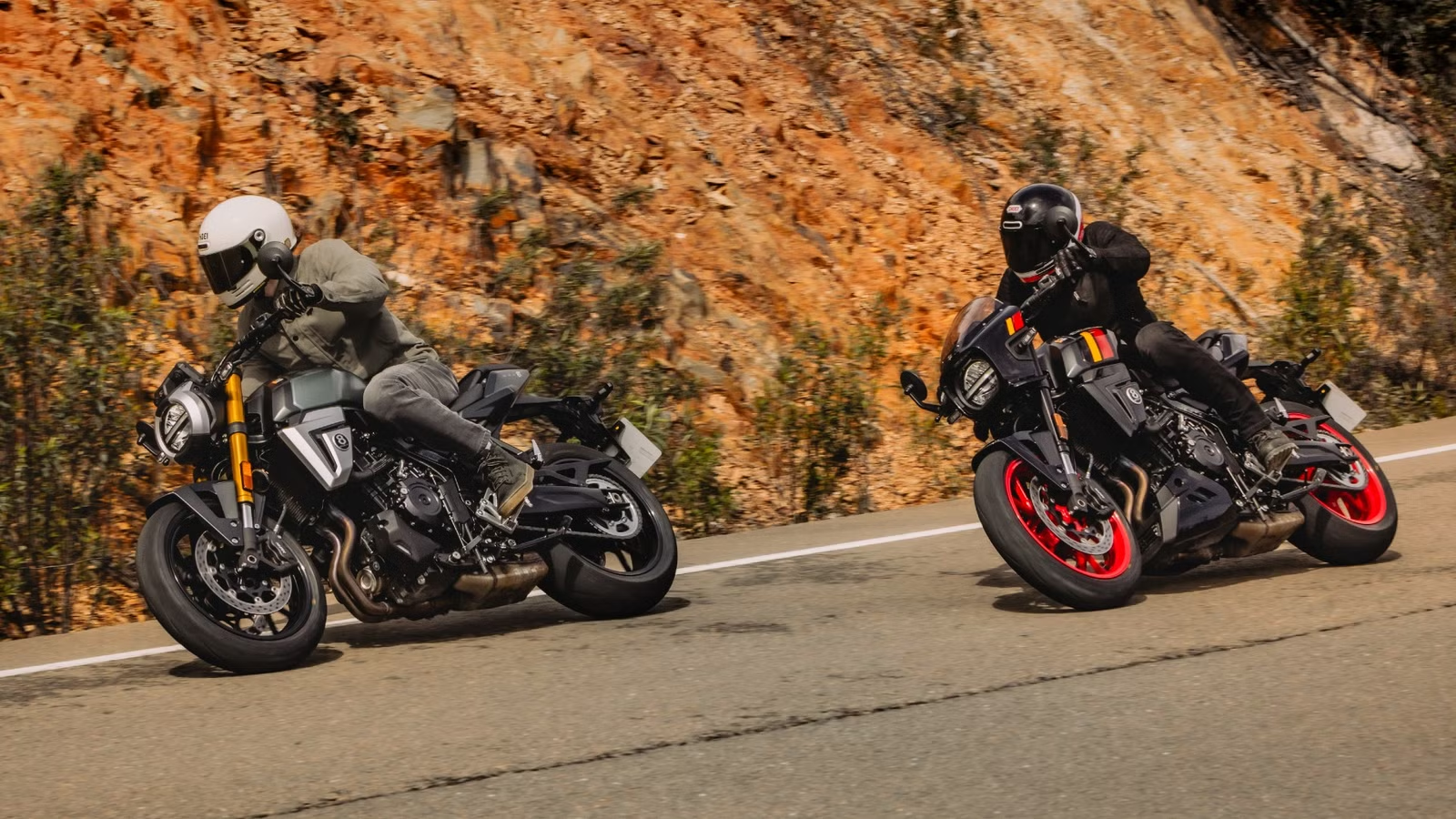
Since its inception, Suzuki has built countless motorcycles. But not every great bike has received the recognition it deserved. Some arrived before the market was ready, like the DL1000 V-Strom ADV. Whereas, others lived in the shadow of more popular rivals, and a few were simply misunderstood, like the Boulevard M109R cruiser. All of these motorcycles offered genuine strengths, from bulletproof reliability and everyday practicality to thrilling performance and unique character. Building on this, here are 10 examples of some underrated Suzukis the world needs to talk about more.
Suzuki TL1000S
Production Years: (1997-2001)

The TL1000S entered one of motorcycling’s fiercest battlegrounds by taking on big V-twin sport bikes from Europe. Its 996 cc V-twin produced impressive power, and had loads of character exaggerated by a muscular exhaust note. Suzuki had also introduced a rotary damper for the rear shock, which seemed innovative at the time, and it looked like the company’s answer to Ducati’s growing dominance.

The TL1000S’s reputation, however, became dominated by controversy. The damper, for example, tended to overheat, and the short wheelbase and aggressive performance produced violently scary tank-slappers. It even earned the nickname “widowmaker” after early crashes. Suzuki did improve the bike after recalls and updates, but its status remained. Looking back, if riders took the time to get to know the motorcycle, they would’ve found an exciting V-twin with excellent performance and a personality that would be hard to find elsewhere.
Suzuki DL1000 V-Strom
Production Years: (2002-2009)


Long before adventure motorcycles became the industry’s hottest category, the original DL1000 V-Strom delivered exactly what many adventure riders wanted. Powered by a dependable V-twin derived from the TL1000, it combined excellent highway performance with upright ergonomics, long-distance comfort and excellent reliability. Suzuki didn’t intend it to conquer off-road trails, but it covered huge distances on pavement and maintained a decent amount of loose gravel capability.

The DL1000 V-Strom’s appearance became one of its biggest obstacles. Many riders viewed it as utilitarian, off-road enthusiasts found it too heavy, and sport touring riders preferred more road-focused machines. The V-Strom then found itself caught between categories before adventure touring became mainstream.
Suzuki Bandit 1250S
Production Years: (2007-2016)

The Bandit 1205 represented an era when big-displacement motorcycles didn’t have to chase superbike performance figures to be enjoyable. The 1,255 cc inline-four produced massive low-end torque that made riding in the city and in traffic effortless. Rather than constantly shifting through gears, you could simply roll on the throttle and let the engine do the work. Add comfortable ergonomics, a practical half-fairing, and Suzuki’s legendary mechanical durability, and the Bandit became one of the easiest motorcycles to live with.

Unfortunately, the Bandit developed an image problem. It wasn’t flashy, and it didn’t have cutting-edge electronics. In a lot of ways, it looked fairly conservative when compared to more aggressive naked bikes and sport tourers. The steel frame and heavy weight also made the Bandit less flattering on magazine pages. Buyers often dismissed it as a motorcycle for older riders, dismissing the fact that it was genuinely capable on the twisties.
Suzuki GSX650F
Production Years: (2008-2015)

The GSX650F arrived at a time when fully faired middleweight bikes were expected to be either razor-sharp supersports or premium sport tourers. But Suzuki wanted to give the audience something that sat comfortably in the middle. Powered by a smooth 656 cc inline-four engine borrowed from the Bandit, it prioritized usable performance over headline horsepower. It had a comfortable riding position and predictable handling, but it also had the kind of soundtrack that only a naturally aspirated inline-four could produce.

The biggest problem, though, was perception. Its aggressive bodywork made many buyers expect GSX-R levels of performance, only to find out that this bike was tuned for versatility. On the other hand, touring riders skipped this because it lacked factory luggage and long-distance features. This slightly awkward positioning meant that the GSX650F rarely topped comparison tests even though it fared well as an affordable all-rounder.
Suzuki Katana
Production Years: (2019-2021)

Reviving the Katana name was always going to be controversial. The original became an icon, so expectations were enormous when Suzuki unveiled the modern interpretation. Beneath the retro-styling sat the proven GSX-S1000 platform with the K5-derived inline-four engine. This meant the Katana had outstanding performance on tap along with excellent reliability and surprisingly comfortable ergonomics.

But many riders never gave it a fair shake. They compared it directly with the legendary original instead of judging it on its own merits. Some criticized its limited wind protection and relatively small fuel tanks, while others debated the premium price tag. The idea was, if this had so much of the GSX-S1000 in it, why did it have to cost so much more? The Katana was supposed to be unique, blending those nostalgic sharp lines and square headlights with the performance and reliability of today’s motorcycles.
Suzuki Boulevard M109R
Production Years: (2006-Present)

The Boulevard M109R has always been difficult to categorize. On one hand, it’s a cruiser with feet-forward ergonomics and imposing style. On the other, the massive 1,783 cc V-twin produces performance that embarrasses many motorcycles outside its class. Suzuki also gave it inverted forks, dual front brakes, aggressive styling and muscular acceleration that made it feel unlike almost anything else on the market. Few cruisers combine such dramatic looks with such thrilling straight-line performance.

But despite those strengths, the M109R often lived in the shadow of the American V-twins. Many cruiser buyers prefer the heritage and customization culture surrounding Harley-Davidson or Indian. Performance enthusiasts, too, looked obviously toward sport bikes. That left the M109R occupying a niche of its own. Years after its introduction, it remains one of Suzuki’s most unique motorcycles and one that deserves far more recognition than it received.
Suzuki V-Strom 800 (Base)
Production Years: (2023-Present)

While the V-Strom 800DE receives most of the headlines thanks to its off-road focus, the standard V-Strom 800 might be Suzuki’s smartest ADV for everyday riders. It uses the same 776 cc parallel-twin engine, but emphasizes daily comfort with low seat height, pavement manners, cast wheels and easier handling. For riders who rarely leave the asphalt, the base version of the V-Strom 800 makes the most sense while still retaining some amount of versatility for occasional gravel patches.

The problem is that buyers naturally gravitate toward the more adventurous-looking DE variant. The standard model lacks the dramatic styling cues and off-road hardware, so it appears less exciting on paper and showroom floors. But its simplicity actually makes it better suited to how many actually ride. It offers smoother road manners, reduced maintenance concerns with street-focused use, and excellent fuel efficiency.
Suzuki GSX-S1000GX+
Production Years: (2024-Present)

Crossovers have become increasingly popular, but the GSX-S1000GX+ still struggles to receive the recognition its engineering deserves. It shares its platform with other Suzuki sport models, combining sport bike performance with upright ergonomics, semi-active suspension, and touring-friendly comfort.

Buyers tend to overlook the GSX-S1000GX mainly because they don’t really get where it fits. ADV shoppers often choose bikes with larger front wheels for greater off-road credentials, while sport touring riders gravitate towards conventional sport bike styling. The crossover identity makes it difficult to classify, even though that is arguably its greatest strength. It manages to deliver thrilling acceleration, advanced rider aids, and impressive comfort all in one package.
Suzuki DR-Z4S
Production Years: (2024-Present)

This bike carries enormous expectations because it follows one of Suzuki’s most beloved dual-sport motorcycles. With the DR-Z4S, Suzuki modernized the dual-sport concept while still maintaining the approachable, durable nature that made the DR-Z400S such a favorite. It is still lightweight, manageable, and capable of handling both trails and daily commutes without any issues.

Ironically, many expected something revolutionary, and that became its biggest weakness. Critics focused more on what didn’t change rather than recognizing the improvements. The DR-Z4S continues to prioritize accessibility and long-term ownership rather than unnecessary complexity, making it attractive for people who value reliability over cutting-edge specs.
Suzuki GSX-8T
Production Years: (2025-Present)

The GSX-8T has entered a crowded middleweight segment where standing out is increasingly difficult. It’s built around Suzuki’s acclaimed 776 cc parallel-twin platform, which offers smooth torque and friendly handling characteristics, making it the perfect candidate for everyday usability. It’s got a strong mid-range for city riding, yet effortless punch for spirited back roads. There’s modern electronics, refined suspension, and approachable ergonomics, too, appealing to a wider audience.

The challenge, however, is that the GSX-8T competes in a class filled with louder personalities. Rivals often have higher horsepower or more aggressive styling. Suzuki’s traditionally conservative marketing doesn’t help either, allowing the GSX-8T to fly under the radar despite being an exceptionally well-rounded motorcycle.
Source: Suzuki Cycles

Related posts


Latest Post


No Comments