
From Screen to Track: How Simulation helped Shape the Bugatti Tourbillon
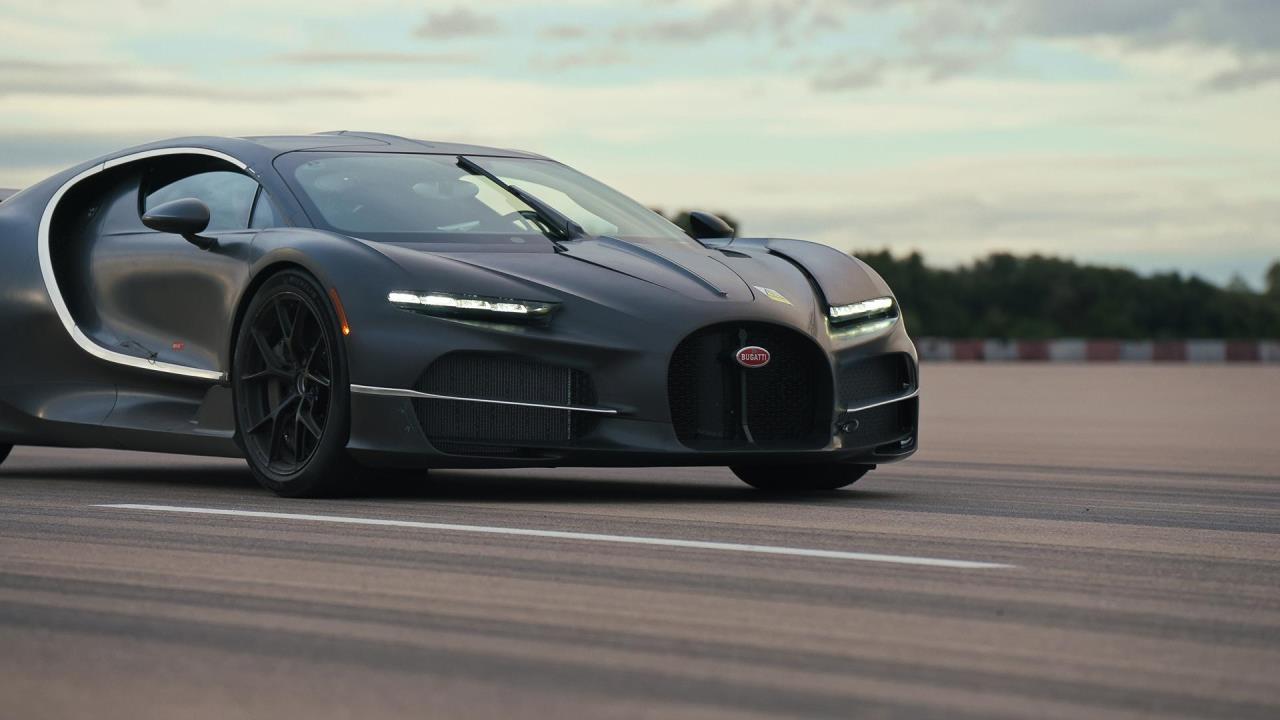
The process begins virtually, long before any physical car exists. Test bench data from the engine, along with information from the suspension’s kinematics and compliance, is fed directly into a virtual model of the Tourbillon. As development matures, engineers validate the same responses on the virtual model against the real one, continuing all progress in parallel with the physical build.
To validate this data during the early stages of development, the team moves to Bugatti’s own driving simulator, where early setups can be explored and refined in a fraction of the time required for physical testing, without depending on weather, track availability, or tire wear, and with 100% repeatable data from every run.


Miroslav Zrnčević
Chief Test and Development Driver at Bugatti Rimac

‘We basically performed some experimental tests at Nardò. We gathered a lot of experimental data with which we correlated our models. And then we are here at the driving simulator, in the very same place, performing validation to see whether the models are better correlated and supporting the next development steps.’

Vehicle Dynamics Manager at Bugatti Rimac
Given the extreme performance envelope of the Tourbillon, with a top speed of 445 km/h, ensuring stability across every conceivable condition is non-negotiable. The Bugatti team runs through a series of scenarios: highway stability and lane-change response, country-road ride quality with dampers, torque vectoring, steering and ABS all under evaluation, and – on a larger, full-motion simulator from simulation specialist VI-grade in Italy – the demands of the Nürburgring Nordschleife itself.


For Bugatti, the value of this approach comes down to time.
‘We are making very expensive vehicles, and even prototypes are very, very expensive. We need to make the most of the limited time we have with the cars in the field, so we use simulation and the driving simulator to gain valuable development time.’
Head of Vehicle Dynamics at Bugatti Rimac

Each virtual environment is built to isolate a different attribute of the car’s performance: agility on country roads, high-speed stability on the autobahn, and, on the Nordschleife, the full combination of both, along with limit handling.
Crucially, this accelerates real-world testing rather than replacing it. Findings from the simulator continue to be validated and refined on the physical car in parallel, with data flowing in both directions: real-world results sharpen the virtual models, and virtual insights shape what the team looks for once they’re back behind the wheel of the real car.
By combining computer-based simulation, Bugatti’s own driving simulator, and the full-motion rig in Italy, the development team is able to explore radical setup changes, test at speeds and in scenarios that would be impractical to attempt repeatedly on track, and arrive at the physical testing phase with a far clearer picture of how the car should behave.
The result is a development process that is more precise, ensuring that by the time engineers get behind the wheel of the real car, the groundwork has already been laid.
The latest episode of Bugatti’s ‘A New Era’ docuseries, ‘Immersive Dynamics,’ is now available exclusively on the Bugatti YouTube channel.
Photo credit: Bugatti
Posted on Autotech-plus.com
Related Posts

Related posts

Latest Post


No Comments