
Yamaha TDR250: The Original Hooligan Bike
Some motorcycles arrive so far ahead of their own market that nobody quite knows what shelf to put them on. Dealers don’t know how to sell them, buyers don’t know how to categorize them, and the concept simply waits, sometimes for decades, until the rest of the industry finally catches up. Yamaha built exactly that kind of motorcycle in the late 1980s, a machine that mixed sportbike urgency with dual-sport toughness so completely that it essentially invented a category the market would not properly name for another twenty years.
A Motorcycle Built For A Category That Didn’t Exist Yet

By the mid-1980s, motorcycle manufacturers had settled comfortably into distinct categories. Sportbikes chased lap times and top speed on smooth pavement, dual-sport and enduro machines prioritized ground clearance and durability over rough terrain, and almost nothing on sale tried seriously to do both at once. The engineering reasons were straightforward enough. A chassis tuned for razor-sharp street handling rarely coped well with a rutted trail, and a motor tuned for low-end trail torque rarely wanted to rev hard enough to satisfy a sportbike rider. Manufacturers generally accepted that compromise as a law of physics rather than a problem waiting for a solution.
One manufacturer decided that law of physics was worth questioning. Rather than picking a side and building another conventional entry into an already crowded segment, its engineers set out to build something that could genuinely satisfy both riders at once, a machine light and sharp enough to embarrass a sportbike through a set of corners, yet tough and capable enough to handle a genuinely rough dirt track afterward. Nobody else in the industry was seriously attempting this combination at the time, and the resulting machine would end up confusing dealers, buyers, and magazine reviewers in roughly equal measure, years before the market had any name for what it actually was.
A Prototype Win That Proved The Concept Before Launch


Before this machine ever reached a single showroom, its engineers wanted proof that the concept actually worked outside a test track, and they chose one of the most punishing environments available to get it. A prototype was entered into a grueling desert rally held across Egypt, an event covering roughly 4,800 km over eleven brutal days of sand, rock, and heat that has ended the ambitions of far more conventional machines. Competing in the event’s prototype class meant going up against purpose-built rally hardware with none of the compromises a genuinely road-legal motorcycle has to accept, and doing so on a bike that still needed to be sold to ordinary riders afterward.
The prototype won its class, a result confirmed by Yamaha’s own official history of the model. That result landed just as the production version of the bike was reaching dealers, and Yamaha leaned into the timing for exactly the reason anyone would expect, a genuine competition win is far more persuasive than any marketing department’s claims about a new bike’s toughness. It also validated the entire premise behind the machine’s development, that a genuinely capable dual-purpose motorcycle did not have to compromise on either half of that equation to succeed.
The 1988 Yamaha TDR250 Blurred Every Line Motorcycles Had

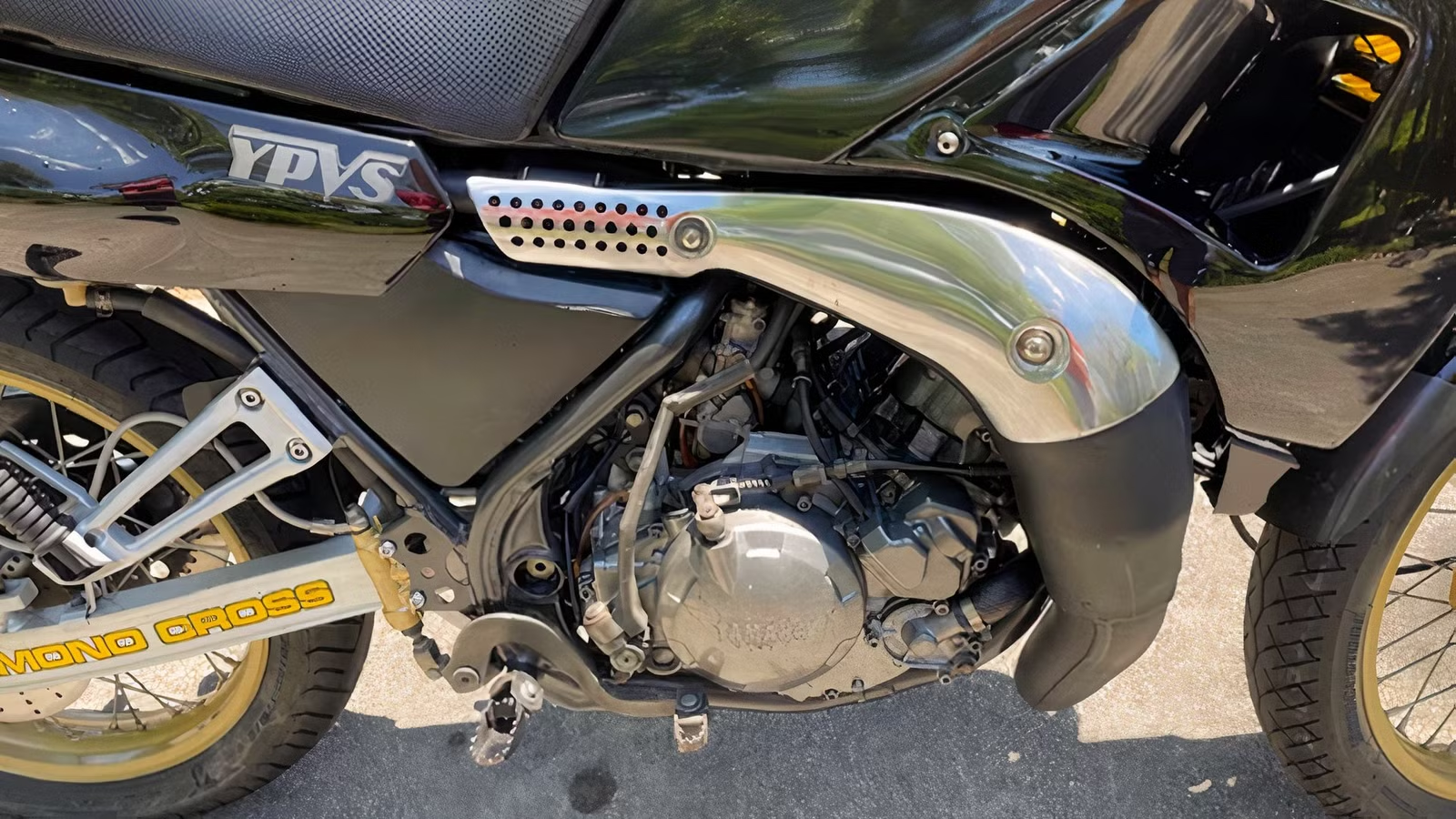
That machine was the 1988 Yamaha TDR250, marketed by Yamaha itself under the tagline Ultimate Dual, and it earned that name honestly. Its liquid-cooled 249cc two-stroke parallel twin, fitted with Yamaha’s YPVS power valve system, produced between roughly 44 and 50 horsepower depending on the market, since Yamaha sold a slightly detuned 239cc version in France alongside the full-power 249cc Japanese domestic model. Either version was genuinely potent for a 250, and Yamaha built the whole package around a dry weight of around 294 to 302 lb, depending on source, wrapped in a lightweight, high-rigidity double-cradle frame designed specifically to handle both road and trail duty without compromise on either front.
Yamaha never officially sold the TDR250 in the United States, and today clean, unmolested examples remain a genuine rarity on the American market as a result. A confirmed 1988 example sold through a recent US auction listing for $9,095, a figure that reflects both the bike’s continued rarity and the slow-building recognition of exactly how far ahead of its era it actually was.
The TZR250 DNA Hiding Inside A Dual-Sport Frame

The TDR250’s engine did not appear from nowhere. Yamaha built it around the same core two-stroke architecture found in the TZR250, the brand’s dedicated sportbike of the same era, sharing the YPVS power valve system along with much of the engine, gearbox, and electrical hardware between the two machines. Yamaha’s own engineers have claimed the TDR’s engine was the first two-stroke motor to combine CDI ignition with a fully electronic spark advance system, a genuinely advanced piece of engineering for a bike wearing knobby-adjacent dual-sport tires rather than sportbike rubber. That shared DNA gave the TDR250 something no conventional dual-sport machine of the era could match, sportbike-grade throttle response and a genuinely high-revving character stuffed into a chassis built to survive rough terrain.
Why The Riding Public Wasn’t Ready For A Do-It-All Bike

For all its engineering ambition, the TDR250 asked a lot of an everyday rider, and the market’s lukewarm response outside a handful of countries reflected exactly how demanding that ask actually was. The two-stroke engine’s power delivery was famously peaky, doing very little below the mid-range before hitting hard once the YPVS valve opened up, a character that rewarded a committed rider but frustrated anyone expecting smooth, predictable response around town. Fuel capacity sat at just 14 liters, a genuinely small tank for a bike marketed partly as an adventure-capable dual-sport machine.
Combined with a thirsty two-stroke engine returning roughly 37 mpg in real-world testing, that small tank translated into a genuinely short range between fill-ups. None of that made the TDR250 a bad motorcycle, but it did make it a commercially incoherent one in 1988, a bike that asked buyers to accept sportbike compromises and dual-sport compromises simultaneously, without the smoothed-over practicality that made either category’s dedicated machines easier to live with day to day.
The Racing Series That Kept The Concept Alive

Where mainstream buyers hesitated, a smaller but genuinely dedicated audience embraced exactly what the TDR250 was trying to do. France in particular developed a strong grassroots motard and supermoto racing culture through the late 1980s and 1990s, a discipline built entirely around taking dirt-capable machines, fitting sticky road tires, and racing them hard on tight, mixed tarmac-and-dirt circuits, precisely the kind of riding the TDR250’s sportbike-derived engine and dual-sport chassis had been built for years before that scene had a proper name. Decades later, TDR250 owners are still actively converting surviving examples into dedicated supermoto builds, swapping in inverted forks and street-focused wheels, a modification trend that essentially completes the transformation the bike’s original engineers had already half-finished back in 1988.
The Formula Modern Hooligan Bikes Still Borrow Today

Every modern hooligan bike currently on sale, KTM’s Duke lineup, Ducati’s Hypermotard, and a dozen other stripped-down, tall-riding, road-focused crossovers built around dirt-bike ergonomics and sportbike urgency, is running a version of the same basic formula Yamaha proved on a Pharaohs Rally podium back in 1987. None of those bikes would describe themselves as a dual-sport, and none of them would describe themselves as a pure sportbike either, and that refusal to commit to one category or the other is exactly the idea Yamaha bet an entire model on twenty years before the segment had a name.
KTM gets credited with inventing the modern supermoto formula, and Ducati gets credited with turning it into a genuine sales category. Neither claim survives scrutiny once the TDR250’s own history gets put next to them. The riders who actually know this bike’s story understand that the real blueprint was drawn up in a Japanese engineering department in the mid-1980s, tested in an Egyptian desert before it ever reached a showroom, and then largely forgotten by an industry that eventually rebuilt the same idea from scratch. The TDR250 got there first. It just did not get the credit.
Sources: Yamaha, Mecum, Iconic Motorbike Auctions.

Related posts

Latest Post


No Comments