
Yamaha Stacked Its Gearbox And Made A Liter Bike Handle Like A 600
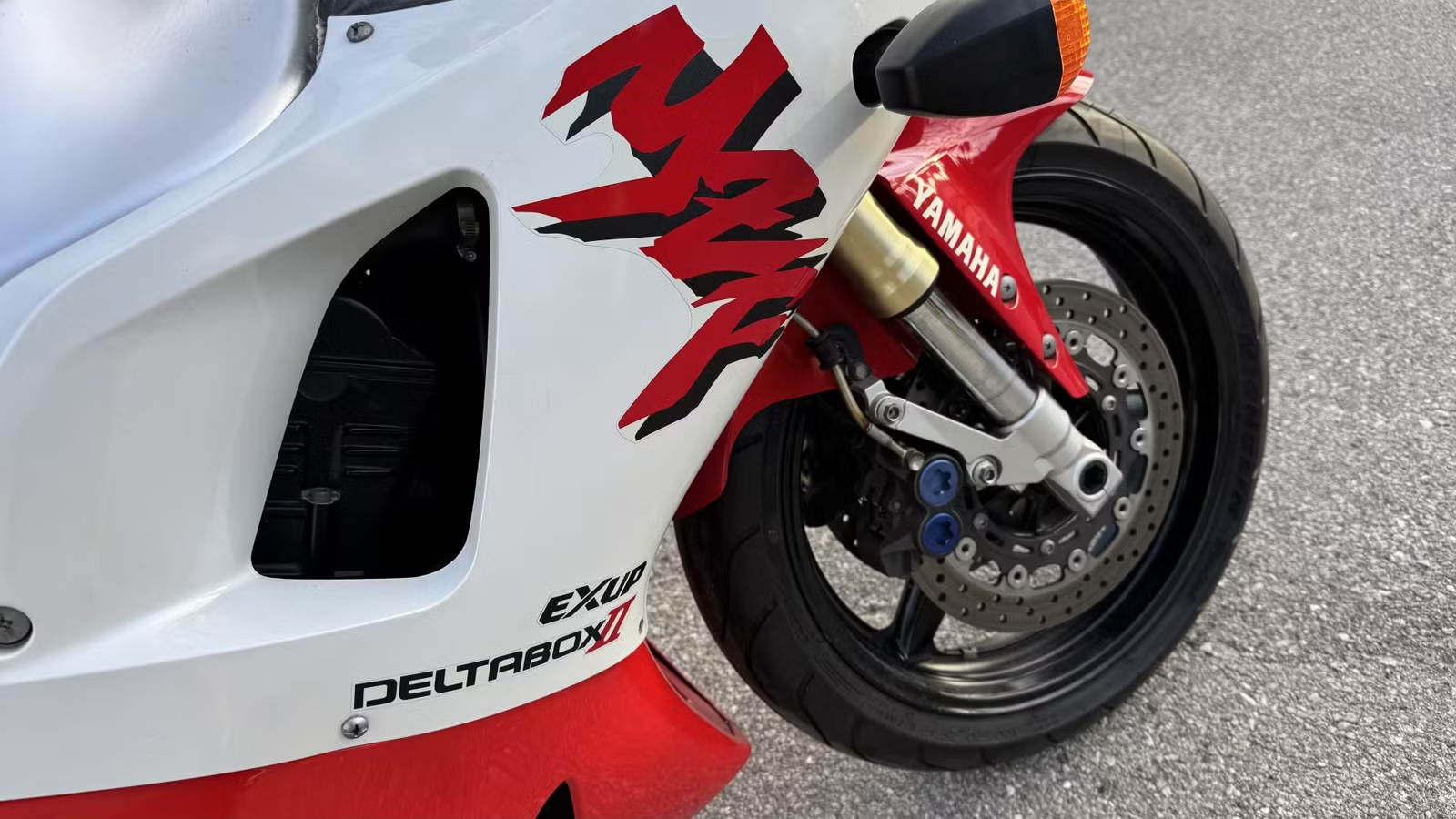
While the other three Japanese brands got obsessed with top speed back in the 80s, Yamaha remained focussed on motorsport. As a result, their bikes generally handled a little better than any of their direct Japanese rivals, but all that changed in 1992. Honda released the FireBlade that offered the handling of a 750, and the power of a liter-class superbike.
A More Dynamic Superbike Takes Shape

Back in the early 90s, Honda were initially planning on developing another inline-four 750. But the brand already had a 750cc V4 in production, and didn’t need to restrict its displacement for racing homologation purposes like other manufacturers. This gave Honda the freedom to increase the displacement of the model, which worked a treat, and in turn gave us one of the very best superbikes of the decade in the process.
Other manufacturers were left scrambling to come up with a suitable answer. Kawasaki’s Ninja ZX-9R was potent, but clearly rushed, and tremendously heavy. Suzuki were content with the GSX-R750, and by the end of the decade were in the process of developing the fastest motorcycle in the world. Yamaha, on the other hand, were not at all content, and set to work developing something lighter, and even more powerful.
The 1998 Yamaha YZF-R1 Was A Game Changer


Just like the FireBlade changed the game in 1992, the YZF-R1 changed the game again in 1998. This time, instead of a liter-class superbike engine in a 750 chassis, we got a more powerful liter-class superbike engine in a 600 supersport chassis. At the time of its release, there was nothing else quite like it on the market, and it quickly became the bike to have for at least the next couple of years.
It is important to underscore the fact that while these superbikes were advanced for the time, they were also purely analog machines with no safety equipment at all. The original R1 was famously able to get within touching distance of 80 MPH in first gear! Suffice to say, in the wrong hands these bikes were incredibly dangerous, and even though they have less power than modern superbikes, the same rings true today.
A More Powerful 20-Valve Engine With A Stacked Gearbox
Power: 148 Horsepower

By the late 90s, the 20-Valve Genesis engine had been in production for quite some time, but for the R1 it was thoroughly reworked. It was given a slightly longer stroke and a smaller bore. This helped Yamaha reduce the width of the lump without compromising performance. It made use of the same EXUP (Exhaust Ultimate Power Valve) system as the bikes that came before, also had a rack of four carbs, and with 148 horsepower, it was only marginally more powerful than the outgoing Thunderace.
Power was never the problem for the old Thunderace, though. Weight was. In an effort to improve weight distribution, Yamaha elected to “stack” the R1’s gearbox behind the engine, instead of simply having it sit in line with the crankshaft as convention dictated. This small innovation proved to be highly effective, making the engine more compact, also allowing for a more compact chassis arrangement without sacrificing stability.
The Art Of Adding “Lightness”
Dry Weight: 390 Pounds

The fact that pretty much every other manufacturer with an inline-four would adopt this “stacked” gearbox design underscores just how much of an impact this relatively small change made. Not only did it allow for superior weight distribution, it also allowed for a shorter chassis without sacrificing stability. Usually a shorter wheelbase necessitated a shorter swingarm, which would have an adverse effect on stability, especially at higher speeds. By losing just a few inches in the middle, engineers found the best of both worlds kind of solution.
Building a lighter bike doesn’t mean anything if the bike doesn’t lose its weight in the right places. For any motorcycle with sporting ambitions, weight distribution is key, and saving weight in the middle makes a genuine difference. The lighter, more compact Genesis engine afforded a lighter, more compact aluminum Deltabox chassis design. Its overall dry weight of 390 pounds is still impressive by modern standards, and while the suspension is dated, the rest of the bike holds up surprisingly well.
After this model, things moved along at breakneck speed in the world of superbikes, with pretty much every second year model receiving significant updates in an effort to keep up with the ever improving competition. This incredible pace of development was maintained right up until around 2015, by which time performance figures had begun to plateau, and sophisticated electronics systems took center stage. While analog bikes like the R1 certainly still offer an adrenaline-fueled riding experience, most of us will be significantly faster on a bike equipped with rider aids. Riding an older bike like the R1, which is now technically a classic motorcycle (!!), can also be a little harrowing under the wrong conditions, i.e. in the wet!
Source: Yamaha Global

Related posts



Latest Post



No Comments