
Will A Toyota Corolla EV Break A 60-Year Tradition Of Cheap, Reliable Simplicity?
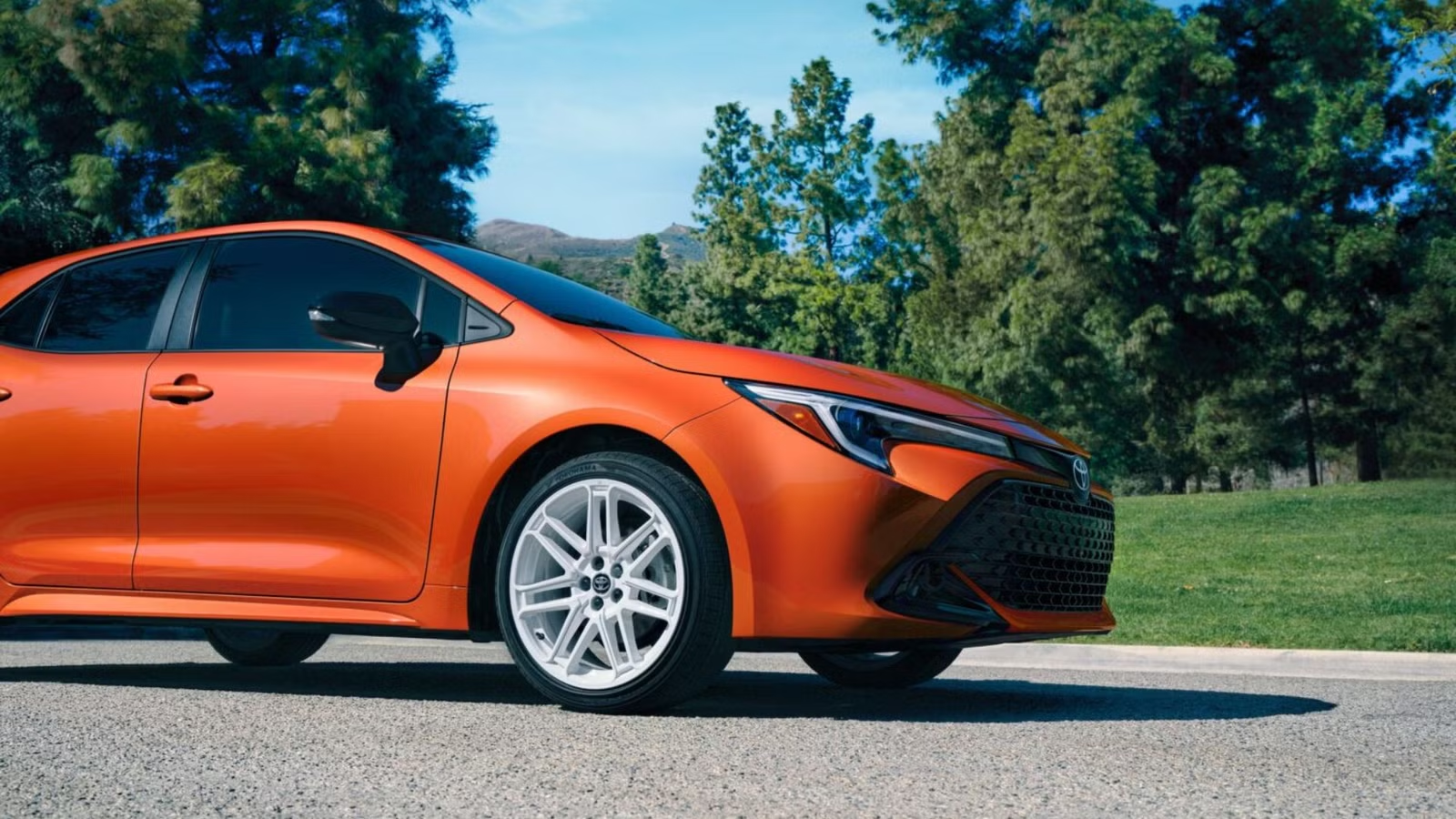
Toyota is finally putting a plug in the Corolla. Car and Driver reported Tuesday that the next-generation model, arriving for the 2028 model year, will get a full EV variant alongside the usual gas and hybrid options, plus a plug-in hybrid for the first time. The gas Corolla is expected to stay around $25,000 and the hybrid around $27,000, but the EV and PHEV models are projected to land in the $30,000 range, according to Car and Driver.

That $30,000 number is the whole story here. For 60 years and 57 million cars, the Corolla’s entire value proposition has been that it’s cheap enough to hand to a broke friend and simple enough that they can’t hurt it. A $30,000 starting price doesn’t just nudge the Corolla upmarket. It takes the car that generations of peopl have used as the default answer to “what should I buy” and turns it into something else entirely.
Why The Corolla Became The Car You Tell Your Broke Friend To Buy
The Corolla isn’t fast, it’s not exciting, and nobody’s hanging a poster of one on their wall. That’s precisely the point. Toyota sold 248,088 Corollas in the U.S. in 2025 alone, making it the brand’s fourth-best-selling model and the 11th-best-selling vehicle in the entire country, and it’s done that on the back of a reputation built over 12 generations for being boring in the best possible way.

The formula never changed much: a naturally aspirated four-cylinder, a CVT or a basic automatic, and mechanical parts that don’t require a specialist to diagnose. That simplicity is why used Corollas hold their value and why they’re everywhere in beater form, still running with 200,000 miles and a check-engine light nobody’s bothered to look at. It’s a car built to be cheap to buy, cheap to fix, and hard to kill.
What $30K Does To The Gateway Car Role

Toyota hasn’t confirmed the electric Corolla is even coming to the U.S., but if it does, it’s like there will be single- and dual-motor versions with at least 250 miles of range. On paper, 250 miles sounds perfectly usable for a commuter car. In practice, that range and the tech that delivers it come at a $5,000 to $10,000 premium over the gas and hybrid versions Toyota plans to keep selling.
That gap matters more for the Corolla than it would for almost any other nameplate, because the Corolla’s entire audience is price-sensitive by definition. A first-time buyer who might have stretched for a $25,000 gas Corolla isn’t necessarily stretching another five to ten grand for the electric one. The likely outcome isn’t that the EV replaces the gas car’s role. It’s that the EV becomes a separate, pricier product while the gas and hybrid Corollas keep doing the actual gateway-car job, at least for now.
Toyota’s Battery Reliability Story Is Still Unwritten

The Corolla’s reputation isn’t just about the sticker price. It’s about what happens five or ten years down the line, when the car has changed hands two or three times and nobody’s babying it anymore. A used gas Corolla with a bad water pump or a worn CV joint is a weekend fix. A used EV Corolla with a battery pack losing capacity is a different kind of problem, and one with a much higher price tag if it needs replacing outside of warranty.
Toyota has real hybrid pedigree going back decades, and the current Corolla Hybrid’s fifth-generation system has a strong track record. But a full battery-electric powertrain, sized to deliver 250-plus miles of range in a compact sedan, is a different engineering and cost equation than the smaller hybrid batteries Toyota has spent 25 years refining. There’s no long-term data yet on how a Corolla EV ages, because there’s never been one on sale.
Will A Used Electric Corolla Ever Be As Low-Maintenance As A Used Gas One?

This is the question that actually matters for the used-car market, and it’s the one nobody can answer yet. Part of the Corolla’s appeal has always been that its simplicity survives neglect. Skip an oil change or two, and a Corolla shrugs it off in a way a lot of other cars won’t. An EV doesn’t have oil changes to skip, but it has a battery that degrades on its own schedule regardless of how well it’s treated, and battery replacement costs remain the single biggest unknown hanging over any EV’s long-term ownership math.
Toyota building a genuinely affordable EV, cheaper than the segment-leading Tesla Model 3’s roughly $37,000 starting price, would still be notable. It just wouldn’t be a Corolla in the way that word has meant something to enthusiasts since 1966. The gas and hybrid versions look set to keep filling that role for now. Whether Toyota ever builds an EV that earns the same trust is a much longer story than one pricing report can settle.
The Corolla nameplate isn’t going anywhere, and neither is the gas version enthusiasts already recommend without a second thought. But if the EV Corolla becomes the version Toyota pushes hardest going forward, the car that’s spent six decades being everyone’s answer to “what should I buy my broke friend” may need a different answer soon.

Related posts

Latest Post


No Comments