
The Motorcycle That Ages Like Fine Whiskey
Motorcycles predictably age as performance moves on, electronics improve, and yesterday’s dream bike eventually becomes a cheaper route into yesterday’s technology. The genuinely special ones don’t follow the usual timeline of this process. Their appeal becomes less dependent on what’s current and more closely tied to design, mechanical character, history, and just how difficult they are to replace today. That has become particularly obvious with early modern-retro motorcycles as the retro-resurrection is still in the thick of it.

Today, practically every major manufacturer has learned how to mix old styling with contemporary hardware. But two decades ago, this idea was considerably less common, and Ducati approached it with unusual seriousness. Rather than simply fitting round headlights and wire wheels to an existing platform, it revisited one of the most important chapters in its own history.
Sporty Retro Motorcycles Were A Very Different Proposition 20 Years Ago
Ducati announced its SportClassic family in 2004, drawing inspiration from the company’s early 1970s L-twins. Pierre Terblanche’s designs weren’t intended as literal reproductions of the classics. They combined familiar shapes and proportions with contemporary chassis engineering, fuel injection, modern tires, and brakes that didn’t require the optimism of a 1970s racer. Three distinct interpretations emerged from this outlook. The Sport 1000 referenced Ducati’s early sporting twins, while the GT1000 leaned toward the 750 GT road bike. Sitting above both was a limited-edition model inspired by the silver 750 SS Desmo and Ducati’s breakthrough racing success at the 1972 Imola 200.


These motorcycles came before retro design became an industry-wide phenomenon, so they weren’t developed around TFT screens, ride modes, or electronics disguised as old-fashioned styling. They were fundamentally analog motorcycles built using what Ducati considered modern mechanical hardware at the time. Twenty years later, that simplicity has become part of the attraction and is aided by its Limited Edition tag to become a rare collector’s motorcycle.
The 2006 Ducati Paul Smart 1000 LE Has Only Become More Special

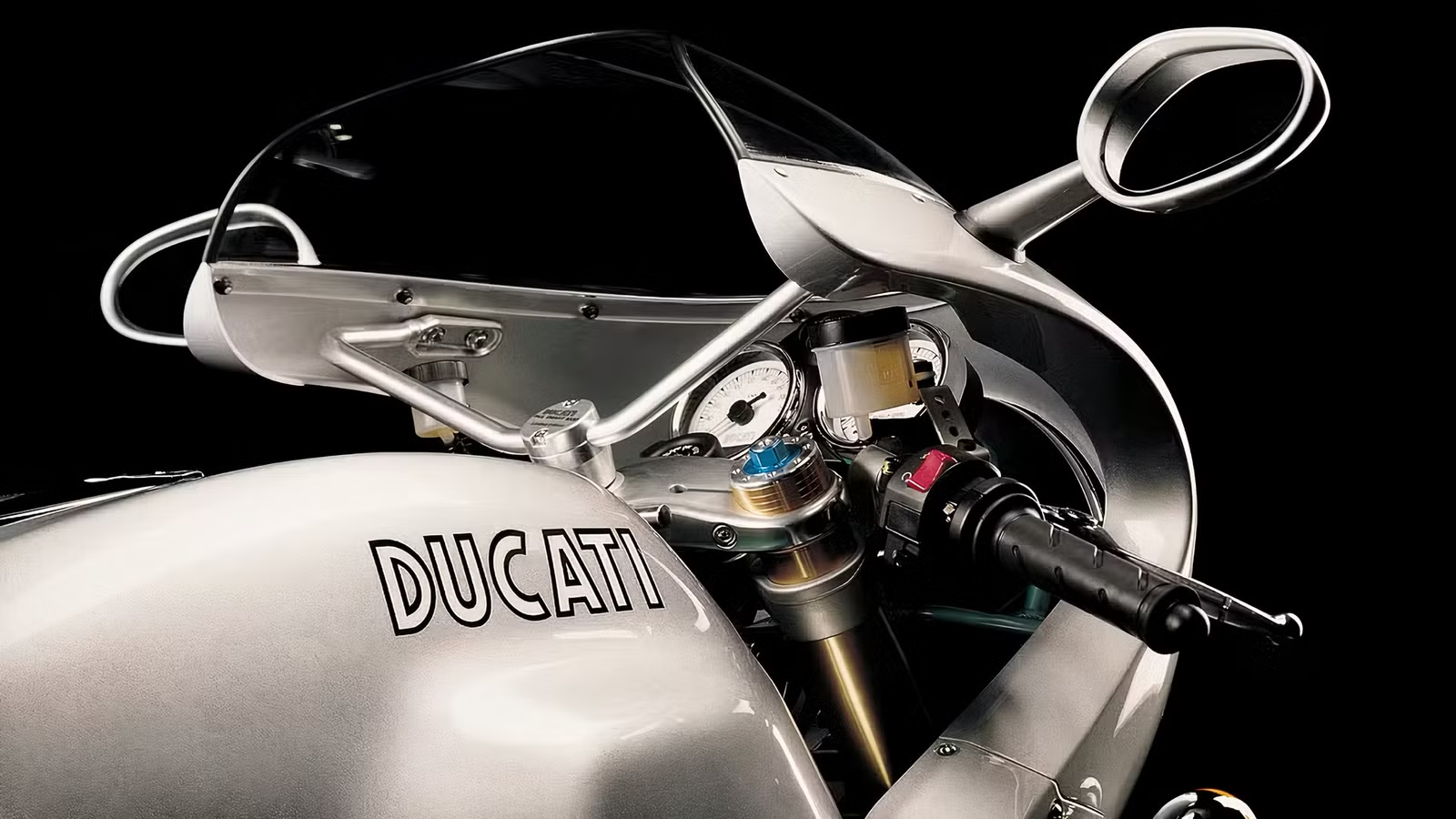
The motorcycle in reference is the 2006 Ducati Paul Smart 1000 LE. Ducati built 2,250 examples of it, and named the motorcycle after the racer Paul Smart, whose 1972 Imola victory helped establish Ducati’s large-capacity V-twins as serious racing machinery. Terblanche, however, resisted producing a carbon copy of Smart’s original race bike.
Instead, the Paul Smart combined the metallic silver bodywork, with a blue-green trellis frame, a half fairing, low clip-ons, wire-spoke wheels, and a single-seat tail section that looked unmistakably inspired by Ducati’s past, and much like the 750 SS before it. It arguably works even better now as modern motorcycles have become increasingly complicated visually. The Paul Smart 1000 LE’s exposed engine, simple frame, sparse cockpit, and clean bodywork lose very little with its age.

It wasn’t cheap either. The Paul Smart cost roughly $15,000, placing it well above more ordinary retro motorcycles and way cheaper than the 750 SS. The difference is that depreciation hasn’t touched the 1000 LE. Recent American-market examples have traded around the low-$20,000 range, while exceptionally low-mileage bikes have climbed beyond $30,000. Condition, originality, mileage, and documentation matter enormously, but this is one 20-year-old motorcycle that can easily cost more than it did new.
Its 992cc Desmodue Used Dual-Spark Ignition

The Paul Smart uses Ducati’s air-cooled 992cc Dual Spark L-twin with two desmodromically operated valves per cylinder and Marelli electronic fuel injection. It put out roughly 92 horsepower at 8,000 rpm and 67 pound-feet at 6,000 rpm, sent through a six-speed transmission and chain final drive. Those figures have long since been demolished by modern Ducati performance bikes but that barely matters.

It still overshadows the more expensive Formula 73 which is based on a lower-powered Scrambler engine. The engine’s broad torque delivery is highly praised, while the absence of variable valve timing, and complex electronics make the riding experience raw and unfiltered. There is a relatively large air-cooled twin, a dry mechanical soundtrack, and useful torque on tap. Twenty years of superbike development hasn’t made that experience obsolete either.
The Chassis Was Far From A Styling Exercise

Ducati also gave the Paul Smart hardware worthy of its Limited Edition badge. A tubular steel trellis frame works with a fully adjustable 43mm Öhlins inverted fork and an Öhlins rear shock mounted unusually on the left side. A Sachs steering damper was standard, while twin 320mm Brembo front discs handled most of the braking. The motorcycle weighed a claimed 399 pounds dry, had a 56.1-inch wheelbase, and used contemporary 120/70 front and 180/55 rear tires despite their deliberately period-correct tread pattern.
Like its highly raised engine, its cornering stability and balance once leaned over were exceptional for a retro machine. Comfort, however, is another matter. The 32.5-inch seat and low clip-ons produce an equally retro-committed riding position, and nobody should mistake this for a GT because it placed the rider in a very front-heavy position, more suited to the racetrack than open-highway touring.
Its Strongest Feature Is That Ducati Didn’t Modernize The Character

Plenty of current retro motorcycles look older than they actually are. But the Paul Smart works differently because so much of the mechanical experience genuinely belongs to another period. Its air-cooled Desmodue leaves the cylinders clearly visible. Analog gauges sit above the top triple clamp. The steel trellis frame and asymmetric shock remain exposed rather than hidden beneath layers of bodywork. Even the wire-spoke wheels preserve the intended visual connection with Ducati’s earlier racers.

There is also an important caveat for anyone shopping for a Paul Smart 1000 LE. SportClassic models with plastic fuel tanks were included in U.S. litigation concerning tank expansion associated with ethanol-blended fuel. Replacement tanks, tank condition, timing-belt history, and originality deserve careful inspection. On a motorcycle whose collector-value can depend heavily on factory parts, an apparently tasteful modification can also matter financially. Then again, nobody is paying that kind of money because they need transportation. They are buying a bike to upgrade their riding experience with some nostalgia, and in this case, a piece of Ducati’s history that can still be ridden properly.
A Used Triumph Thruxton 900 Is Much Cheaper, But It Doesn’t Match The Appeal

The contemporary Triumph Thruxton 900 is a great retro alternative to the Paul Smart if the objective is simply an old-school café racer experience. The 2006 Thruxton used an air-cooled 865cc parallel twin producing roughly 69 horsepower, along with carburetors, clip-on bars, wire wheels, and a five-speed transmission. It delivered much of the same visual nostalgia for $8,199 when new. Early Thruxton 900s can still be found around the $4,000 to $6,000 mark, making them dramatically easier motorcycles to buy and ride.

But that comparison also explains why the Paul Smart 1000 LE has aged differently. It combined limited production, genuine racing lineage, bespoke styling, premium Öhlins hardware, and one of Ducati’s most charismatic air-cooled engines from the outset. Twenty years later, the Ducati Paul Smart 1000 LE isn’t younger, faster, or easier to own, and probably won’t be made again, but it has simply become clearer why Ducati got it so right in the first place.
Source: Ducati

Related posts

Latest Post


No Comments