
Why This Japanese Bike Is A Smart Choice For Adventure And Daily Riding
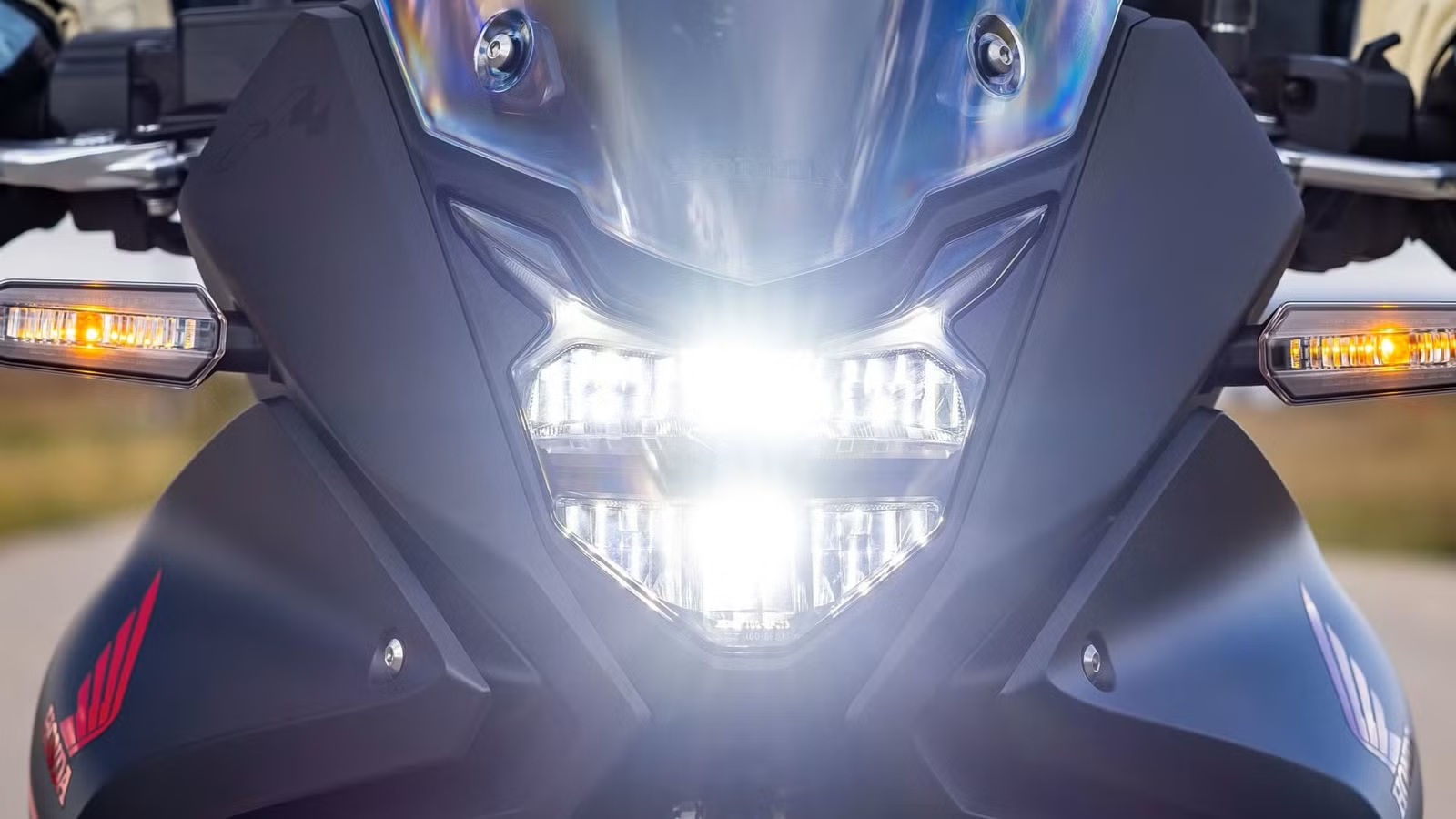
Adventure bikes have always promised to do it all — but somewhere along the way, “all” started meaning continent-crossing expeditions on machines that weigh as much as a small car. Today’s flagship ADVs are genuinely impressive, yet their size, weight, and thirst for fuel make them a chore for everyday use. Squeezing one into a parking spot or filtering through city traffic can feel like a workout before the ride even begins. The heavily off-road-focused machines aren’t much better for daily duties, either.

For an adventure bike to be truly usable all the time, it needs to dial back the extremes — less hardcore tourer, less dedicated dirt weapon, more well-rounded companion. That’s a trade-off most riders can live with, since the vast majority of ADV owners never attempt a cross-continental expedition or treat their bike like a motocross machine. Honda clearly understands this, and the XL750 Transalp is the result: a middleweight that balances usability, approachability, and genuine off-road competence in a package you can ride every single day.
The Honda XL 750 Transalp E-Clutch Is Your Go-To Motorcycle For Adventure And Daily Riding
Price: $10,199
The Transalp name carries real heritage — it traces back to one of Honda’s celebrated off-road racing lineages. After a lengthy hiatus, the nameplate was revived with the XL750 Transalp for the 2023 model year. The goal was to build an adventure bike with broad appeal, which fits neatly into Honda’s philosophy: rather than chasing the hardcore off-road ADV segment, the brand focuses on machines that work well for the widest possible audience. As a result, the Transalp leans on proven, well-sorted components that prioritize long-term reliability over cutting-edge novelty.

This approach reflects how most riders actually use their bikes. Even the most capable adventure machines rarely see serious off-road terrain, so why not build something that behaves impeccably day-to-day and still handles the occasional dirt road with confidence? That is precisely what the Transalp delivers, and it is why it remains a smart choice for both adventure and daily riding.
Honda’s 755 cc Parallel-Twin Engine Is A Capable Performer
Shared With the CB750 Hornet
The current Transalp is the first in the nameplate’s history to forgo a V-twin engine. In its place is a 755 cc parallel twin with a 270-degree firing order — the closest thing to V-twin character you can get from an inline layout. It’s the same engine found in the CB750 Hornet, which has proven enormously popular in the European market. The Transalp carries more weight than the Hornet, but Honda retuned the engine specifically for this application, emphasizing strong low-to-mid-range torque where riders need it most.
Honda XL750 Transalp Engine Specifications
|
Engine Configuration |
24.5 degree parallel twin, liquid cooling, Unicam SOHC, 4 valves per cylinder |
|
Displacement |
755 cc |
|
Bore x Stroke |
87 x 63.5 mm |
|
Compression Ratio |
11.0:1 |
|
Power |
90.5 HP @ 9,500 RPM |
|
Torque |
55.3 LB-FT @ 7,250 RPM |
|
Fuel System |
PGM-FI Electronic Fuel Injection |
|
Transmission |
6 speed manual transmission, assist and slipper clutch, standard quickshifter, final chain drive |
That torque bias pays dividends in both settings: street bikes and off-road machines alike benefit from grunt low in the rev range, and the Transalp exploits this well. Rider aids are managed through a ride-by-wire throttle system offering four engine power levels, three engine brake levels, and wheelie control, alongside Honda Selectable Torque Control (HSTC). A six-speed manual gearbox handles the shifts. For 2026, Honda has even added an E-Clutch. The E-Clutch minimizes chances of stalling in challenging terrain, enables clutchless up- and downshifts everywhere, and still gives you the total control of a handlebar-mounted clutch lever. Final chain drive may not be every tourer’s first choice, but it remains the optimal solution when paired with long-travel suspension.
A Simple Chassis Underpins The Honda Transalp
Overall, A Good All-Rounder

The Transalp uses a steel diamond frame with the engine serving as a stressed member — an approach Honda employs across several models in its lineup, including the CB650R. For the Transalp, the subframe is built to a higher standard, as it needs to handle the demands of a pillion passenger and a full luggage load. Suspension duties fall to Showa, with an inverted separate-function front fork and a Pro-Link rear unit; both ends offer preload adjustment.
Honda XL750 Transalp Chassis Specs And Dimensions
|
Chassis |
Steel diamond |
|
Front Suspension |
43mm Showa SFF-CA inverted fork; 7.9 inches travel |
|
Rear Suspension |
Pro-Link Showa single shock; 7.5 inches travel |
|
Front Tire And Wheel |
90/90 21 |
|
Rear Tire And Wheel |
150/70 18 |
|
Front Brakes |
Dual 310mm wave discs with radial-mount two-piston floating calipers |
|
Rear Brakes |
256 mm wave disc with single piston floating caliper |
|
Length |
91.5 inches |
|
Wheelbase |
57 inches |
|
Rake |
27 degrees |
|
Trail |
4.4 inches |
|
Seat Height |
33.7 inches/32.6 inch option |
|
Ground Clearance |
8.2 inches |
|
Curb Weight |
459 LBs (ready to ride) |
Braking is handled by two-piston floating calipers up front and a single-piston caliper at the rear. Wave-pattern discs aid heat dissipation, and the rear ABS can be switched off to allow controlled slides on loose terrain. The spoke wheels use a 21/18-inch rim combination, keeping the bike friendly to off-road rubber. Despite its rugged appearance, the Transalp is more at home on tarmac than on trails — though it is more than capable of handling unpaved roads when the occasion calls for it.
Honda Transalp Features: Good, But Needs An Update
It Has The Basics Covered

The Transalp offers 42 degrees of steering lock, which makes it surprisingly nimble — useful not only on tight dirt tracks but equally welcome when threading through city traffic. The one-piece seat is a rarity in a segment increasingly obsessed with sporty aesthetics, but it provides generous room for both rider and pillion to settle in comfortably. An optional low seat is also available, dropping the seat height by 1.1 inches for shorter riders.
Additional features include a 5-inch TFT color display with Bluetooth connectivity via Honda RoadSync, enabling music control, turn-by-turn navigation, and on-screen message reading. The self-canceling turn signals are a thoughtful touch — rather than relying on a simple timer, the system compares wheel speeds to determine when to cancel the indicators, making it genuinely useful in real-world riding conditions.
Honda XL750 Transalp Competition
Nothing With A Similar Combination Is Available At Present
No other Japanese ADV currently matches the Transalp’s particular blend of abilities. One of our favorite middleweights, the Kawasaki Versys 650, is only available with alloy wheels, which limits its off-road usefulness. The Yamaha Ténéré 700 sits at the opposite end of the spectrum — genuinely capable off-road, but with daily usability sacrificed in the process. CFMoto’s Ibex 800 E is also a solid option worth considering. The closest rival to the Transalp, however, remains the Suzuki V-Strom 800 DE, which offers comparable performance, a twin-spar chassis with good on-road manners, meaningful off-road ability, and spoke rims in a 21/17-inch configuration.
Honda XL750 Transalp Vs Rivals
|
Model |
Honda XL750 Transalp |
Yamaha Tenere 700 |
CFMoto Ibex 800 E |
Suzuki V-Strom 800 DE |
|
Price |
$9,999 |
$10,999 |
$10,299 |
$11,709 |
|
Displacement |
755 cc |
689 cc |
799 cc |
776 cc |
|
Power |
90.5 HP @ 9,500 RPM |
73.4 HP @ 9,000 RPM |
94 HP @ 9,000 RPM |
83.1 HP @ 8,500 RPM |
|
Torque |
55.3 LB-FT @ 7,250 RPM |
50 LB-FT @ 6,500 RPM |
56.8 LB-FT @ 6,500 RPM |
57.5 LB-FT @ 6,800 RPM |
|
Curb Weight (Wet) |
459 pounds |
452 pounds |
509 pounds |
507 pounds |
Sources: Honda, Yamaha, CFMoto, Suzuki

Related posts




Latest Post


No Comments