
The 10-Second AMC Muscle Car Sold “As Is” With No Warranty
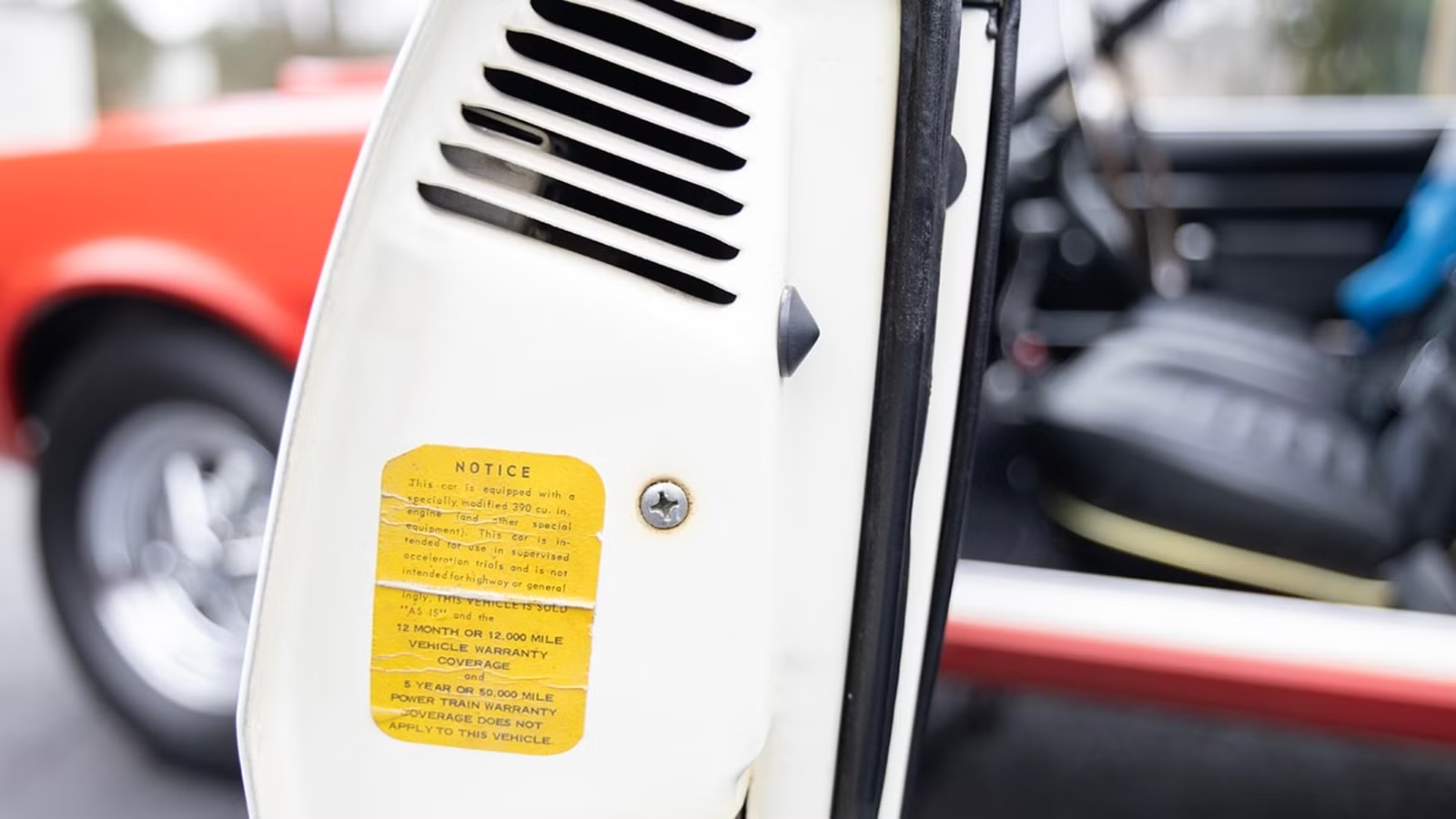
Most window stickers list all the nifty features and extras a given car comes with. In 1969, one American Motors sticker went out of its way to tell buyers what they weren’t getting. No ordinary warranty. No powertrain warranty. And no pretense that the car belonged on regular roads. The strange part was the muscle car’s badge: AMC, a company best known for practical transportation. But Kenosha had it in for Detroit. And it had powerful allies in Michigan.
AMC Built A Quirky Two-Seat Road Car To Challenge The Corvette

American Motors spent much of the 1960s selling sensible cars to sensible people. That made its 1968 AMX rather startling. AMC chopped a foot out of the Javelin’s wheelbase (dropping it to 97 inches), deleted the back seat, and created a truly unique, nimble coupe. An available handling package helped the AMX hug the pavement. But that wasn’t its only trick.
Under the hood, even the base AMX carried a V8. Buyers could step up from the 290 to a 343. If they wanted to go all out, they could even order the 390 with 315 advertised horsepower and 425 lb-ft of torque. A four-speed transmission, available power front disc brakes, and the Go Package made it a serious road car, ready to fight a Corvette for a fraction of the price. Despite its respectable quarter-mile times, the AMX was far from America’s fastest production car on the drag strip. But AMC had those cars in its sights.
Detroit’s Factory Drag Racers Made Regular Muscle Cars Look Slow


As its name implies, the NHRA’s factory Super Stock class was reserved for “stock” cars. In the name of bragging rights, manufacturers worked the rule book as hard as their rev limiters. Pontiac’s lightweight Super Duty cars sacrificed ordinary conveniences and even had holes drilled in the frames to reduce weight, Ford’s 427 Thunderbolt put NASCAR power in a completely re-engineered Fairlane, and Chrysler’s specials stuffed 426 Hemis into compacts with aluminum body panels. From afar, you might confuse these cars with production models. But sitting inside, you would never confuse them for comfortable sports cars.
By 1968, Hurst was helping to build Hemi Darts and Barracudas destined for the drag strip. AMC, meanwhile, had a two-seat platform with a short wheelbase, a strong 390, and a stodgy reputation it desperately wanted to change. AMC needed a purpose-built weapon, and Hurst already knew how to turn a production shell into one.
AMC Built Just 52 Hurst Super Stock AMXs For 1969

AMC’s own drag strip missile arrived for 1969: the Super Stock AMX. The automaker shipped 52 Frost White 390-powered four-speed cars from Kenosha to Hurst’s Michigan facility for conversion. It was a run just large enough to meet the NHRA’s 50-vehicle homologation requirement. (Note that the total excludes the earlier development prototype associated with Shirley and H.L. Shahan.) The finished cars wore either Frost White or AMC’s iconic red-white-blue racing colors. There was no automatic option, and no attempt to disguise what these cars were built to do.
The 390 was no longer an ordinary 390. Forged JE pistons pushed compression to 12.3:1; Crane worked the cylinder heads, while two Holley four-barrels fed an Edelbrock cross-ram intake. A Mallory ignition and tubular headers completed the package. AMC nevertheless advertised only 340 horsepower, just 25 above the road car’s 315. That put the AMX in the sweet spot for competition. The factory cam remained in place, leaving racers to select their own more aggressive grind. Hurst stripped all unnecessary equipment; the race package weighed in at about 3,050 pounds.
AMC Sold Its Super Stock AMX “As Is” With No Warranty

Hurst moved the battery to the trunk, removed the front sway bar and assorted trim, installed racing shocks and springs, and modified the rear suspension to help the car launch. The Borg-Warner four-speed gained a competition clutch and safety bellhousing, while the rear axle received tougher shafts to handle its factory-installed 4.44:1 gearing. Enlarged rear wheel openings made room for slicks. At $5,994, this stripped AMX cost $2,697 more than the regular 1969 AMX’s $3,297 base price.

Then came the fine print. AMC’s door sticker said the car was intended for supervised acceleration trials, not highway or normal passenger use. More remarkable was the factory’s blunt declaration: THIS VEHICLE IS SOLD “AS IS.” AMC expressly denied the ordinary 12-month/12,000-mile vehicle warranty and five-year/50,000-mile powertrain coverage.
The Super Stock AMX Was So Fast, NHRA Reclassified It

The hot-rodded AMX quickly proved its worth. In 1969, Shirley Shahan ran a 10.97-second quarter-mile at 125.69 mph at Orange County Raceway with H.L. Shahan tuning. Another Super Stock AMX, the S&K car driven by Fred Dellis, reportedly set an AHRA mark at 11.08 seconds and 127.11 mph. Exciting launches, thanks to its short wheelbase, made the cars crowd favorites. But these were more than exhibition wheelie cars: AMC’s little two-door was a genuine 10-second machine.
NHRA saw through the modest 340-horsepower claim. The sanctioning body initially assigned the engine a 405-hp factor, then raised it to 420 for classification purposes. Those numbers put the AMX up against tougher Super Stock company, bumping it into classes including SS/E, SS/D, and SS/C. It kept turning up on drag strips anyway. AMC had started with a quirky road car, then Hurst’s specialists helped it produce something that could embarrass some of Detroit’s most notorious machinery.
Sources: NHRA, SS/AMX Registry, Mecum Auctions, Mac’s Motor City Garage, and “Hurst Equipped” by Mark Fletcher and Richard Truesdell

Related posts

Latest Post


No Comments