
The 390-hp Pontiac Sedan That Hid GTO Power Behind Taxi Sheetmetal
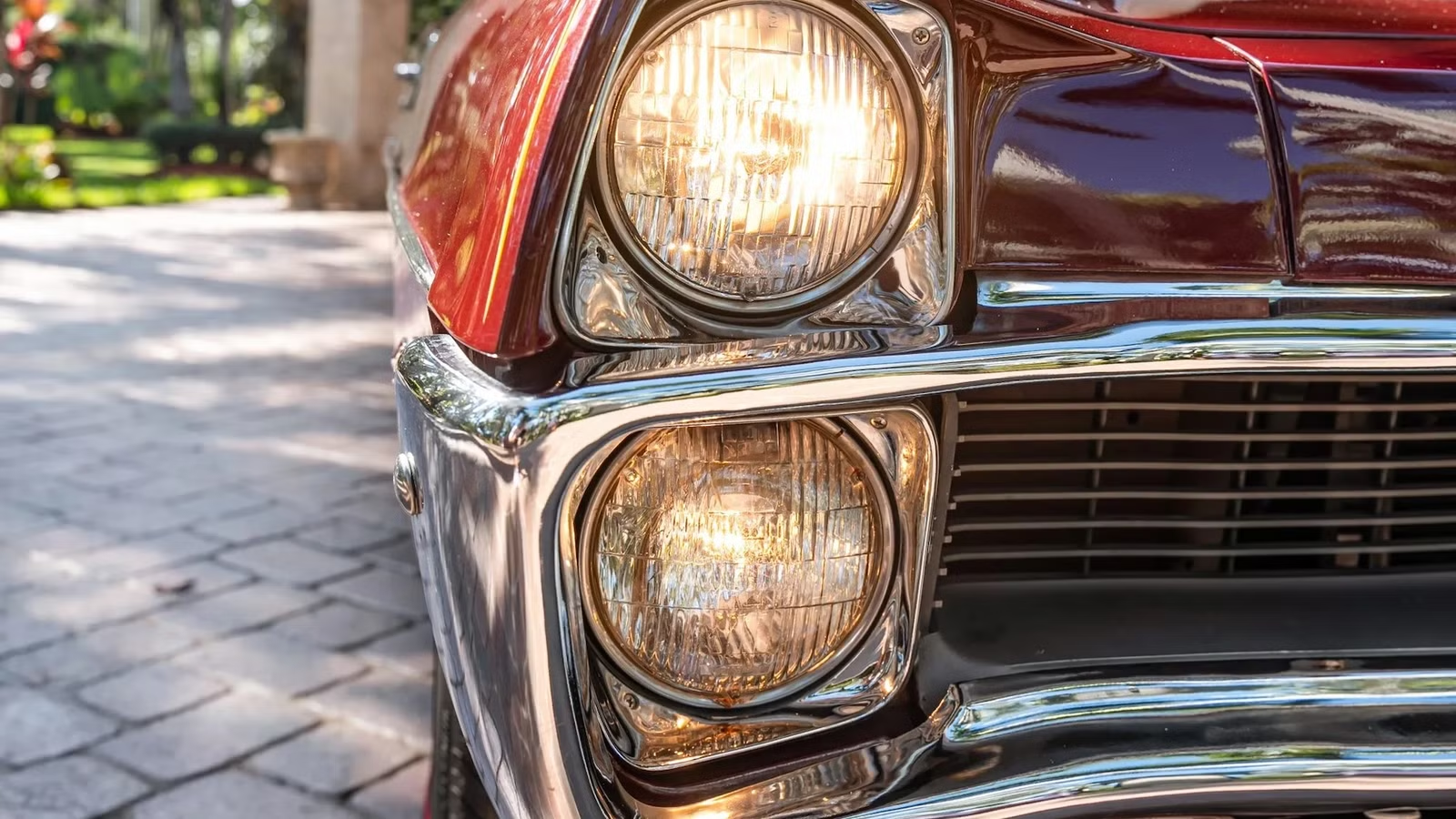
It would be worth taking another look at a massive four-door sedan, as it’s secretly hiding Pontiac GTO power under the hood. Seriously, 390 hp was available in land yacht form and was rumored to be offered in fleet spec, causing two-door GTO models to get embarrassed at stoplights. Sadly, the full-size car wasn’t as popular as the automaker’s iconic muscle cars. Today, the potent power is still ignored under the bloated grandpa-car camouflage, allowing rare survivors to be snatched up at incredibly low prices.
Pontiac Wanted To Outmuscle Rival Big-Blocks

Pontiac had a lot of skin in the muscle car game during the 1960s and didn’t take losing very well. The automaker was determined to fight rivals like the Chrysler 426 cubic-inch (7.0-liter) ‘Street Hemi’ with 425 hp and 490 lb-ft of torque. The Chevy 427 V8 was another serious competitor with up to 435 hp and 460 lb-ft of torque. Plus, we can’t forget the Ford 427 FE big-block V8 with 425 hp and 480 lb-ft of torque.
But Pontiac had a plan by building upon its existing 421 cubic-inch (6.9-liter) V8 engine that delivered between 305 and 320 hp and 425 lb-ft of torque. The bore was increased from 4.09 to 4.12 inches while maintaining the 3.25-inch large-journal crank. It features 428-specific pistons for the correct dish-to-deck height calculations.
The displacement grew to 426.6 cubic inches, but it was rounded up to 428 to one-up its rivals instead of tying with them. This was seen as a comical yet brilliant marketing move. It effectively filled the gap between small-block V8 engines to meet the power demands of full-size luxury cruisers.

Fleet Spec Sedans Out-Torque The GTO

Unfortunately, General Motors imposed rules that restricted engine sizes in intermediate bodies to 400 cubic inches in the mid-1960s. Therefore, the 428 V8 engine was mostly found in fleet cars and executive cruisers instead of mid-size muscle cars like the Pontiac GTO. The engine was dropped into B-body platforms used by the Catalina, Bonneville, Grand Prix, and Executive.
Plus, the 428 was available in full-size police and law enforcement fleet packages with an upgraded heavy-duty suspension for highway pursuits. In 1967, the High Output Quadra-Power 428 configuration produced 376 hp and 462 lb-ft of torque. In 1968, the engine gained revised valve timing and higher lift profiles, an optimized fuel distributor, and recalibrated Rochester four-barrel carburetors, boosting its power to 390 hp and 465 lb-ft of torque.

Meanwhile, the 1968 Pontiac GTO had an available 400 cubic-inch (6.6-liter) V8 H.O. Ram Air II configuration with 366 hp and 445 lb-ft of torque. The Catalina 428 HO accelerated from 0 to 60 mph in about 6.1 seconds and completed a quarter mile in 14.6 seconds at around 96 miles per hour. It had a top speed of 125 mph.
The 1968 GTO Ram Air II accelerated from 0 to 60 mph in roughly 6.2 seconds with a 14.4-second quarter-mile time at about 100 mph. This muscle car had a top speed of 125 mph, and drivers never expected that a full-size sedan would be able to keep up with it at red lights or drag strips.
But The Pontiac 428 HO Was Short-Lived

The Pontiac 428 big-block V8 was only in production from 1967 until 1969 before quickly being replaced by the 455 cubic-inch (7.5-liter) big-block V8 in 1970 with 370 hp and 500 lb-ft of torque. Restricting the 428 to full-size cars may have been what initially killed it, as drivers weren’t interested in massive four-door family cars.
Pontiac also assumed luxury buyers would prefer the extra torque of the 455 before it was choked down by increasingly strict emission standards. Options like the Catalina were luxury cruisers for older, more mature buyers, while compact two-door muscle cars were extremely popular in the late 1960s.
The Catalina was seen as a heavy commuter car that had to work hard to move its excessive weight compared to more agile street brawlers. It lived in the shadows of more popular options like the GTO. The Pontiac GTO benefited from highly successful marketing campaigns and became a pop-culture icon that attracted younger buyers.

Also, the Pontiac 400 cubic-inch (6.6-liter) V8 was preferred by muscle car enthusiasts because it was more affordable and featured a more convenient size for tighter engine bays. On top of that, the 400 ci had a solid reputation for durability and ease of modification for improved straight-line performance.
The Four-Door Sedans Are Still Ignored

Options like the 1968 Pontiac Catalina 428 HO still sit on the sidelines as people battle for GTO models instead, even though they’re quite rare. Only 385 Catalina 2+2 428 HO models were made in 1967, and even fewer four-door variants are believed to exist. They are often passed over due to their grandpa car camouflage despite being potent sleeper cars.
The survivors rarely come up for sale, as there was low demand for high-performance engines in four-door cars. They were heavily used as daily transportation, so they were most likely worn out and scrapped rather than preserved as classic muscle cars have been.

Value for 1968 Pontiac Catalina 428 V8 four-door models hovers around $3,500 to $5,000 if they’re found in running but rough project condition. Rare survivors in average or good condition that are considered to be reliable for driving often fetch between $8,000 and $11,000. Show-ready or fully restored models can fetch between $13,000 and $18,000.
Those are low prices for a considerable amount of power, simply because the engine is in disguise. The engine itself has considerable potential and can be dropped directly onto stock GTO motor mounts. Plus, it bolts to the original transmissions without requiring frame modifications. It shares internal components with other Pontiac engines and is known for being incredibly reliable, making it highly versatile for hot rodders and project builds.
Source: Hagerty, Automobile Catalogue

Related posts



Latest Post


No Comments