
Under The Hood Of Mazda’s Overlooked CX-70 Turbo Six Buy
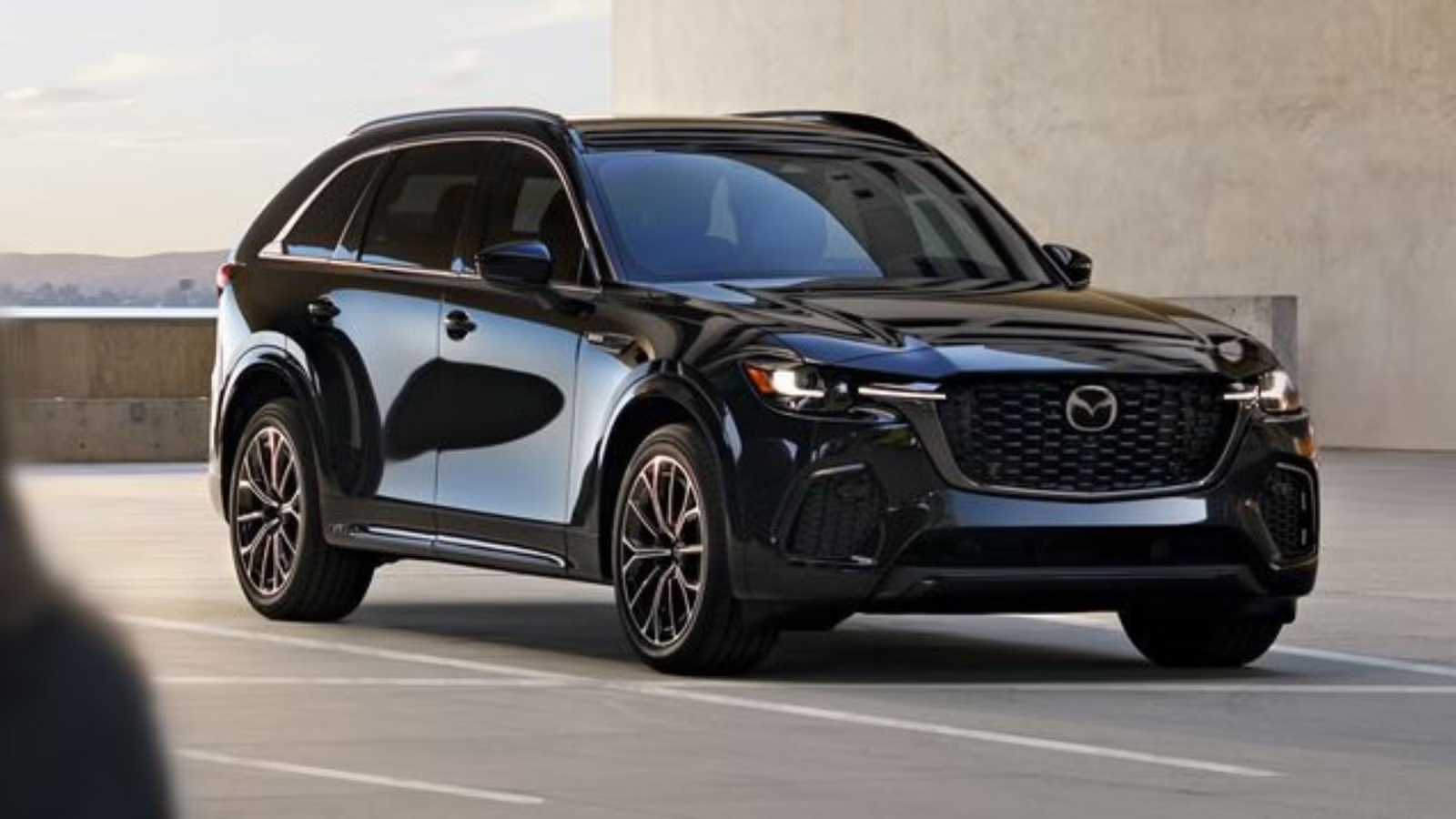
Walk into a luxury car dealership with a $50,000 budget, and you’ll be offered a turbocharged four-cylinder and a long options list. Walk into a Mazda showroom with less than that and, increasingly, you can drive out with a straight-six, a handsome cabin and standard all-wheel drive. That sounds like marketing. It is also, on paper, accurate. One Mazda model has been quietly doing this for two model years while its louder sibling soaks up the attention. If you shop the BMW X3 and Audi Q5 class, you owe it to your wallet to find out which one it is.
The Overlooked Two-Row Sweet Spot Mazda Built Beneath The CX-90’s Shadow

Mazda spent most of 2024 and 2025 talking about one big SUV. The three-row CX-90 got the launch event, the plug-in hybrid headlines and, eventually, the price conversations that follow any flagship. Fair enough. It is a handsome, serious machine. It is also more vehicle than plenty of households need.
Sitting on the same underpinnings is a two-row sibling that gets a fraction of the attention. Without a third row, it trades a couple of occasional seats for a cleaner profile and a lower starting price. For a couple with two children and a dog, or an empty-nester who hauls bikes rather than carpools, that is not a compromise. It is the right answer to the question being asked.

Here is why that matters for the shopper in this story. You are somewhere between 35 and 55. The household income is healthy but not limitless, and you have been reading X3 and Q5 reviews because the badge on the grille feels like a reward for years of hard work. Then you open the configurator, add heated seats, a driver-assistance bundle, and a decent audio upgrade, and watch a $50,000 sticker drift toward $60,000.

That is the gap Mazda is aiming at. It is not a cheaper copy of the German formula but a different one, offering a bigger engine, more standard equipment, and a driving character that rewards people who actually enjoy the commute. Whether the engineering justifies the ambition is the real question, and it starts under the hood.
Mazda’s 280-HP Turbo Six Brings Serious Power To A Mainstream Price

Meet the 2026 Mazda CX-70, and in particular its 3.3 Turbo variants. Every version of the 2026 model uses a 3.3-liter turbocharged inline-six with mild-hybrid assist. In standard tune it makes 280 horsepower at 5,000 rpm and 332 pound-feet of torque at just 2,000 rpm. That low-rev torque figure is the number to remember. It means the SUV pulls hard from a stoplight and while merging onto the highway, without hunting for gears.
Compare that with what the Germans offer at the entry point. BMW’s X3 30 xDrive uses a 2.0-liter turbo four with 255 horsepower and 295 pound-feet. Audi’s Q5 also relies on a 2.0-liter turbo four, with output in the same neighborhood at 268 horsepower. Both are polished and efficient. Neither has Mazda’s two extra cylinders or its 37 pound-feet torque advantage over the X3.

Straight-sixes are naturally smooth because their firing order cancels vibration, and that tends to show in how power arrives often linearly, without the buzzier thrum of a four. Plenty of excellent turbo fours exist, and the X3’s is one of them. Published figures put the 280-horsepower model at roughly 7.3 seconds to 60 mph, while BMW-dealer material quotes about six seconds for the X3 30 xDrive.
The Mazda is also the larger, heavier vehicle. If straight-line pace matters, Mazda offers the Turbo S, with 340 horsepower and 369 pound-feet, which trims the 0-60 time to about 6.5 seconds. It costs more, and we will get to that. The takeaway is that the base engine is not the quickest in this class, but it is the most characterful, and it is the only one that puts six cylinders under the hood at this price.
A Premium-Feeling Cabin That Challenges X3 And Q5 Value

Open the door and the first impression is calm. The dashboard is wide and horizontal, the controls fall where your hand expects them, and Mazda has resisted the temptation to bury everything behind a touchscreen. A dial on the center console operates the infotainment display, while climate controls remain physical buttons and knobs. Anyone who has tried to change cabin temperature on a bumpy road in a screen-only luxury car will appreciate that.
The equipment list is where Mazda pulls ahead on paper. For 2026, even the entry Preferred trim gets ventilated front seats, heated rear seats, a heated steering wheel, and eight-way power front seats with driver memory. European brands commonly sell items like these as part of option packages. Higher trims add leather upgrades and wood ash trim.

Mazda is a mainstream brand, and it shows in places. Lower dash panels and some switchgear feel more everyday than they would in a $55,000 BMW, and the infotainment graphics are less polished than the displays in the X3 and Q5. Rear-seat room and cargo space deserve a tape-measure test with your own family and gear.
Even so, the gap is smaller than the price implies. KBB’s X3 review notes that its materials lack the plushness of the Volvo XC60’s interior, which suggests the German advantage is more about brand than about every touchpoint. Mazda’s cabin does not shout. It simply feels considered, and for many buyers that is worth more than another logo.
Eight-Speed AWD Tuning Balances Driver Engagement With 25-MPG Efficiency

Mazda has long tuned its cars for the person holding the wheel, and this SUV follows the script. Kinematic Posture Control limits body lean in corners, Mi-Drive offers Normal, Sport and Off-Road settings, and the CX-70 Turbo S adds a Towing mode. Steering is meant to feel natural rather than numb or artificially heavy.
Ride quality is where the philosophy shows. Expect a firmer, more connected feel than the comfort-first Volvo XC60 or Audi Q5, closer in spirit to the sportier BMW X3. That suits drivers who enjoy a favorite back road. It may feel busy to anyone whose commute is a patchwork of broken pavement, so spend part of your test drive on the worst road you know.

The eight-speed automatic uses a clutch pack instead of a torque converter, and standard all-wheel drive sends most of the power rearward until grip demands it. Both choices favor responsiveness over plushness. Sport mode sharpens throttle response and holds gears longer, while Normal mode is calmer. Check low-speed behavior in stop-and-go traffic, which is where clutch-based gearboxes can feel less smooth than a traditional automatic.
Then there is efficiency. The EPA rates the 3.3 Turbo at 25 mpg combined, with roughly 24 mpg in the city and 28 on the highway. BMW lists the X3 30 xDrive at 29 mpg combined. At 15,000 miles a year and at $3.50 a gallon, a 25-mpg SUV costs about $2,100 in fuel against roughly $1,810 for a 29-mpg rival. That is around $290 a year, set against a purchase-price difference of roughly $10,000. The inline-six asks for a modest fuel premium, not a painful one.
Where The CX-70 Turbo Six Makes The Luxury-SUV Price Gap Hard To Ignore
The 2026 3.3 Turbo Preferred launched at $42,250, and Mazda raised 2026 prices in May, so current listings show $42,750. Destination charges are extra. The rest of the model ladder looks like this:
|
3.3 Turbo Premium |
$46,780 |
|---|---|
|
3.3 Turbo Premium Plus |
$49,570 |
|
3.3 Turbo S Premium (340 hp) |
$53,440 |
|
3.3 Turbo S Premium (340 hp) |
$53,440 |
|
3.3 Turbo S Premium Plus |
$56,870 |
Against that, the X3 30 xDrive starts at $52,650. The Q5 sits slightly above the BMW at $52,800, and the XC60 lands within a couple of thousand dollars of it. So Premium Plus, at $49,570, undercuts all three. The 340-horsepower Turbo S Premium costs about the same as a base X3 while offering 85 more horsepower. Earlier this year, Mazda also offered a $3,000 customer rebate on most gas trims, so check what incentives are live now. Present-day value is worth a look, too. Used 2025 examples average around $39,150 in national listings, only a few thousand dollars under a new Preferred, so buying new looks sensible.

Who should buy it? Drivers who value engagement, standard equipment and a smooth six-cylinder, and who do not need the X3’s brand cachet or its better mpg. Stretch for the X3 if you want the more polished infotainment, the stronger badge and the lower fuel bills. Whichever you choose, drive both back to back on rough pavement and in traffic. The price gap is hard to ignore because the Mazda is not a pretender. It is a different bargain, offering more engine and more kit for less money, with a few places where the savings show.
Sources: Mazda U.S., Motortrend, Kelley Blue Book, The EPA

Related posts

Latest Post


No Comments