
The Japanese Sports Car Toyota Tried To Erase From History
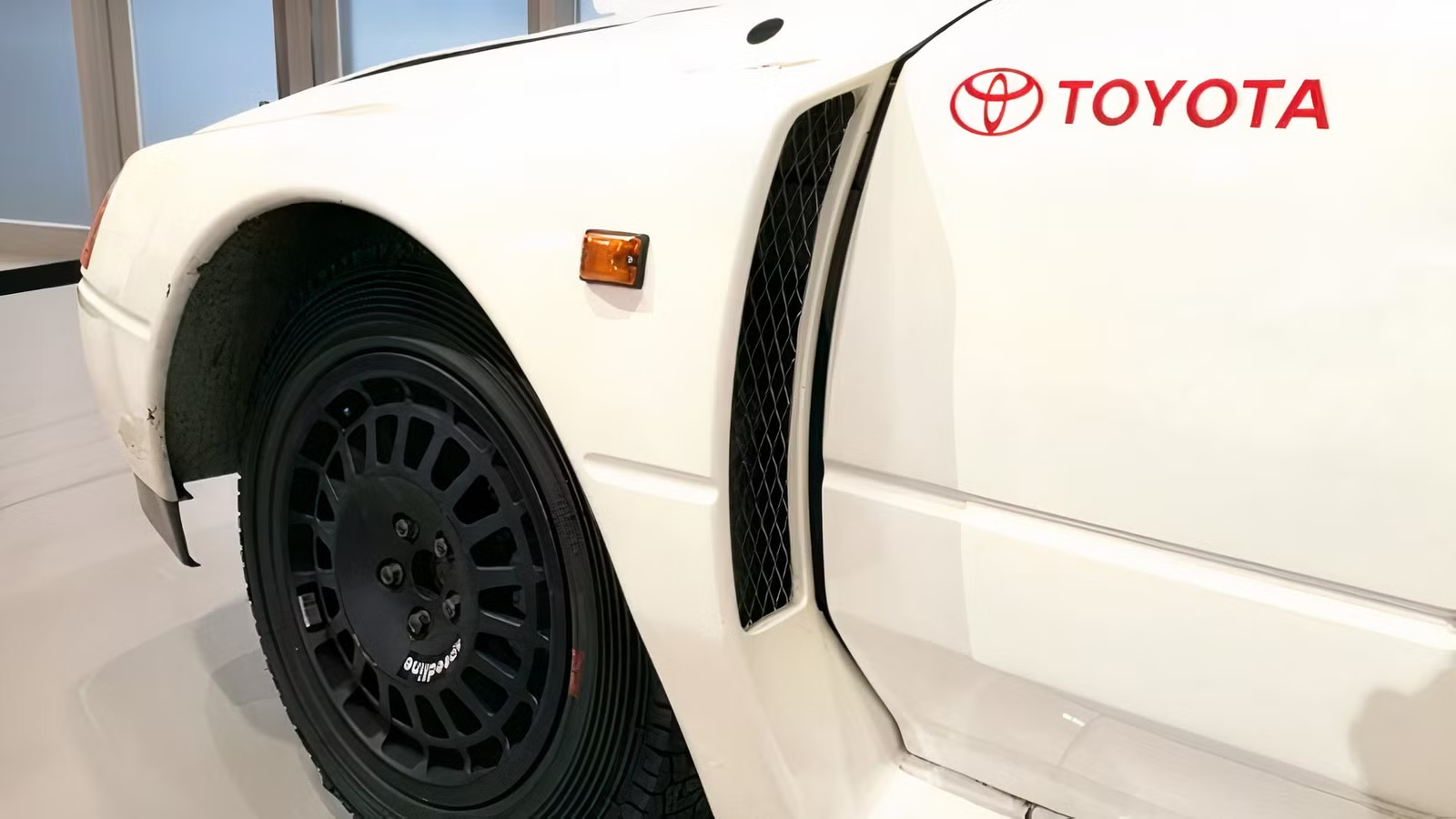
Toyota has built plenty of competition cars that entered history through the front door. This one, however, nearly went out through the workshop’s back gate, headed for destruction before the public knew what had been created.

It was a mid-engine rally prototype developed for a championship future that disappeared almost overnight. By the time its engineers had shaped the hardware, motorsport’s governing body had changed course, leaving Toyota with a brutally fast machine that, unfortunately, had nowhere to race.
Toyota’s Rally Formula Had Reached Its Limit
Toyota Team Europe had learned how to win with the Celica Twin Cam Turbo, particularly on long-distance events where toughness mattered more than surgical agility. The rear-wheel-drive Celica won the 1983 Ivory Coast Rally, then claimed the Safari Rally in 1984 and 1985. Those were serious results, but they also disguised an uncomfortable truth about the broader championship.

On faster European stages, the Celica was fighting machinery conceived around Group B rather than adapted to it. Peugeot’s 205 T16 and Audi’s Quattro brought all-wheel-drive traction, while Lancia pushed the mid-engine formula. Toyota’s front-engine, rear-drive coupe could absorb punishment, but it couldn’t consistently match the grip or directional changes of the purpose-built opposition.
Toyota needed to start with a clean sheet. Its next contender would place the engine behind the crew and send power through all four wheels, a layout chosen to chase the championship rather than to collect occasional wins. Approval came in 1984, with Toyota keeping development in-house so the hard-earned lessons would remain inside the company.
Group S Let Toyota Abandon The Rulebook

The proposed Group S category looked like an engineer’s dream with a finance department’s blessing. Group B required manufacturers to build 200 homologation cars. Group S reduced that figure to 10, which meant a competition department could assemble the required batch without creating a small road-car production line.
The class was expected to appear in 1987 before becoming eligible for championship points in 1988, giving teams time to turn experimental hardware into a workable package. That change opened the door to true rally prototypes. The showroom model only needed to lend its shape and marketing value, while the hardware underneath could be designed around speed.
Gaining Ground

Peugeot had already demonstrated the trick with the 205 T16, whose road-car resemblance became rather vague once someone raised the bodywork and looked underneath. Toyota had introduced a compact mid-engine sports car in 1984, giving the rally program an unusually convenient silhouette. The new machine could resemble something customers recognized while using a bespoke structure with competition suspension.
The road car supplied the family face, then wisely stepped away before the serious engineering started. The first prototype was completed in February 1985 and tested in Japan and Europe. Evaluations prompted changes to its engine position and suspension travel, followed by larger tires. Toyota also explored a torque-split system that could switch between rear-wheel drive and all-wheel drive as the regulations continued to evolve.
The Toyota 222D Was An MR2 In Silhouette Only

The Toyota 222D is the subject here, although calling it an MR2 rally car oversells the family connection. Both carried their engines behind the cabin and shared a broadly similar outline. Beyond that, though, the 222D was a specialized competition car wearing enough AW11 styling to keep the marketing team happy.
Under its composite bodywork sat a central competition structure with a tubular rear section supporting the engine and transmission. Double-wishbone front suspension replaced the road car’s MacPherson-strut arrangement, while the rear used an independent multi-link design. Cross-drilled ventilated brakes featured adjustable balance from the cockpit, because stopping a prototype like this required more than optimistic pedal pressure.
In All Seriousness
Even the exterior’s familiar parts were scarce. Reports indicate that only the doors could interchange with a production MR2. Huge fender extensions reshaped the body, while fixed headlights sat beneath clear covers. The roof scoop and extensive cooling ducts belonged to the rally car as well. It looked like an MR2 after several months in a very questionable gym.
Toyota Team Europe developed rear-wheel-drive and all-wheel-drive versions in parallel. The rear-drive car used a longitudinal engine layout and was intended for asphalt, while the Xtrac-equipped all-wheel-drive version placed its engine transversely for loose surfaces. Toyota wasn’t chasing one compromise setup. It was developing separate answers for different rallies, which showed how seriously it regarded Group S.
Its Performance Came With A Mean Streak

Early development cars used the turbocharged 2.1-liter 4T-GTE four-cylinder derived from the Celica program. In one documented specification, it produced 380 hp at 9,000 rpm and 317 lb-ft of torque at 5,500 rpm. That was already substantial in such a small machine, but Toyota viewed it as an interim engine rather than the final weapon.
The planned competition unit was the 2.1-liter 503E, an engine connected to Toyota’s endurance-racing work. Published figures vary by tune and development stage, with 600 hp frequently associated with a surviving car and more than 750 hp described as the engine’s potential. Against a reported curb weight near 1,650 pounds, either figure is enough to make modern supercars look a bit overfed.
The numbers tell only half the story because the chassis wasn’t finished. The 222D had a short wheelbase and limited suspension travel, which made it nervous over fast, uneven surfaces. Its turbo could also take roughly three seconds to deliver full power. That is an awkward pause when a driver is waiting for hundreds of horsepower to arrive between trees that are not known for moving aside.
A curator familiar with the surviving machinery described behavior that could swing from understeer to oversteer, with the car often deciding what happened next. More testing might have softened those traits through revised geometry and better boost control. Instead, the prototypes preserve a development snapshot, capturing the 222D at its most powerful and least refined.
Toyota Sent Its Rally Future To The Crusher
Group S was supposed to follow Group B, but rallying’s safety crisis changed the sport’s direction. Fatal accidents forced the governing body to abandon Group B and drop the proposed prototype category. Group A became the replacement, pulling manufacturers back toward production-based cars with far higher homologation requirements.
It demanded 5,000 production examples over 12 months, a very different proposition from Group S’s workshop-sized batch of 10. That decision left the Toyota 222D with no legal home. Toyota had built 11 prototypes according to several accounts, divided between four rear-wheel-drive cars and seven all-wheel-drive versions. Most were ordered destroyed after the program ended.
The Missing Link

The exact number surviving is disputed among the available histories, although three cars are widely reported and only one is generally considered operational. The escapees are key because Toyota’s official rally story moved on quickly. The company continued with rear-wheel-drive Celica and Supra models, then introduced the Group A ST165 Celica GT-Four in the 1988 WRC season.
That car pointed toward Toyota’s successful all-wheel-drive future, while the 222D remained the missing link that showed where its thinking had already gone. Toyota tried to erase a machine made obsolete by regulation, yet the survivors turned that attempted clean-up into the best part of the story.
Sources: Toyota, Hagerty

Related posts



Latest Post


No Comments