
Toyota’s Rarest 2GR-Powered Hatchback Is A FWD Sleeper Cheaper Than A Used Civic
In North America, insanely overpowered Toyota hatchbacks are something of a novel thing. When the GR Corolla hit the scene in the spring of 2022, the reaction was one of abject wonder and utter amazement. Over in Japan, crazy powerful Toyota hatchbacks are nothing new. On at least one occasion, Toyota blurred the line between a hot hatchback and a low-slung cruiser that drew customers away from established luxury cars like the Crown. In America, where hatchbacks are almost always cheap and cheerful, the blending of these two paradigms is enough to make your head hurt. Still, it was all too real.
The E150 Platform: Unobtanium in the US, But a Mainstay Overseas

No shame if you read “E150”and immediately think of a full-sized van from Ford. In Japan and elsewhere around the world, it’s simply Toyota’s internal designation for a hatchback platform produced from 2006 to 2012, called the Auris. Distinct from Toyota’s NA-spec hatchback, the Matrix, the first-generation E150 Auris was one of the first demonstrations of Toyota’s then brand-new “Vibrant Clarity” design philosophy. While it sounds like typical design-department jargon, the philosophy attempted to bring modern, sleek styling lines to a brand that often felt perpetually stuck in the 1990s.
Formed under then Global Design Chief Wahei Hirai in 2002, the Vibrant Clarity design philosophy championed icons like the global Gen-II Toyota Yaris, and both the second and third-generation Prius. Vibrant Clarity was one of the most recognizable automotive design languages of the 21st century, yet it was also subtle and reserved enough that you could never quite identify it when spotting one of its examples on the road. To be fair, Vibrant Clarity also gave us the FT-1 concept car in its final years, the very same concept that would be refined into the fifth-generation GR Supra.

As far as the Auris was concerned, it certainly made the E150 series look distinct from the competition. A whole range of four-cylinder engines, both gas and diesel, were available across Asian and European markets, including the Japanese-only Blade, which featured higher-quality interior materials, fewer plastics, and the same 2.4-liter 2AZ-FE you’d find in the Toyota Camry and Scion tC in North America. It was a fine engine, one that could run trouble-free for hundreds of thousands of miles. Of course, it wasn’t in hot hatch territory, but Toyota was prepared on that front—far more prepared than they had any reason to be, if we’re being honest, but we’re all here for it.

The 2GR-FE V6: A Legit Luxury Car Motor Moonlighting as a Sports Car Engine

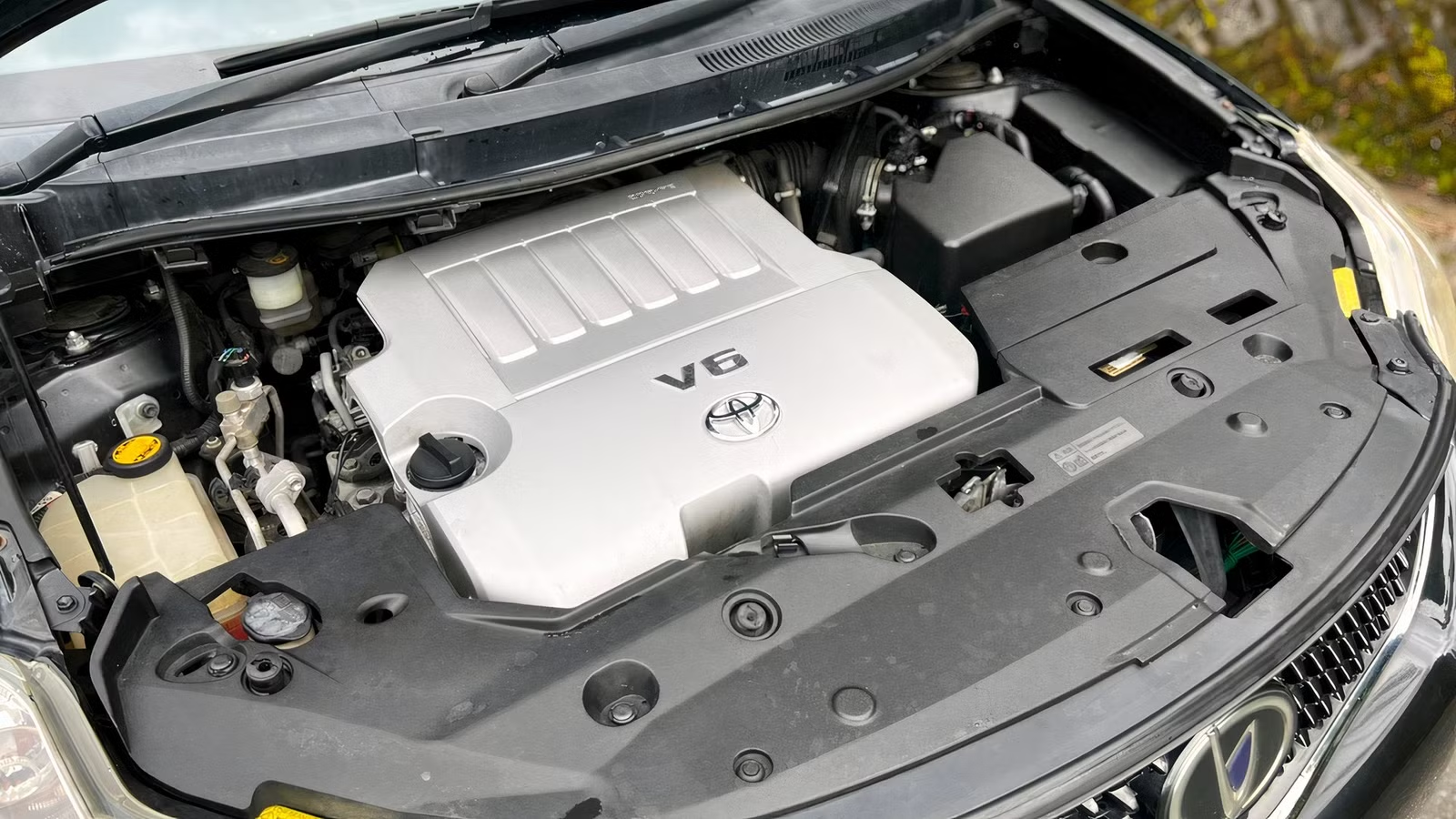
Knowing what we know about the way modern hot hatchbacks are built, you’d think a sporty flagship trim for the Auris would pack something like a bigger four-cylinder motor. Maybe with a single large turbo or two smaller ones—you know the formula. Well, you’d be wrong there, because what they actually used was a 3.5-liter V6 engine called the 2GR-FE.
Here in the US, we know it as the engine you’d find under the hood of the US-spec Gen-VI Toyota Camry in fully loaded trim. Elsewhere, the second-generation Toyota Highlander also used the engine, as did the Gen-I Venza, the Lexus RX 350, ES 350, and the RAV4. It was an absolutely prolific engine, one that produced in the neighborhood of 280 hp depending on the application. For an aluminum block V6, the 2GR-FE was remarkably stout thanks to its rigid open deck layout and cast-iron cylinder liners. Still, sports car-strong? That’s pretty hard to believe. Yet, it really is the case, and the British Lotus brand is living proof.

The Exige S, Evora S, and the Emira have used this Toyota V6 since 2009to great effect. With a supercharger and factory tune, Lotus has managed to squeeze as much as 430 hp out of the 2GR-FE block while maintaining the Toyota level of reliability that helped the brand proliferate in the 21st century. What do you suppose happens when you take that same V6 and engineer it into an Auris hatchback? Well, you get the blueprint for the modern GR Corolla, and, for that matter, any modern Toyota hot hatch.
The Blade Master, Awesome Name, Awesome Engine, Amazing Car

First things first: Blade Master? That’s legitimately one of the coolest nameplates ever applied to an automobile. We tend to think of aggressively named cars as being an American invention.Dodge Demon this, Mercury Marauder that, you get the idea. When a Japanese brand takes the same approach, the result sounds like the name of an anime anti-hero, and it is genuinely impressive. Beyond the name, the Toyota Blade Master was a genuine problem for rival manufacturers.
How Toyota managed to squeeze this bona fide sports car V6 under its hood can only be pinned down to sheer determination. Yet it certainly succeeded, delivering 276 hp and 253 lb-ft of torque. For a Japanese hatchback sold in the late 2000s, that is a remarkable amount of power. For reference, a 2026 GR Corolla makes 300 hp and 295 lb-ft of torque out of its turbocharged three-cylinder engine, and it has the benefit of a modern all-wheel-drive system and a lightning-quick optional automatic transmission. Getting within striking distance of a modern GR in those days would have been remarkable, and the setup sounds like a classic recipe for torque steer.

That assessment about torque steer was accurate, as there was plenty of it to be had while driving a Blade Master. Beyond that, there was little else to complain about, as the range-topping Blade Master G was truly luxurious. It featured genuine leather seats with Alcantara accents, wood-grain trim pieces, and satellite navigation at a time when such technology was still considered a luxury item. By American standards, such a package defied belief. It was as if a Lexus had been wedged inside a hatchback and forgotten to leave, and in practice, that was essentially the case. Zero to 60 mph was achieved in the low six-second range, about on par with the R32 Golf of the era, and just about a second slower than a modern GR Corolla. For the time, it was a wild car, and one that has appeal even today.
American Car Nuts Would Love it, But it’s Locked Behind Import Laws

A touch under 3,000 units of the Blade Master were made between mid 2007 and 2012, or 2,880 in total by most estimates. When they were new, they sold for roughly 3.3 million yen, or about $28,000 in USD at the time. Given the way Americans lust after Japanese performance cars, you might expect depreciation to be a relatively small affliction. As it turns out, you can find one of these listed on international auction websites for anywhere between $6,000 and $12,000. That is roughly used Corolla or Civic money here in the States.
So, by the time import restrictions are lifted from the Blade Master sometime in roughly the early 2030s, the cost of import fees and associated taxes might tally up to a significant portion of the sale price. Consider that being the case for virtually any other JDM-spec sports car. That is simply what happens when you put a sports car V6 in a hatchback: it flies right under the radar.
Source: cultandclassic.com.au

Related posts




Latest Post


No Comments