
Toyota’s Corolla Hybrid Now Bites Deep Into Prius Territory
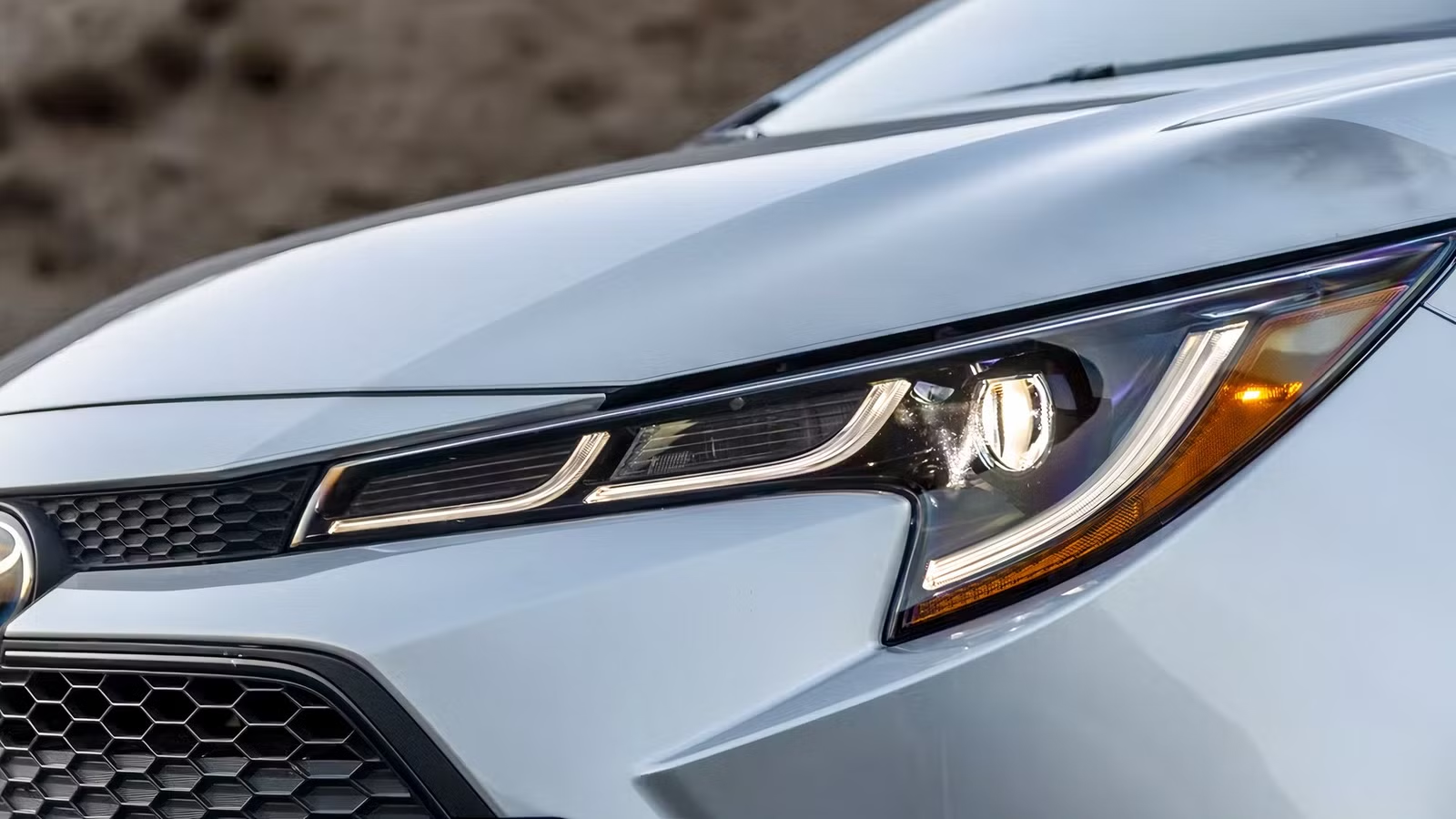
You can buy the Toyota hybrid with the highest fuel-economy rating and still spend more than necessary on your commute. That is the tension between the 2026 Corolla Hybrid and Prius: the Prius uses less fuel, but the Corolla’s lower purchase price can outweigh that advantage for years.

The Corolla Hybrid LE FWD starts at $24,975 before destination and delivers an estimated 50 mpg combined. The Prius LE FWD starts at $28,550 and reaches 57 mpg combined, putting $3,575 between two efficient Toyotas. The Prius remains the mileage leader, but that does not automatically make it the better financial decision.
The Prius’s Reputation Is Costing Buyers Money They Don’t Have To Spend
Brand Trust Alone Can Cost You $3,575 Before You Turn The Key
The Prius earned its place on your shopping list by making hybrid efficiency its defining feature. Its long history gives the name immediate meaning, and the current generation adds styling and performance that broaden its appeal beyond fuel savings.

That reputation can also encourage you to skip a comparison that deserves your attention. If your goal is affordable transportation, the important question is how much each car costs to operate over your ownership period, including the price you pay before the first tank of gas.
The Corolla Hybrid Changes What Buyers Must Compare

The Corolla Hybrid gives you another route into Toyota’s hybrid lineup without requiring the higher price of the Prius. It also offers AWD on LE and SE models, so choosing the less expensive car does not automatically mean giving up that option.
However, the SE needs careful consideration if efficiency is your priority. Its $27,415 base price and 47-mpg combined FWD rating narrow its price advantage over the Prius LE to $1,135 while increasing the efficiency gap to 10 mpg. The Corolla LE makes the stronger savings argument; the SE asks you to value its sportier presentation and equipment.
The Corolla Hybrid Gets Close Enough To Make Price Matter

The Corolla Hybrid LE and XLE FWD earn 50 mpg combined, while the SE FWD earns 47 mpg. The Prius LE FWD reaches 57 mpg, but the XLE FWD drops to 52 mpg, making the difference between that Prius and a Corolla LE just two mpg.
That reverses an assumption you might make when moving up the trim ladder. A more expensive Prius is not necessarily a more efficient Prius, and the XLE’s approximately $31,995 base price buys additional equipment rather than the lineup’s best mileage. Match the EPA rating to the specific trim and drivetrain on the window sticker.
Translate The MPG Gap Into A Commute

Assume you drive 12,000 miles annually and pay $3.50 per gallon as a constant illustrative fuel price. Based on their combined fuel efficiency ratings, the Corolla LE would use 240 gallons and cost $840 annually, while the Prius LE would use about 211 gallons and cost $737 annually. Over five years, the Prius saves approximately $516 in fuel.
The Corolla SE would cost about $894 annually under the same assumptions, giving the Prius LE roughly $784 in five-year savings. Those are estimates rather than promised results: Edmunds reports just over 41 mpg on its Corolla Hybrid evaluation route and 52.3 mpg for a Prius Limited FWD. Those separate tests are not a controlled LE-versus-LE comparison, but they show why highway speed, hills, weather, and driving habits should factor into your calculation.
The Prius Needs 35 Years Of Fuel Savings To Break Even With The Corolla

Based on the base MSRP and that five-year fuel estimate, the 2026 Corolla LE remains approximately $3,059 cheaper than the Prius LE. The Corolla SE’s advantage shrinks to about $351, which is small enough for a discount or financing difference to erase. Destination, taxes, financing, insurance, maintenance, and resale are excluded from those figures.
At the stated mileage and fuel price, the Prius LE would need roughly 35 years of fuel savings to recover its $3,575 premium over the Corolla LE. That simplified calculation does not forecast decades of ownership, but it explains why the extra mpg alone is a weak reason to stretch your budget. Higher annual mileage and gasoline prices shorten the payback period.
Where The Prius Still Earns Its Premium

The Corolla Hybrid has a 13.1-cubic-foot trunk, compared with 23.8 cubic feet behind the Prius LE’s rear seats and 20.3 cubic feet in the Prius XLE. These figures make the hatchback’s advantage concrete, while its larger opening improves access when your cargo is awkwardly shaped.
Passenger space does not produce the same decisive result because both cars offer 34.8 inches of rear legroom. You should still sit behind your own driving position and check headroom, particularly in the Prius’s sloping cabin. If your regular load is a laptop bag and groceries, the Corolla may have enough space for you; if you routinely carry bulky purchases, the Prius offers something the fuel calculation cannot capture.
Its Powertrain And Cabin May Be Worth Paying For

The Prius FWD delivers 194 combined horsepower versus the Corolla Hybrid’s 138 horsepower, a meaningful difference when acceleration matters to you. The Corolla SE’s appearance and Sport mode do not change that output comparison. Try highway merging, an uphill stretch, and a rough section of pavement before deciding which car’s handling and ride suit you.
Technology also requires a trim-specific comparison instead of a blanket Prius win. The Corolla LE and SE have a standard seven-inch digital gauge cluster and eight-inch touchscreen, with larger displays available higher in the lineup, while the Prius LE and XLE also start with an eight-inch touchscreen. Edmunds flags steering-wheel obstruction of the Prius’s gauges and noise under acceleration, so its higher price does not guarantee a more comfortable or refined driving experience.

Consider an illustrative buyer persona rather than a quoted owner: a commuter driving 12,000 miles annually, usually traveling alone, carrying ordinary bags, and planning to keep the car for five years. This buyer chooses the Corolla Hybrid LE because the Corolla’s trunk is adequate, and the Prius’s projected $516 in fuel savings cannot offset a $3,575 purchase premium.
If that resembles your use, begin with the LE instead of assuming the SE is the best compromise. Check whether the SE’s seats, styling, and additional equipment justify spending $2,440 more while accepting lower efficiency. The savings argument is strongest when you resist adding features you do not particularly want.

The Prius LE makes sense when you value maximum efficiency, stronger acceleration, and hatchback access together. The XLE can also justify its premium through equipment you will use, but its 52-mpg combined rating means you should not choose it to expect better efficiency than the LE.
If neither Toyota fits, the Hyundai Elantra Hybrid Blue deserves a quote: its EPA-estimated 54 mpg combined supplies a third efficiency-focused alternative. Then compare out-the-door prices, current financing, insurance, and the exact drivetrain’s rating before signing. Choose the Corolla to keep more money available when its simpler package meets your needs, or pay for the Prius when its added capability earns its place in your daily life.
Sources: Toyota, Hyundai, Edmunds, Kelley Blue Book, Fueleconomy.gov

Related posts






Latest Post


No Comments