
The Fastest Quarter Mile Time For A Production Car In The ’60s
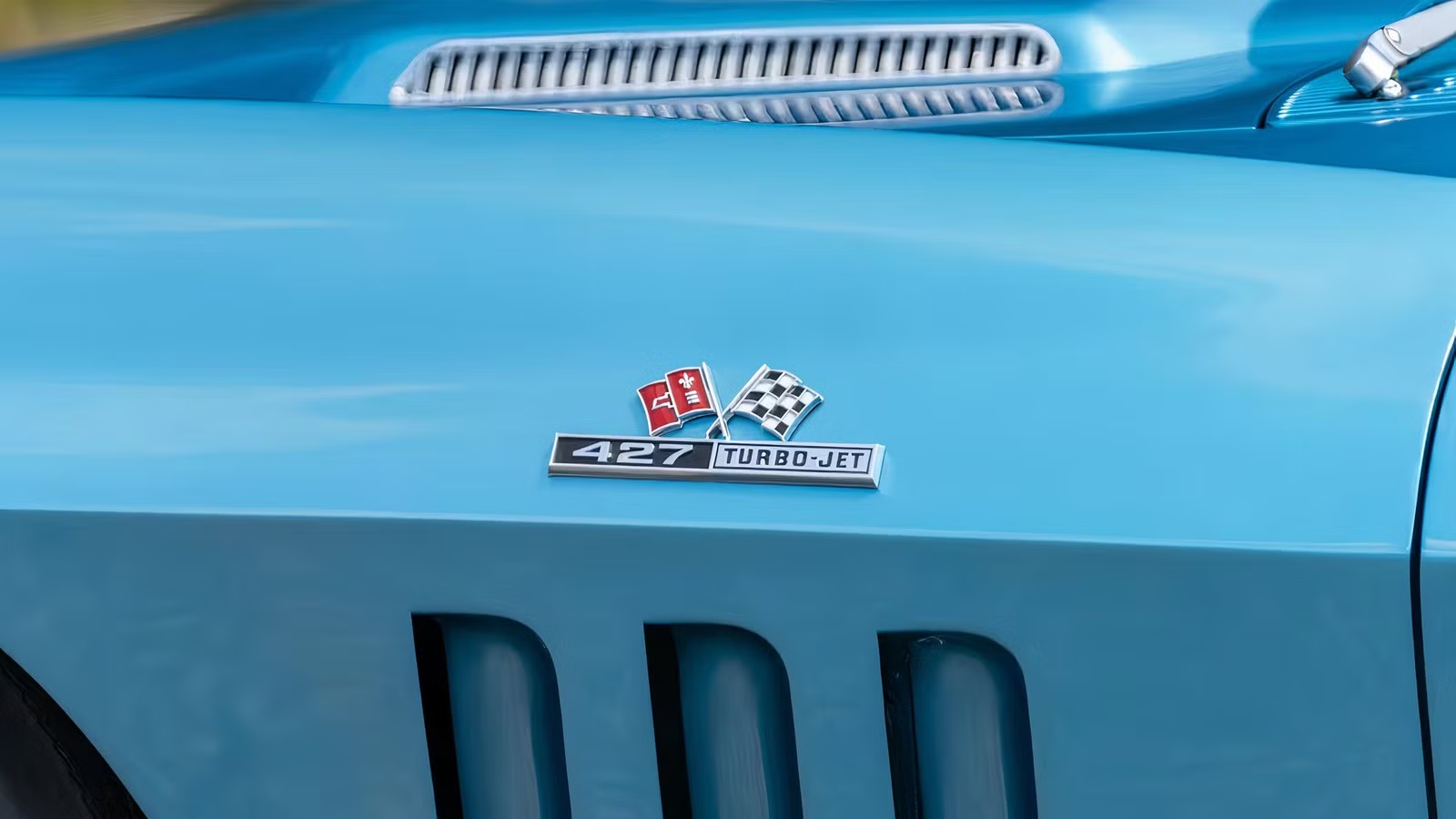
Sixty years on, the 1960s horsepower wars still spark arguments at car shows and on forums — and for good reason. Every major American automaker was chasing the same prize: bragging rights for the quickest, most brutal machine a buyer could drive off a dealer lot. What makes the era’s ultimate quarter-mile champion so compelling, even today, is that it wasn’t the car anyone expected to win.

While the muscle car crowd traded cubic inches and compression ratios, a nimble sports car stole the crown from its heavier, more powerful rivals. It stood out as the world’s quickest street-legal mass-market production car in a decade marked by aggressive horsepower wars and big-block performance. And sure, Detroit rolled out some seriously fast specialty and limited-production rockets during that wild decade, but among the cars regular folks could actually walk into a showroom and buy, one particular American sports car left everything else in its dust.
The 1966 C2 Corvette Is The Fastest Production Quarter-Miler
Through its two generations in the 1960s, and its ever-evolving small- and big-block engines, Corvettes remained the go-to car for acceleration, and the name became synonymous with American iron and the deep, growling power it delivered. By the time the mid-’60s rolled around, the Chevrolet Corvette had the engine and the muscle to rip off a 13-second quarter mile — the fastest of any production car in the 1960s.


Every young driver dreamed of purchasing a basic car that would then be enhanced by high-performance parts, and blood and sweat, to out-drag their rivals. A Corvette, though, was delivered with the ability and the tools to go fast right out of the box.
In 1966, that tool was a big-block 427 Chevy V8 that could propel the two-seat coupe or convertible through a quarter mile in about 13 seconds.
Corvette 427s Could Rip Out 13-Second Quarter Miles

Depending on which source you trust for performance figures, the quarter mile in a Corvette 427 took anywhere between 12.8 seconds (Car & Driver, Sports Car Digest) and 14.0 seconds. Most contemporary tests put it solidly in the high-12 to low-13-second range.
Needless to say, some buyers wanted even more, so special orders and one-offs pushed the two-seater into low- to mid-12-second territory.
Less Than Half Of 1966 C2s Came With 427 V8s

A total of 27,720 C2 Corvettes were produced for the 1966 model year, with the vast majority being roadsters — 17,762 convertibles versus 9,958 coupes. Roughly half of production, 10,644 cars, were fitted with the big-block 7.0-liter V8, and 5,528 of those received the 425-hp Turbo Jet 427.
Corvette 427 Sports Car Over-Powered Muscle Cars

The second-generation Corvette arrived just as muscle cars were starting to find their footing, and the sports car didn’t merely hold its own in that crowded field — it out-sprinted the competition in the quarter mile by nearly a full second.
At the peak of their popularity, and with their resurrection decades later, there were some mighty stock muscle cars that could run a 10-second quarter mile, but that was well after the 1960s.
The Turbo Jet Corvette 427 Was The Most Powerful

In 1966, Corvette buyers could opt for the standard small-block 327 or upgrade to the powerful 427 big-block. Chevy sweetened the deal with its Turbo Jet package, which cranked up the compression from 10.25 to 11.0:1 and improved breathing for both engines, unleashing extra horsepower in the process.
The compression bump shifted the power band higher, moving both horsepower and torque peaks up by 400 rpm. This gave the ’66 Corvette more room to breathe at the top end, allowing it to really fly once it crossed the 5,252 rpm mark where horsepower overtakes torque. But the real secret to the Corvette’s drag strip dominance wasn’t what happened at redline — it was the 427’s brutal low-end punch that launched it off the line hard enough to clock quarter-mile runs in the low 13-second range. While the 427’s peak horsepower figure was unchanged from 1965, torque received a serious boost, jumping 11% from 415 to a tire-shredding 460 lb-ft.
Corvette V8 Engine Specs Comparison
|
7.0-Liter V8 |
5.4-Liter V8 |
|
|
Horsepower |
390-425 HP @ 5,200-5,600 RPM |
300-350 HP @ 5,000-5,800 RPM |
|
Torque |
460 LB-FT @ 3,600-4,000 RPM |
360 LB-FT @ 3,200-3,600 RPM |
|
Transmission |
4-Speed Manual |
3-Speed Manual, 4-Speed Manual, 3-Speed Automatic |
|
Quarter-Mile |
12.8 Seconds @ 111 MPH |
15.7 Seconds @ 86 MPH |
|
0-60 MPH |
4.8 Seconds |
8.34 Seconds |
|
Top Speed |
134 MPH |
115 MPH |
Of course, the horsepower and torque numbers on paper told only part of the story. It’s widely accepted that manufacturers played it coy with their official ratings back then, deliberately understating the figures to keep insurance companies happy and land their cars in more favorable NHRA competition classes. After all, lower horsepower ratings meant racing against slower competition — a clever bit of gamesmanship that fooled no one at the track.
425-HP Turbo-Jet 427 Enhancements
- Mechanical valve lifters, rather than hydraulic
- Intake-valve diameter increased to 2.19 inches, from 2.065
- Valve lift increased to 0.5197 inches, from 0.4614 intake and 0.48 exhaust
With the increased compression ratio, Chevrolet also fitted the 427 with a larger four-barrel carburetor that necessitated a freer-breathing intake manifold, larger higher-lifting intake valves, and a new camshaft with mechanical valve lifters. The exhaust system was, of course, also upgraded.
The crankshaft was also more rigid, with main bearing caps held in place by four bolts (upgraded from two), along with larger crankshaft journals and bearings. A special hardening process was applied to all journals to improve durability.
The 1968 Hemi Dodge Dart Covered The Quarter Mile In Under 11 Seconds

The muscle car era was just starting to accelerate, so the 1966 Corvette had some very fast rivals for quarter-mile domination, though the quickest of them weren’t really Corvette competitors — namely the Dodge Dart and Plymouth Barracuda twins. Its main segment rival, the 427 Cobra, was constantly being developed to be equally quick, with the Corvette always in mind as Shelby pursued more powerful engines.
The sole reason the Corvette beats them out in the context of this story, though, is that all three were low-volume products, and the three quickest versions were not certified for street use.
Dodge LO23 Hemi Dart Specs And Details
|
Production Totals |
80 |
|
Engine |
7.0-Liter Hemi V8 |
|
Horsepower/Torque |
425 HP/490 LB-FT |
|
Quarter Mile |
The Dodge-rated 425 hp for the Hurst Hemi Dart LO23 was probably closer to 540, and the engineers themselves often toed the corporate line with a wink and a roll of the eyes.
Although little documentation of its quarter-mile times exists, most historians place the runs in the 10-to-11-second range, with accounts of highly tuned versions dipping into the nines. The cars were supplied to Hurst Performance stripped to the bone, were not covered by the factory warranty, and carried a window sticker proclaiming they were not to be used on the street.
Plymouth BO29 Hemi Cuda

Specs And Details
|
Production Totals |
50 |
|
Engine |
7.0-Liter Hemi V8 |
|
Horsepower/Torque |
425 HP/490 LB-FT |
|
Quarter Mile |
10.3 Seconds |
Like its Dodge counterpart, the Hemi Cuda was a race car through and through. It was sent to Hurst for the necessary modifications to allow it to compete and win in the NHRA Super Stock class, which is why it’s sometimes referred to as a Hemi Cuda SS.
The main reason production Barracudas and Darts didn’t come with the big-block Hemi was because it was simply too large to fit, so it fell on Hurst to shoehorn the Elephant into the engine bay — which they accomplished by overhauling the front suspension.
Add fiberglass body panels and a modified rear suspension, among other changes, and you have a non-street-legal Barracuda capable of running the quarter in less than 10.5 seconds.
Shelby Cobra 427 S/C

Specs And Details
|
Production Totals |
31 |
|
Engine |
7.0-Liter Ford V8 |
|
Horsepower/Torque |
485 HP/480 LB-FT |
|
Quarter Mile |
11.8 Seconds @ 121 MPH |
Like the others presented above, the Shelby Cobra 427 gets a big-block 7.0-liter V8, a Ford unit nestled into this tiny roadster. Shelby’s sports car came about in the spirit of competition, at a time when GM started bolting big-block V8s into its new generation of Corvettes.

The story goes that Carroll Shelby wanted to go racing with his Cobras, but the FIA required that he homologate the car to the tune of 100 or more units. He canceled his 100-chassis order and took the 53 cars he already had — selling 19 as bona fide race cars, sending three to Ford, and converting the remaining 31 to Semi-Competition models for street use.
The Corvette Has Always Had Quick Quarter Miles

The Chevy Corvette is not the most powerful car ever made, nor the outright quickest, but the Corvette has become unbreakably bonded to American performance, and backing up that reputation on a quarter mile of pavement is a timeless way to keep that image alive in drivers’ minds.
In the 1960s, driving — and by extension car ownership — was all about power, and the Corvette was just beginning to forge its legacy. To that end, the C2 427 stepped up to do its part in projecting an image of raw performance and refusing to take a back seat to any car.
Sources: GM Heritage, Corvette Central, Corvette Museum, CobraAuthority, DodgeGarage, ShelbyAmericanCollection, SportsCarDigest, Street Muscle Magazine.

Related posts
Latest Post


No Comments