
The Corvette E-Ray Is GM’s Only Hybrid, And That Makes It The Most Consequential Car In The Lineup Right Now
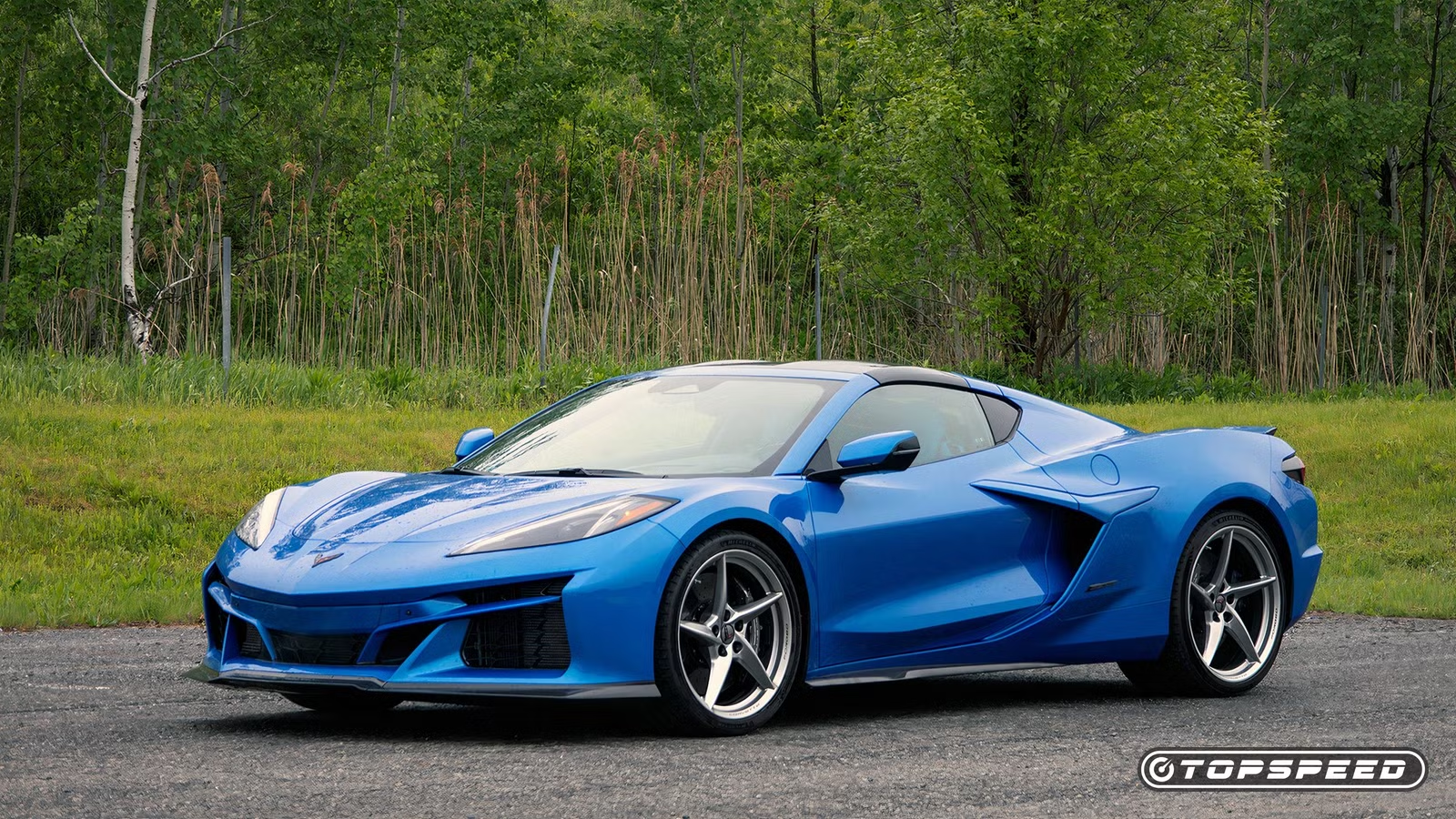
General Motors sells roughly a dozen electric vehicles in the United States, a fleet of highly profitable gas-powered trucks and SUVs, and exactly one hybrid: the Corvette E-Ray. That single exception to GM’s binary powertrain strategy has taken on an outsized meaning as hybrid sales surge and EV demand softens — making the E-Ray less a sports car story and more a strategic pressure valve.

A Reuters report published this week, drawing on dealer accounts and analyst forecasts, captures how exposed GM’s position has become. Hybrids accounted for 19 percent of U.S. retail vehicle sales in August, up from roughly 16 percent before an Iran-related conflict drove gasoline prices to a national average of $4.37 per gallon. Hybrids are selling off dealer lots more than twice as fast as non-hybrid gas vehicles, according to J.D. Power. GM, the top-selling automaker in the country, has almost none to offer.
Why GM Walked Away From Hybrids In The First Place
GM’s hybrid absence wasn’t an oversight — it was a deliberate strategic call, rooted in a regulatory bet that has since shifted beneath the company’s feet. CEO Mary Barra framed hybrids as an “interim solution” as far back as a 2019 Barclays conference, arguing that customers weren’t interested and that GM’s capital was better spent reaching zero-emission vehicles directly. She later acknowledged that “up until a year ago, we were on a journey to a regulatory environment where we had to drive EVs” — a journey that shaped a decade of product planning and factory investment.

The irony is that GM was an early hybrid pioneer. The company developed hybrid technology ahead of most rivals and was first to market with a hybrid truck. It chose to treat that capability as a stepping stone rather than a product line, running two generations of the Volt from 2011 to 2019 before pivoting hard toward battery-electric. The Volt’s engineering informed the Bolt, which in turn shaped GM’s Ultium platform. GM effectively used hybrid development as an R&D runway, then abandoned the terminal.
The Cost of Going All-In on EVs

The financial toll of GM’s EV commitment is visible and specific. The company invested $2.2 billion to convert its Factory Zero plant in Detroit-Hamtramck for electric trucks and SUVs, then cut shifts and laid off hundreds of workers when demand fell short of projections. At the Fairfax Assembly plant in Kansas, 900 workers moved from temporary to indefinite layoff as the site was retooled — not for EVs, but for the gas-powered Equinox.
GM’s Toledo Propulsion Systems facility was the company’s first U.S. powertrain plant transformed for EV components, at a cost GM pegged at $760 million in 2022. The company later told workers it would remove that equipment entirely. A local union leader described the reversal as “a punch to the gut.” GM also received $480 million in Michigan state grants to expand its Orion Assembly plant for EVs, then redirected the facility to full-size gas pickups and the Cadillac Escalade. When Congress ended the federal EV tax credit — up to $7,500 for new buyers — ahead of schedule, the pricing cushion that helped GM move electric inventory disappeared with it.
The E-Ray’s Quiet Strategic Significance

Against that backdrop, the Corvette E-Ray’s all-wheel-drive electric front axle looks less like a performance feature and more like a proof of concept. The E-Ray pairs a 6.2-liter V8 with an electric motor on the front axle — GM’s only production hybrid architecture currently on sale in the U.S. If GM ever needs to scale hybrid capability across its lineup, the E-Ray is the one working template it has.
Dealers are already pushing for exactly that. A New Jersey GM dealer told Reuters he hopes “GM can adapt and come up with a way to build hybrids,” reflecting pressure that’s building across the network. By late 2024, Barra acknowledged the company would look at plug-in hybrids for North America by 2027, though supplier sources and forecasting firms project GM won’t have a hybrid on sale until near the end of the decade. GM’s U.S. market share slipped to 16.8 percent in the first half of this year, down from 17.6 percent a year prior, while hybrid leaders Toyota and Honda gained ground.
Why the Strategy Isn’t a Clear Failure Yet

The case against GM’s approach is real, but the case for it isn’t closed. GM is the second-largest EV seller in the U.S. behind Tesla, and its EV market share rose to 13.2 percent from 8.8 percent in a recent full year, with Cadillac nearly doubling its EV volume to roughly 49,000 units. GM’s overall market share across all propulsion types reached 17.2 percent — the highest in a decade, according to the company — with North America president Duncan Aldred crediting the EV lineup directly.
Analyst John Murphy of Murphy Automotive Partners expects hybrids to reach 34 percent of U.S. sales by 2031, yet still argues GM’s approach “is not as clear a major mistake as I think some people believe.” The logic: GM has already absorbed the enormous cost of building a broad EV portfolio, and that lead is expensive for rivals to replicate quickly. Toyota, the global hybrid leader, is now rolling out a wave of EVs. Ford is developing new electric models to fill a thin roster. Everyone is moving toward the same destination GM committed to early — the question is whether GM can hold its position until the market catches up. The E-Ray, sitting quietly at the top of the Corvette lineup, may be the clearest sign that GM left itself at least one door open.

Related posts



Latest Post


No Comments