
This Toyota GT-One Render Makes Ford’s Supercar Strategy Look Foolish
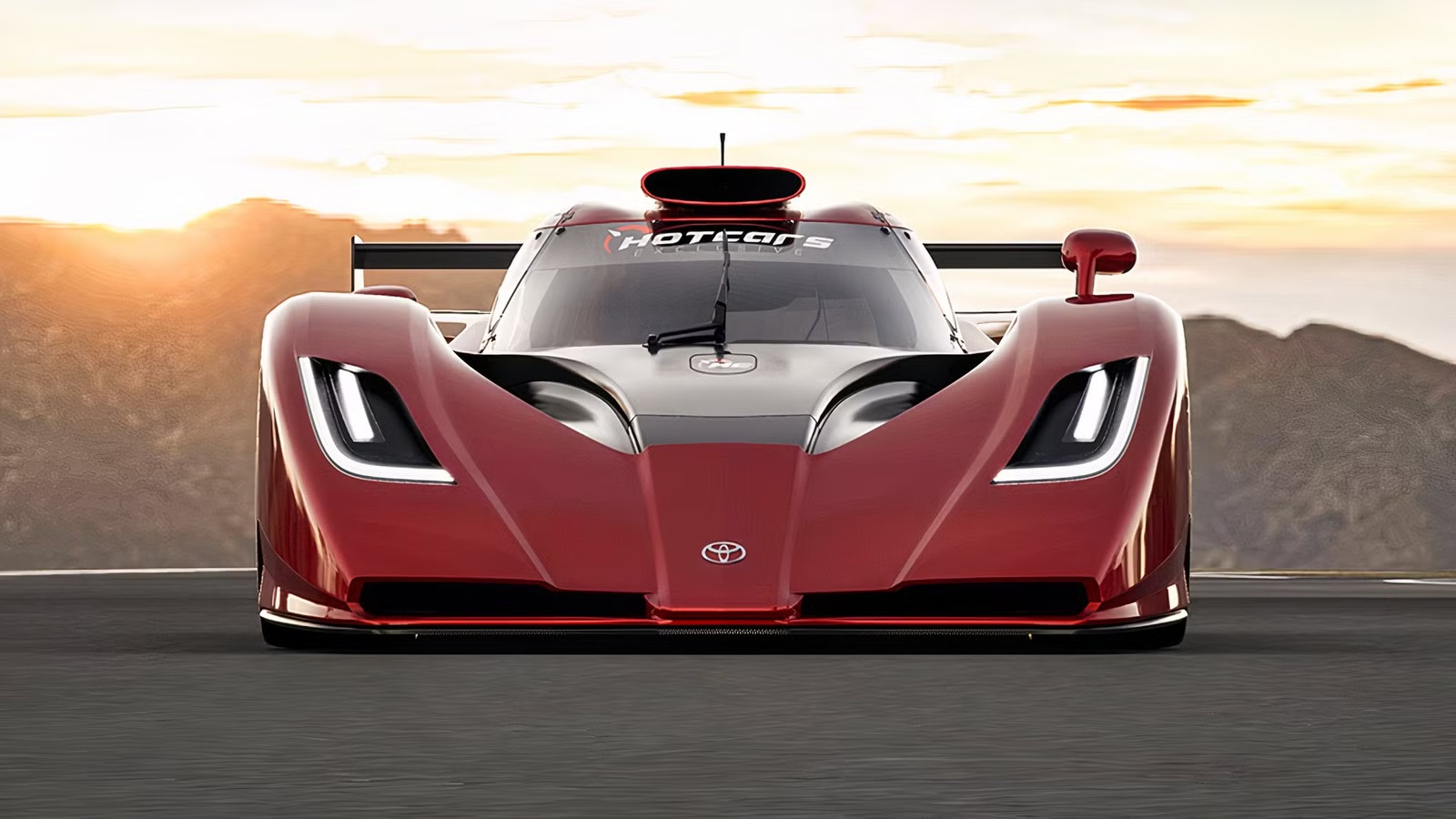
Toyota built a Le Mans contender so extreme that its supposed luggage compartment was effectively a fuel tank. Sadly, it never won, but it became one of Toyota’s most memorable machines. Now, our 2028 Toyota GT-One render hurls that unfinished business into the future, complete with a fighter-jet cockpit and a rear wing big enough to consider a viable alternative to a dinner table.
Toyota’s 1998 GT-One Was A Racing Loophole With 600 HP

The original Toyota GT-One, internally designated TS020, arrived for the 1998 24 Hours of Le Mans. Developed in Cologne under André de Cortanze, it was designed digitally and refined in a wind tunnel. Its carbon-fiber monocoque housed a mid-mounted, twin-turbocharged 3.6-liter V8 producing around 600 horsepower and 479 lb-ft of torque. A six-speed sequential gearbox drove the rear wheels, while the bodywork treated airflow with the seriousness most Toyotas reserve for reliability.
It was blisteringly fast, as you’d imagine, though Le Mans refused to cooperate. Toyota led in 1998, but mechanical trouble and accidents left its sole finisher ninth. In 1999, an improved GT-One claimed pole position, but two cars retired and a puncture in the closing hour derailed the remaining machine’s challenge. Ukyo Katayama, Toshio Suzuki, and Keiichi Tsuchiya finished second behind BMW. Two attempts, no victory, and enough frustration to power a small town.
The stranger story involves the road-going GT-One built to satisfy period GT1 homologation rules. Toyota barely civilized the racer with catalytic converters, interior trim, and higher suspension. The luggage space requirement produced an inspired interpretation: the fuel tank could theoretically accommodate a suitcase when empty. Imagine explaining that to a valet.

Our 2028 Toyota GT-One Render Doubles Down On The Aerodynamics
Our digital 2028 Toyota GT-One refuses to soften that peculiar DNA. The pointed nose sinks between dramatically raised front fenders, while crisp white LED signatures trace the headlight openings. A dark center section runs from the windshield toward the nose, making the red body panels appear even more sculpted. It looks like a modern endurance racer that accidentally took the exit toward the public highway, then decided there wasn’t any harm in keeping it going.
From the side, the render’s relationship to the 1998 Toyota GT-One becomes even clearer. The cockpit sits low and forward, the roof-mounted air scoop rises above it, and deep channels carve into the body behind the doors. Bronze multi-spoke wheels contrast with the red finish. There’s also an enormous amount of exposed-looking aerodynamic hardware, although it’s hard to tell whether any of it would generate useful downforce.
Backing It In

The back’s this writer’s best part. A full-width red lighting signature outlines twin vented sections, while an enormous rear wing stands over a deep diffuser. The center-mounted Toyota badge is almost comically polite considering the rest of the car looks prepared to inhale a passing Chevrolet Corvette. Those elements echo the original’s obsession with managing airflow rather than decorating the body with random vents.
Of course, spectacle brings consequences. Those swollen fenders would make judging the corners on a narrow road a challenge (to say the least), and the huge wing could obliterate rearward visibility. The front splitter also seems well-positioned to have a lengthy chat with every speed bump in America. Obviously, a production version would need aero testing, crash protection, cooling, and suspension travel. Still, sanding away every outrageous detail would defeat the entire point of resurrecting Toyota’s most unapologetic racing silhouette.
A Modern Twin-Turbo V8 Could Make This Toyota Supercar Irresistible

This render’s a clean slate, and that means no confirmed engine specs. But a spiritual successor deserves more than an impressive desktop wallpaper, no? A mid-mounted twin-turbo V8 making 750 to 850 horsepower sounds about right. Combined with a lightweight carbon fiber chassis, such a setup could deliver the mad acceleration its appearance practically demands.
There’s a compelling case for retaining the original’s mechanical personality, too. The 1998 Toyota GT-One weighed roughly 2,000 pounds in racing trim, a number modern road safety equipment would make extremely difficult to repeat. Rather than chase an unrealistic weight figure, a new interpretation could prioritize low mass, responsive steering, effective cooling, and brakes capable of repeated hard laps. A quick-shifting transmission would suit the Le Mans theme, though a road car could spare its owner the original racer’s God-awesome mechanical soundtrack.
Audacious Fantasy

A hybrid-assisted powertrain is another possibility, especially given Toyota’s long experience with electrified endurance racers. Electric torque could help a smaller combustion engine deliver astonishing performance, but batteries, cooling hardware, and extra mass would complicate the lightweight brief. The cabin would need supportive seats, usable controls, and enough visibility to avoid needing a pit crew for a coffee run.
Toyota clearly hasn’t forgotten the GT-One. Its 2025 GR010 Hybrid Le Mans entry wore a red-and-white tribute livery recalling the TS020, proof that the original still matters decades after its final race. This 2028 Toyota GT-One render suggests a more audacious tribute: a street-going machine that puts its outrageous engineering in private hands. It’s a fantasy, obviously, but the company that once argued an empty fuel tank counted as luggage space has already shown how creative it can be when racing rules get in the way.

Related posts






Latest Post



No Comments