
Ford Stuffed A Compact Car’s 65-HP V-4 Behind The Driver Of Its First Mustang
Remember when some nefarious force went out of their way to leak the GTA VI pre-alpha a few years ago, and everyone and their mother lost their mind about it? Well, what do you think would happen if the devs themselves were the ones behind the leak, and on purpose at that? Well, it’s not apples-to-apples, but back in 1962, Ford did something very similar with what would become its flagship sports car. Crazier still, Ford’s impromptu pre-alpha sports car bore almost no resemblance whatsoever to how it would look upon production just a few short years later.
Ford in the Early ‘60s: A Well-Oiled Machine Run by a Quasi Tyrant

Let’s paint the scene for you. In 1960, Ford was an absolute monarchy ruled for the most part by one of Edsel Ford’s sons, Henry II. Henry II borrowed many things from his father and grandfather: a volatile, mildly autocratic management style that demanded results, yet he was reformed enough to fire his father’s chief enforcer and primary union buster Harry Bennett upon his ascension to the company. Still, Henry II had enforcers of his own, just not ones who operated through a reign of terror.
Suspect number one? That would be Lee Iacocca, the newly minted vice president and general manager of the Ford Division. Meanwhile, his foil was Ford’s President and future US Secretary of Defense, Robert McNamara. As for the future flagship Ford, Iacocca and McNamara had two very different ideas for the path forward before McNamara left for the Pentagon. McNamara’s vision involved a reserved, downright modest design called the Cardinal. Closer to a VW Beetle than a real sports car, this philosophy clashed with Iacocca’s vision.

McNamara was gone by early 1961, leaving Iacocca to throw the wimpy Cardinal in the wood chipper to focus on his own idea of the next big Ford. In the early days of clandestine meetings, Iacocca and his team realized that petitioning the boardroom for a large investment after the costly failure of the Edsel program was only going to make Henry II want to fire them. And so, his team bypassed the top brass entirely, designing a concept car in complete secrecy and leaking it to the public so Henry II could only sit back and watch in amazement. The plan was as brilliant as it was reckless, and it had a truly novel engine at its heart.
A V4 Engine? Not as Crazy as it Sounds


To execute this audacious maneuver, Lee Iacocca’s team had to move fast and use whatever corporate cast-offs Ford had lying around. . It featured a tubular steel frame mounted to a hand-formed aluminum body with four-wheel independent suspension and front disc brakes, weighing in at a feathery 1,500-ish pounds.
Yet, the real intrigue was to be found underneath the hatch behind the cockpit. Instead of a V8, Lee Iacocca’s team scavenged a liquid-cooled 1.5-liter V4 engine straight out of McNamara’s exiled Cardinal economy project. Not an inline-four, nope, four cylinders in a ‘V’ formation, half a V8, a legit V4. Originally intended to produce somewhere in the ballpark of 65 hp, Iacocca’s team modified this V4 with dual Weber carburetors and a more aggressive camshaft profile to make 109 hp, paired to a four-speed manual transaxle.
The resulting car had an angular, aerodynamic body shell with pop-up headlights and a low-slung silhouette just begging to be flung around a track. That’s exactly where this eccentric Ford prototype made its debut, at New York’s Watkins Glen International Raceway in time for the 1962 US Grand Prix. With none other than Dan Gurney and Stirling Moss in attendance, Iacocca’s team was primed to impress.
The Ford Mustang I: Absolutely Nothing Like the Production Car

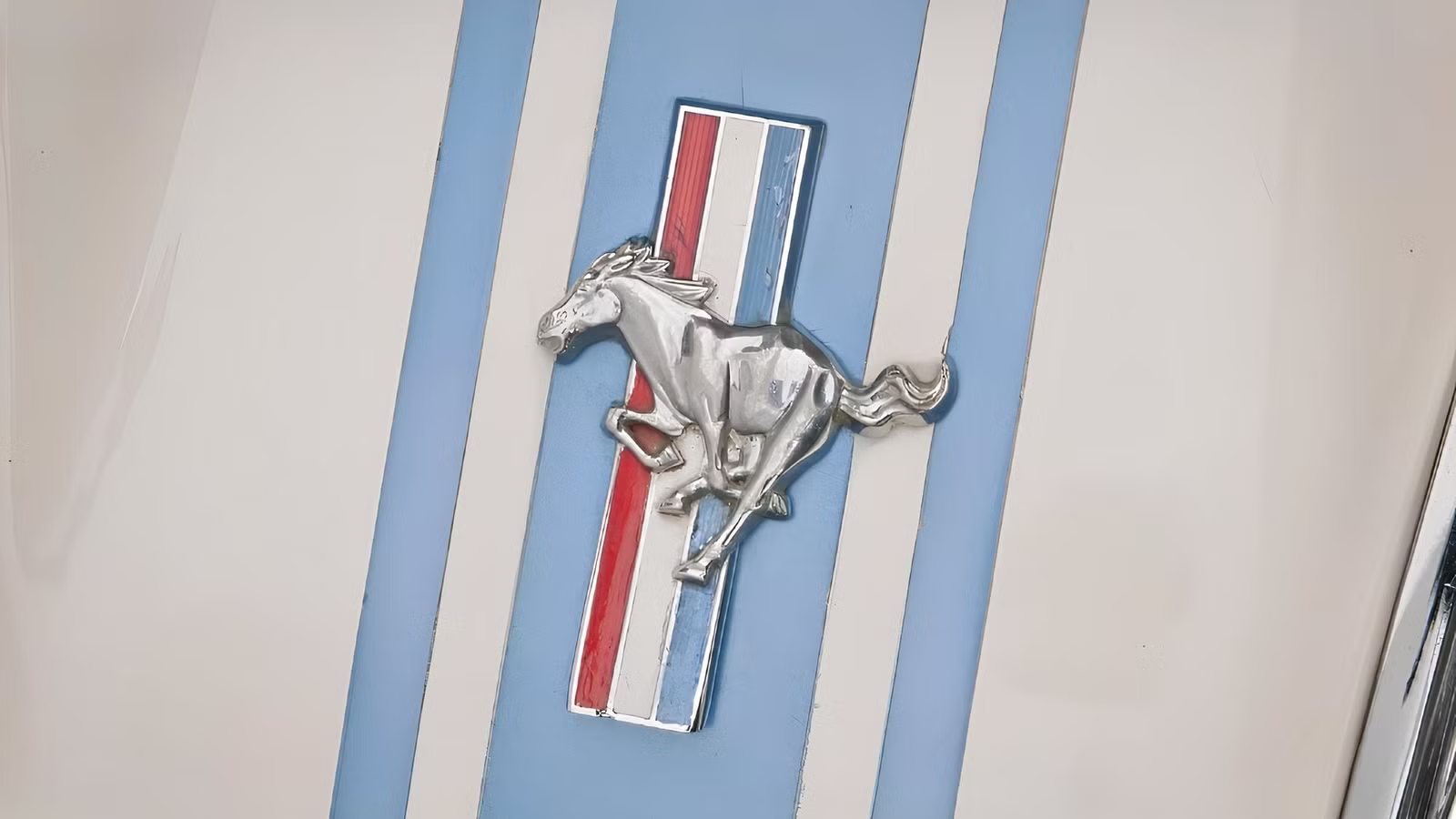
When Gurney took the wheel and pushed the featherweight roadster to an estimated 118 mph on the track, he proved that Ford’s rogue engineers had actually built a legit Euro-style sports car hunter. Still, perhaps the biggest shock to the automotive world wasn’t the speed or the radical engineering; it was the emblem slapped on the nose. This bizarre, mid-engine track toy was dubbed the Ford Mustang I, the very first vehicle in history to wear the iconic galloping horse.
While one might have expected Henry II to be seething with rage at the sight of a V4 sports car he himself didn’t greenlight, the man had already given the thumbs-up to a completely different, more conventional Ford sports car based on the American version of the Falcon platform. That was a full month before the whole V4 Watkins Glen stunt took place, by the way, making the Mustang I prototype a little bit redundant in the end. With that said, it was certainly a marketing masterclass, one we can’t help but think even Henry II would’ve had a hard time getting mad at.
In the end, only one running and driving Mustang I prototype was ever built, and it survives today on permanent display at The Henry Ford Museum in Dearborn, Michigan.
The Hardware That Survives

While America got the legendary V8-powered pony car of its dreams, McNamara’s little cast-off quietly went on to mobilize an entire continent. Not bad for an engine that was supposedly destined for the corporate wood chipper. It just goes to show that failed prototypes aren’t always failures in the long run. Their basic components have a funny way of escaping the corporate chopping block, sneaking out the back door, and reshaping the automotive landscape halfway across the world while everyone stateside has already stopped looking.
So, the next time you see a 1964.5 Mustang at your local concours show, just understand how much corporate tomfoolery went into its creation. By the standards of the condensed history we’re all spoon-fed, it’s a lot more entertaining. In a way, the Mustang GTD quasi-mid-engine monster owes everything to the Mustang I, because it helped form a similar blueprint roughly 60 years earlier.
Source: The Henry Ford Museum

Related posts




Latest Post



No Comments