
This Suzuki Feels More Refined Than You’d Ever Expect
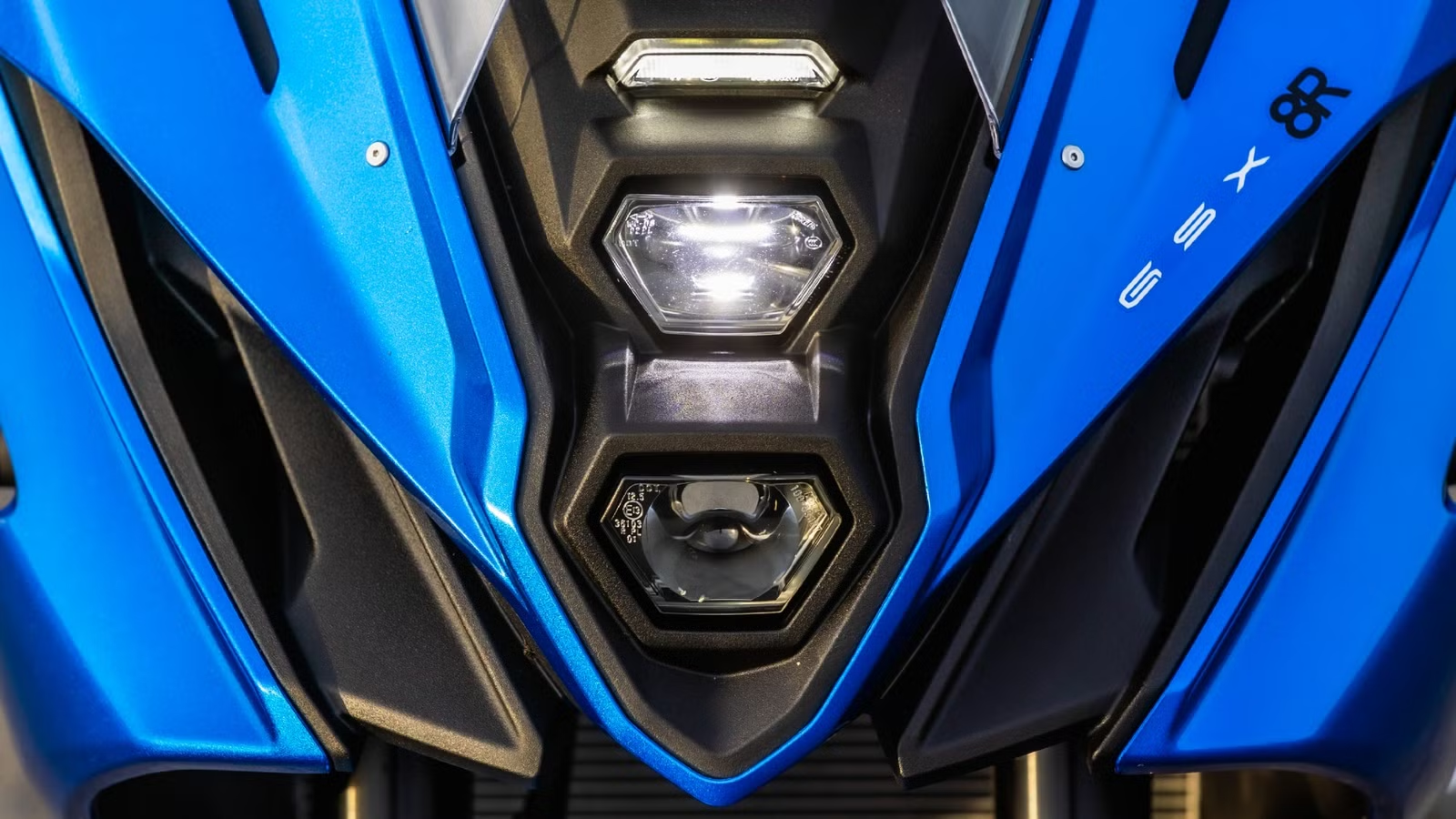
Middleweight sport bikes have become one of the most interesting corners of the motorcycle market because manufacturers are chasing very different definitions of the same thing. Some prioritize aggression and track-inspired character, while others lean toward everyday usability. The tricky part is finding a bike that delivers genuine performance without making refinement seem like an afterthought. It’s not impossible, though, as proven by a certain Suzuki GSX machine with a new parallel-twin engine.
Twin-Cylinder Middleweight Sport Bikes Usually Make You Pick A Side

Take two of the most familiar Japanese options. The Yamaha R7 puts performance first with a committed riding position, a relatively light 417-pound wet weight, and a lively 689cc CP2 twin. The Kawasaki Ninja 650 goes the other way, pairing its 649cc twin with friendlier ergonomics and 67 horsepower. Both approaches work, but they’re reminders that sportiness and everyday polish don’t always arrive in equal proportions.
That divide matters because a middleweight is often expected to do far more than its appearance suggests. It might spend Saturday chasing corners, then commute through traffic on Monday morning. Making a motorcycle sharp enough to entertain without becoming tiring is harder than simply bolting fairings onto a naked bike or detuning something racier. The engine, chassis, electronics, ergonomics, and controls all need to cooperate.
Performance And Refinement Don’t Always Arrive Together

Parallel-twins make sense here because they’re narrow, compact, relatively inexpensive to manufacture, and capable of producing excellent torque. The catch is vibration. A twin pushing serious performance can become increasingly coarse as the revs climb, and that vibration eventually finds its way into the handlebars, foot pegs, mirrors, and seat. Peak horsepower tells you how fast an engine can be. It doesn’t tell you whether you’ll enjoy sitting behind it for three hours.

A 270-degree crank can give a parallel-twin more character and a delivery reminiscent of a V-twin, but refinement still requires careful engineering. Balancing, throttle calibration, fueling, transmission behavior, and even cooling strategy all contribute to how sophisticated an engine seems from the saddle. That’s especially important when the motor itself is new rather than a design that’s benefited from 15 years of incremental improvements.
Suzuki Has Always Thrived In The Middleweight Segment

Suzuki knows this territory better than most. The SV650 arrived in 1999 and spent decades proving a middleweight didn’t need outrageous specifications to become genuinely beloved. Its 645cc V-twin was flexible, friendly, characterful, and useful enough for everything from commuting to track days. The SV built its reputation by getting the fundamentals right, which is probably why Suzuki kept it around for so long.
But Suzuki eventually needed something newer. The next-generation naked streetfighter GSX-8S arrived for 2023 with a clean-sheet 776cc parallel-twin, replacing the familiar V-twin formula with a 270-degree crank and an entirely new platform. That same architecture has since spread into multiple Suzuki models, but arguably its most interesting application is the one wrapped in bodywork and aimed directly at riders who want a sport bike without the usual compromises.
The Suzuki GSX-8R Is An Underrated Middleweight Sport Bike

That bike is the Suzuki GSX-8R, and its current MSRP is $9,699, excluding Suzuki’s $700 destination charge. Underneath the full fairing sits a liquid-cooled 776cc DOHC parallel-twin with an 84.0mm bore, 70.0mm stroke, 12.8:1 compression ratio, electronic fuel injection, a 270-degree crank, six-speed transmission, and chain final drive. It’s essentially Suzuki’s modern middleweight platform sharpened for road-focused sport riding.
Suzuki claims 82 horsepower at 8,500 rpm and 57.5 pound-feet at 6,800 rpm. That puts it among the healthier Japanese parallel-twins in this part of the market. More importantly, the engine doesn’t need to be thrashed to become interesting. There’s meaningful torque through the middle of the rev range, followed by enough top-end enthusiasm to remind you there’s an R on the fairing.
And despite the relatively fresh engine architecture, nothing about the package comes across as experimental. Suzuki backs the six-speed gearbox with its Clutch Assist System, which combines assist and slipper functions, while a bi-directional quickshifter comes standard. Even the cooling system uses an inlet-control thermostat valve designed to stabilize engine temperature and smooth idle behavior during warm-up. There’s a surprising amount of detail hiding behind what looks like a fairly straightforward twin.
Suzuki’s Cross Balancer Is Doing A Lot Of Heavy Lifting

The clever bit is Suzuki’s patented Cross Balancer. Instead of treating vibration as something riders simply have to tolerate, Suzuki developed a biaxial primary balancer arrangement that positions two balancers at 90 degrees to the crankshaft. Suzuki says the system was used for the first time on a production motorcycle with this engine, and its compact layout helps keep the motor narrow while canceling much of the unwanted vibration produced by the parallel-twin.
That’s a big reason the engine comes across as more mature than its age suggests. The 270-degree firing order can still provide the pulse and character riders want from this configuration without forcing the bars and pegs to buzz incessantly at cruising speeds. It lets the rider use more of the rev range without refinement falling apart near the top, which is exactly the sort of polish that separates a good middleweight engine from one that merely produces respectable numbers.
It’s Smooth, But Suzuki Didn’t Forget The Horsepower
Smoothness would’ve meant very little if Suzuki had achieved it by making the engine dull. Instead, the GSX-8R occupies an interesting space between familiar rivals. The R7 is more overtly focused and puts greater emphasis on the rider’s connection to the chassis, while the Ninja 650 is an easygoing road bike wearing sporty clothes. The Suzuki manages to sit somewhere in between, but brings considerably newer engine and electronics architecture to the argument.
That balance is reinforced by the bike’s dimensions. It has a 57.7-inch wheelbase, 31.9-inch seat height, 5.7 inches of ground clearance, and a 3.7-gallon tank. At 452 pounds, it isn’t exceptionally light, especially beside an R7, but Suzuki hasn’t tried to disguise the GSX-8R as a minimalist track weapon. It’s built to provide stability, comfort, and genuine road usefulness while still having enough chassis capability to reward a rider when the pace picks up.
The Chassis Matches The Engine’s Grown-Up Personality

Up front is a 41mm Showa SFF-BP inverted fork with 5.1 inches of travel, paired with a link-type Showa rear shock and aluminum swingarm. Braking comes from radial-mount four-piston Nissin calipers biting twin 310mm front discs, backed by ABS, while a single-piston Nissin caliper handles the rear. The 17-inch wheels wear 120/70ZR17 front and 180/55ZR17 rear tires, giving the bike properly substantial middleweight rubber.
Then there’s the electronics. Ride-by-wire feeds two 42mm throttle bodies and enables Suzuki’s three-mode Drive Mode Selector. The traction control system has three intervention levels plus an off setting, while Easy Start and Low RPM Assist handle the less glamorous parts of everyday riding. A five-inch color TFT, full LED lighting, and that standard up-and-down quickshifter round out a package that doesn’t require an options catalog to seem modern.
The GSX-8R Might Be Suzuki’s New Middleweight Benchmark

That’s ultimately what makes the GSX-8R stand out. Its refinement doesn’t come at the expense of character, and its performance doesn’t demand supersport levels of commitment. It’s smooth enough for highway miles, tractable enough for traffic, and powerful enough to make a winding road genuinely entertaining. The full fairing even gets wind-tunnel-developed aerodynamics, giving the rider useful wind protection without turning the bike into a sport tourer.
Suzuki spent decades building its reputation around screaming GSX-R inline-fours and charismatic V-twins like the SV650s. Yet one of the company’s most convincing modern engines is now a 776cc parallel-twin using a balancer system that barely gets mentioned outside technical discussions. That’s the GSX-8R’s biggest surprise. It doesn’t need decades of evolution to seem mature. Suzuki engineered the maturity into it from the beginning.
Source: Suzuki Cycles

Related posts




Latest Post


No Comments