
The Forgotten Harley-Davidson That’s Still One Of The Brand’s Best
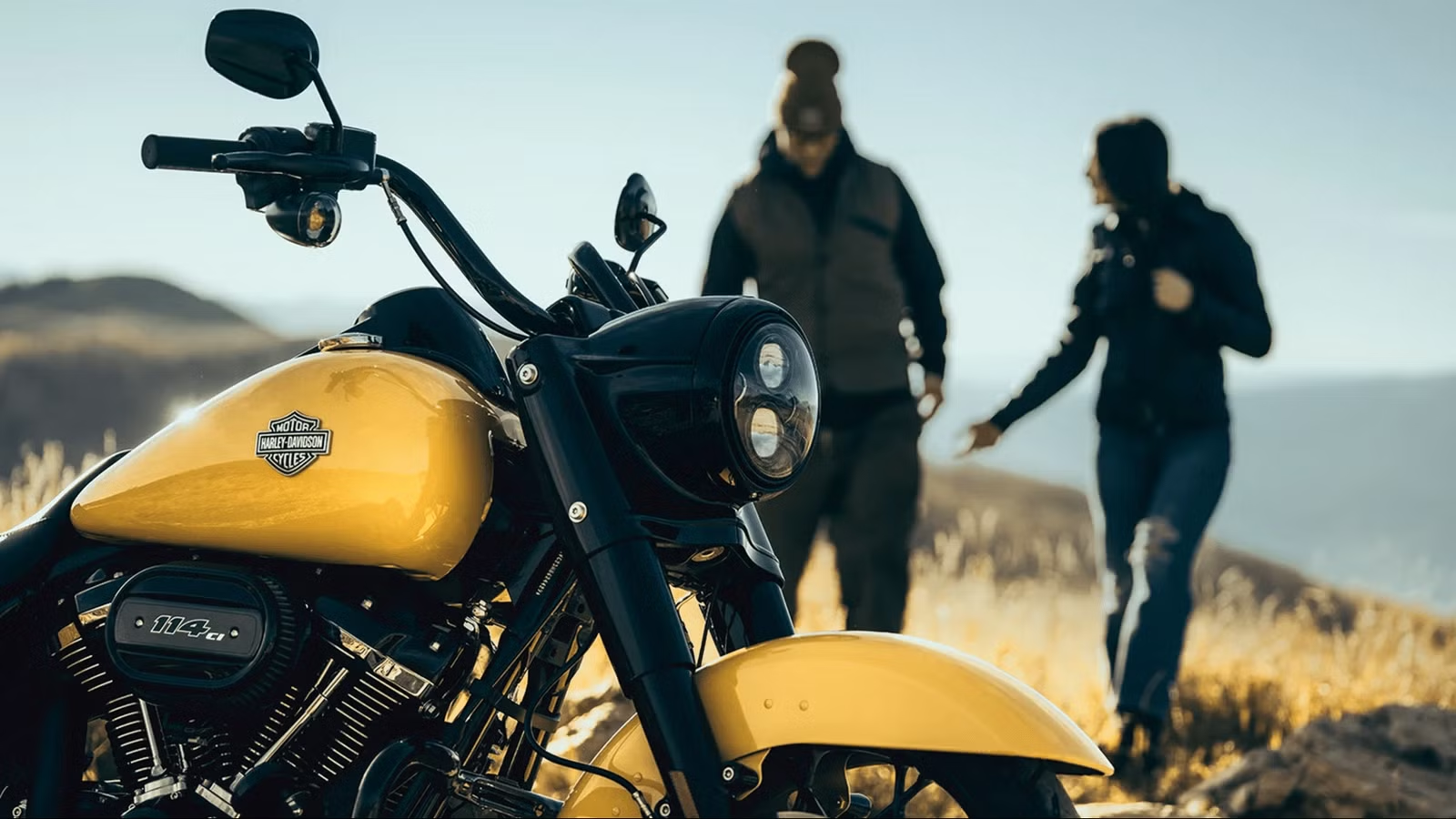
In recent years, Harley-Davidson has practically upturned its touring lineup. Gone are the old Milwaukee-Eight 114 models, replaced by new-age machines with more tech and bigger engines. Between these headlines, it is easy to forget some of the previously popular models. And that’s exactly what has happened to the bagger we’re going to talk about here. This used to be the entry point into the Grand American Touring range, but it’s now bowed out rather quietly.
Harley’s Touring Family Has Become An Infotainment Arms War

Look at Harley’s current Grand American Touring range, and the pattern is obvious. The Street Glide and Road Glide both wear frame-mounted fairings shaped by computational fluid dynamics, both run the 12.3-inch Skyline OS touchscreen, and both serve as the platform for Harley’s most expensive CVO builds, priced well north of $44,000. The Street Glide Ultra and Road Glide Limited pile on even more: premium audio, additional rider aids, full-dress luggage.
But A Simpler Grand American Tourer Used To Exist

Somewhere in that roster, we forgot a bike that carried the same Grand American Touring badge, the same touring-grade chassis, and a price tag lower than every one of its stablemates. It didn’t have a fairing to shape with CFD software, and it doesn’t have a screen to update. What it did get you is a simple, no-frills touring experience none of its peers could offer.
The Harley-Davidson Road King Is Forgotten Yet Stands Out As A Timeless Purebred
Base Price: $24,999 (MY2025)


That bike is the Harley-Davidson Road King Special, a direct descendant of the original 1994 Road King — the model that essentially invented Harley’s modern touring formula on a Big Twin cruiser. Three decades later, the formula didn’t change much. The company described it as a modern interpretation of earlier machines, combining cues from the pared-back 1988 Electra Glide Sport, the front fender of the 1965 Electra Glide, and the classic paint treatments associated with the 1958 Duo Glide.
Although not updated for MY2026, some 2025 Road King Special units remain available through dealers even as Harley’s current touring pages push the Street Glide and Road Glide’s latest updates, which makes it something increasingly rare in Harley’s own lineup: a bike still being sold on mechanical character rather than a spec sheet of electronics. At $24,999, it is at par with the Street Glide and undercuts the Road Glide by $1,000. So the value proposition is lower here, but the stripped-back experience is higher.
Retro Design Meets Contemporary Styling

Coming to the deets, the Road King Special leans hard into its post-war touring roots. Blacked-out engine covers and fork skirts contrast against stretched hard saddlebags that flow into a two-into-two blacked-out exhaust, and the whole thing is topped off by a low, sleek headlamp nacelle. Mini-ape handlebars put the rider in an upright, commanding stance, while a tank-mounted, analog-style gauge keeps the cockpit clean instead of cluttering it with a screen.
None of that reads as “old” so much as it reads as deliberate. Strip away the fairing, the windshield, and the infotainment stack that define its stablemates, and what’s left is one of the most cohesively styled big-twin tourers Harley has ever built — proof that a touring motorcycle doesn’t need a dashboard to feel complete.
The Milwaukee-Eight 114 Prioritizes Torque Over Bragging Rights

The Road King Special has the 1,868cc Milwaukee-Eight 114, which makes 95 horsepower at 5,020 rpm and 122 lb-ft of torque at just 2,750 rpm. Yes, these are smaller numbers than the 117’s 105 horsepower and 130 lb-ft, but the torque peak arrives 500 rpm earlier in the rev range. In practice, that means the Road King Special pulls hard right off idle. This engine is also more proven over the years than the recent Milwaukee-Eight 117 trims.
Simple Tech Means Full Control For You

The absence of a TFT display does not make the Road King entirely mechanical, but it does remove one of the most visible and potentially expensive electronic assemblies found on modern touring motorcycles. That said, there are still meaningful safety systems in place. The MY2025 Road King Special includes ABS and electronic linked braking, while Harley offers additional cornering rider-safety features, vehicle hold control, and tire pressure monitoring as optional equipment.
Why It Handles Better Than You Remember

Fairings aren’t just about wind protection — they’re weight, hung out at the front of the bike, right where it matters most for steering. The Street Glide’s fork-mounted Batwing fairing and the Road Glide’s frame-mounted Sharknose both add mass that the handlebars, or the chassis, have to manage every time the bike changes direction. The Road King Special carries none of that.
With nothing but a small headlamp nacelle up front, steering effort drops noticeably at parking-lot speeds, and the view forward is completely unobstructed — no fairing edge, no windshield line, just open road. Paired with wide floorboards and those upright mini-ape handlebars, the riding position feels less like a dedicated touring bike and more like a big, comfortable standard, with genuinely accommodating passenger space for when it’s time to two-up.
Touring Chassis, Brembo Braking, And Adjustable Suspension

Underneath the retro sheet metal, the Road King Special rides on the same stiffened touring frame Harley introduced across its Big Twin lineup back in 2009, paired with 49mm Dual Bending Valve forks and Brembo brakes comprising dual floating rotors up front and a single fixed rotor out back — squeezed by 32mm four-piston calipers. The rear suspension is hand-adjustable for preload rather than air-adjustable, but it still lets riders dial in support for a passenger and luggage without needing tools. None of it is flashy, yet all of it works, which is arguably the entire ethos of this bike in one sentence.
Dual Personality On Demand

The Road King Special was sold without a windshield. That gave it a cleaner boulevard-cruiser appearance, but it also exposed the rider to considerably more wind pressure. Harley-Davidson thus offered detachable windshields and quick-release mounting hardware for compatible Road King models. Properly equipped, the Special can therefore gain much of the standard Road King’s dual-purpose character: wind protection for a long trip, followed by a stripped-down appearance after the screen is removed. That flexibility is something a fixed-fairing Street Glide or Road Glide cannot replicate.
The Road King Special lets the rider decide what kind of machine it should be. Add a windshield, pack the saddlebags, and it becomes a capable long-distance cruiser. Remove the screen and luggage, and it returns to being one of the cleanest factory baggers Harley has produced. That adaptability is ultimately why the forgotten Road King still matters. It may lack the horsepower, displays, speakers, and headline technology of Harley-Davidson’s latest touring motorcycles, but it preserves something increasingly rare: the sensation of riding a big American V-twin without a wall of hardware between the rider and the road.
Source: Harley-Davidson

Related posts




Latest Post


No Comments