
The Lifted VW Hatchback Built By The Same Factory That Made The G-Wagon
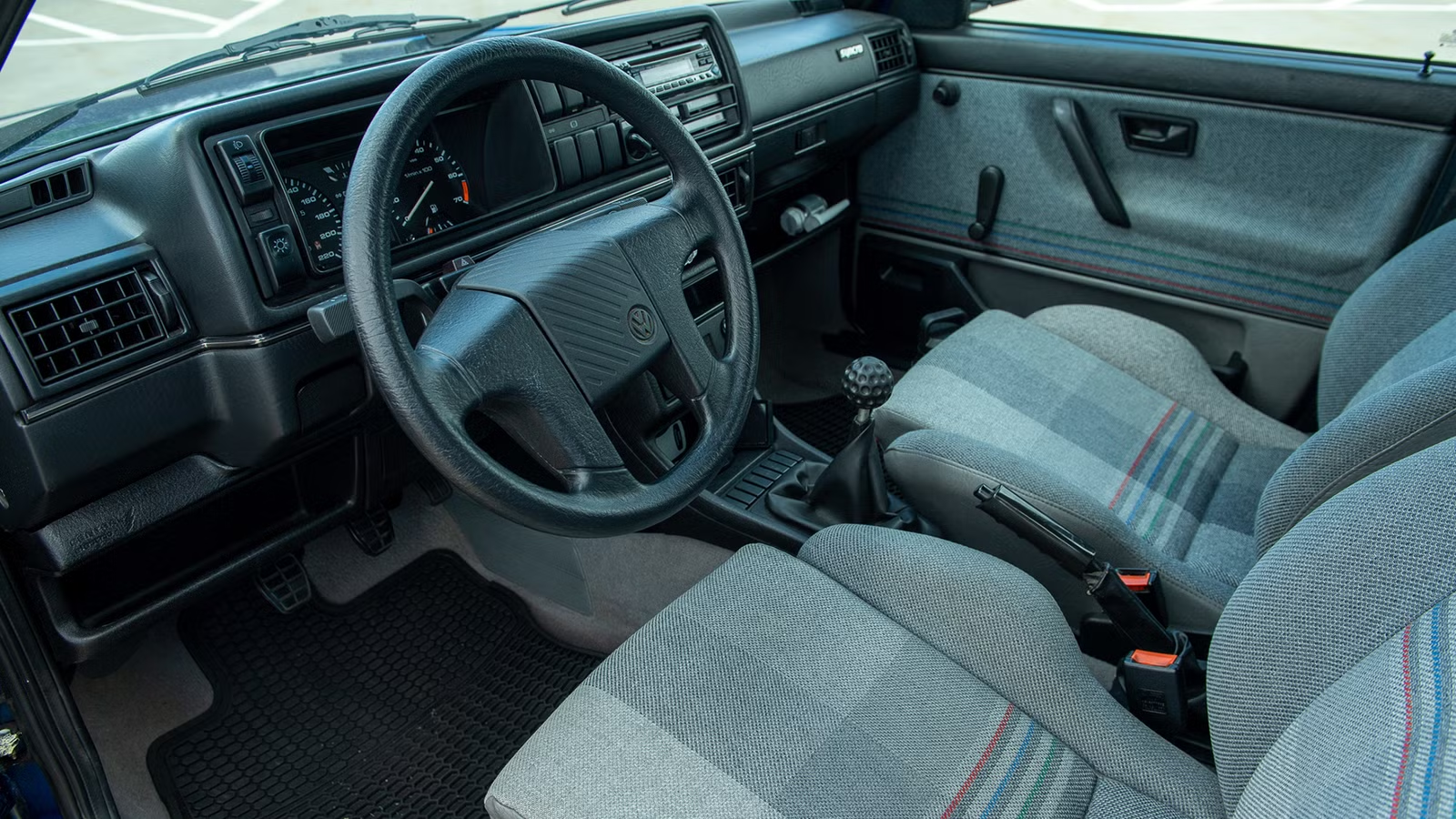
The popularity of the modern crossover hardly needs an introduction, and it’s hard to remember a time when they didn’t dominate the roads. But as popular as they are today, there was a time when they didn’t exist. In the 1990s, there was one car that could well have started the crossover craze, and which had all the elements of a successful car today, but which failed to make an impression despite doing everything right.
Drivers Weren’t Ready For The Crossover

The crossover today is as ubiquitous as Starbucks and air conditioning. Seemingly every manufacturer has made one, and a whole lot of people drive one. As frustrating as it is seeing these part-car, part-SUVs driving around and clogging up the roads, it does make sense why someone would have one; they’re high enough to see more, feel slightly safer due to their larger size, and yet still have the comfort of a normal passenger car. But while they might be outstandingly common today, it wasn’t always that way.
Cars used to be designed for the roads they’d use, with daily drivers made for paved roads, commuting, and family transport, while those who wanted something they could genuinely take off-road (not just those who like the look) were rugged, durable, and, often, utilitarian. The middle ground existed, but it was still niche rather than mainstream and people bought a car that suited their needs.
This purpose-driven design also followed in a car’s marketing. Off-road capability was a serious utility feature rather than a choice on a spec sheet, as the idea that a vehicle could be both economical and 12 yards long, two lanes wide, and 65 tons of American pride wasn’t yet a reality. But before the modern crossover market proved that consumers wanted all that in a vehicle, some cars had to test the waters.

When Off-Road Capability Meant More Than Looking Tough

Form usually follows function for off-roaders. Vehicles designed for genuine hard work would have things like four-wheel-drive, durable suspension, generous ground clearance, and underbody protection not as stylish motifs, but to make sure they could do the job with which they were tasked. If a vehicle had these features, it was because it was going to need them. But as automakers started to discover the appeal of a pavement-based vehicle that looked like it was just as capable as a 4×4, designs started to change.
Rugged styling became a way to make regular cars look more adventurous, creating a divide between regular cars and something specifically engineered for difficult terrain. This was important, as making a car that is legitimately capable off-road is difficult, but throwing some plastic cladding and chunky bumpers onto an existing vehicle was relatively easy. If the driver never intended to take their car off-road but merely wanted to emulate the look, that was something automakers could not only do, but were more than happy to sell them.
We can see it today with the sheer volume of crossovers that don’t do anything more demanding than scaling the odd speed bump or curb. But before ruggedness became a bandwagon to jump on, one unusual car showed just how far an automaker could go when simply looking capable wasn’t enough.
Meet The Volkswagen Golf Country: The G-Wagen Factory-Built Crossover

Those who know the Volkswagen Golf know that it’s not exactly a prime candidate for off-roading. From its first introduction back in 1974, the Golf has always been a plucky little hatchback aimed at getting you around economically and easily — it was intended to replace the Beetle, after all. It wasn’t until 12 years after the car’s introduction that the first four-wheel-drive version, the Golf Syncro, was released, though even this was primarily front-wheel-drive to save on fuel. But it would be another five years before the 4×4 hardware and the idea of making it capable off-road were combined into a concept, with the Volkswagen Montana concept unveiled at the 1989 Geneva Motor Show.
The Montana was an off-road Mk2 Golf that featured a lifted suspension, syncro all-wheel-drive, bull bars, and a rear-mounted spare tire. Intended to be a test of customer interest, the response to the Montana was so strong that customers reportedly went into VW dealerships to order one before the dealerships had even heard of the concept. Another showing at the 1989 Frankfurt Motor Show sealed the deal, and the car went into production. But making a proper production car is far more complicated than simply adding some springs and calling it a concept, so VW turned to Steyr-Daimler-Puch in Graz, Austria, to help.
The manufacturing facility had already helped to produce the G-Wagen from 1979, so it had history in creating off-road vehicles. The partnership worked by VW sending finished Golf Syncros to the plant, where the car was extensively modified with a tubular subframe, revised suspension components, skid plates, suspension raised by 120mm (4.7″) for an additional 63mm (2.4″) of clearance, and everything else needed to make a hatchback into an off-roader. In all, 438 unique parts were added during the process, as Steyr-Daimler-Puch gave the car the G-Wagen treatment. It was still a Golf, but now it was a Golf for the country — not the country club.

Production lasted just a year and a half, between April 1990 and October 1991, with 7,735 examples being made. That makes it a somewhat limited edition already, but there were some even rarer models, like the Chrome Edition (558 cars) and the exceptionally rare Wolfsburg Edition, which used the more powerful 16-valve GTI engine and which accounted for just 50 vehicles sold to factory employees. But for all the pre-sale furor, and the obvious market for them today, the car wasn’t especially successful.
The Market Rejected It, Then Spent Decades Proving Its Formula

While the car itself was good, it had one major problem: people just didn’t know why they’d need one. The market at the time was still very much segmented into buying vehicles for purpose, and if you were going to be going off-roading, you likely wanted something custom-built for the job rather than a commuter that had parts added or raised to make it suitable.
It made for a car that sat in an awkward middle ground. At 18,820 Deutsch Marks (equivalent to around $11,600 at the time) for a base Golf in 1990, or 33,225 Deutsch Marks (equivalent to around $20,600 at the time) for the Golf Country, it was an option that was not only far more expensive, but which didn’t have the size or image of a traditional 4×4. This made it difficult to justify for buyers who didn’t specifically need its extra capability.
The irony of the Golf Country is that while it was a commercial flop at the time, almost everything about its formula would become mainstream. Modern crossovers regularly combine car-like practicality with raised suspension and rugged styling, and the car could well have been a success had it launched slightly later. It just didn’t happen that way.
The Forgotten Crossover That Got Everything Right

The Golf Country’s legacy isn’t that it created the blueprint of the modern crossover. Hardly any were made compared to other Golf models, and it barely made it two years despite its early promise. But while it failed to create an entire segment, it did demonstrate that the crossover formula could work if done right.
The Golf Country didn’t just slap some bull bars on and call itself rugged; it actually had everything it needed to be a competent off-roader. Being finished in the same factory that built the iconic G-Wagen only furthered this, as genuine capability was built into those 438 additional parts, its 120mm suspension lift, and four-wheel-drive system. But it came at a time when people didn’t know they wanted one — it was before its time, arriving before people knew they wanted a car that could cross over.
It remains today a rare, somewhat unknown relic. A failed experiment that has picked up a niche following and which could have been huge had it come later. It didn’t create the crossover, it just understood it long before anyone knew how to sell it.
Sources: Volkswagen, Hemmings, Volkswagen, Hagerty

Related posts



Latest Post


No Comments