
This 111-Year-Old Harley-Davidson Might Be the Ultimate Collectible For Americans
Motorcycles rarely ever cross the $100,000 mark at auctions. Even to get close, the bikes have to be radically iconic and mark an important milestone in motorcycling history. This privilege is only ever experienced by the most iconic models, like the Brough Superior SS100, Harley-Davidson EL Knucklehead, or the Indian Altoona OHV Racer. In a few days, a new member might join the lineup to cross (or at least get close to) the $100k mark. Here’s all you need to know about that bike.
The Types Of Bikes That Collectors Look For

Motorcycle collectors don’t just go out there and pick any random bike they like. There’s quite a bit of thought that goes into narrowing down on a model that would fit the collection. In doing so, collectors usually go for one of three kinds of motorcycles, starting with the good ol’ vintage bikes that changed what motorcycles could be. These are mechanically revolutionary and pioneering bikes, such as the Brough Superior SS100, Vincent Black Shadow, and the original Suzuki GSX-R750.

Then come race-bred machines or technological showcases, including halo bikes and homologation specials. These motorcycles, when new, were essentially tech showcases for the manufacturer, hinting at where motorcycle performance would eventually head in the next era. Some excellent examples include the Honda NR750, the Britten V1000, and the Ducati Desmosedici RR. Note that there is an overlap between this and the earlier category in some cases.

The third kind is the bikes that serious collectors love, but those not in the know may question their decisions. These bikes aren’t anything mechanically revolutionary, or a halo product built by the finest engineers a company can afford. Their importance extends beyond their engineering; they sometimes represent a cultural shift or a crucial period in the company’s history. Think the first-ever Honda Cub, Harley-Davidson WL Liberator, or Royal Enfield Bullet.

The bike in question today belongs to this kind, predating most manufacturers still in business today. The bike is older than BMW Motorrad, Moto Guzzi, Ducati, and the Japanese Big Four. Plus, it represents a transitional period for one of the most prominent manufacturers, standing as the first of a lineup that would go on to define the brand and, by extension, the spirit of American motorcycling culture. Of course, it’s a Harley-Davidson!
1915 J Model Is The First Proper Big Twin By Harley-Davidson

The bike in question is the Harley-Davidson J Model, introduced in 1915. When it came about, Harley had just over a decade of production experience, and yet, it had evolved into one of America’s premier motorcycle manufacturers. This year marked a turning point for the motor company, and it had the broadest lineup to date, with each of the 16 bringing a host of mechanical innovations that helped the company into the modern era. The Model J was one of them, and perhaps the most important one.
The First Mature Harley-Davidson Big Twin

There are a couple of reasons why the J Model is special, starting with its engine. Produced from 1915 to 1929 in Milwaukee, Wisconsin, the J Model was part of the F-head Big Twin, commonly called a pocket-valve Harley. The F-head was an air-cooled 61ci 45-degree V-twin with an inlet-over-exhaust design, producing around 17 horsepower. The engine was mated to a 3-speed sliding-gear manual with hand shift, sending the power to the rear wheel via a chain final drive.

The J Model, as the company’s flagship at the time, sat at the center of the F-head lineup, and it represented the company’s first mature Big Twin powerplant. The J Model carried the motor company from the pioneering, belt-driven age into the relatively modern, 3-speed, chain-driven, and electronically equipped era. It was the first stepping stone for the company, leading to the current crop of Softail Big Twin cruisers.
A Real-World Motorcycle, Not A Limited-Edition Special

Despite being the first of the Big Twins, the J Model wasn’t anything revolutionary, especially in the way the later EL Knucklehead would be. Instead, the bike had a real-world identity that tied it back to the collector’s bike of the third kind, one that represented more than just its engineering. What makes the J Model so important here is that it came at a time when the First World War was just around the corner, police fleet purchasing was on the rise, and electric lighting was the next big thing. It also marked the beginning of American touring expectations.

The J Model was a practical motorcycle, featuring a large V-twin engine, a usable 3-speed gearbox, chain drive, and an expanding electrical specification. Even the chassis was sturdy enough for solo rides, sidecars, deliveries, and the poor roads of the time. As a result, the bike quickly found its way into the hands of civilians, police departments, commercial work, and later, the military during WWI. That identity as a reliable workhorse, among the first of its kind, is part of the J Model’s appeal.
The J Model Is A Working-Class Collector’s Special Today

In the collector’s world, the J Model occupies a nuanced position. It’s not as iconic as the EL Knucklehead or the XR750, but it is the first proper Big Twin. It is also more mechanically open than the later Flathead era and more usable than the earlier pioneering machines. It’s also more historically important as a utility machine. It marked the company’s transition from the primitive motor-bicycle stage to the durable road machine that would define the motor company.

In a way, the Honda Cub and the J Model are iconic for a very similar reason, but acquiring a Cub is as easy as checking your local classifieds. Finding a J Model, however, is a different ballgame. It’s a rare motorcycle today, and given its importance in the shared history of Harley-Davidson and American motorcycling culture, it’s quite in demand. For collectors, pristine-condition models are also a great reference point in understanding pioneering engineering decisions which are often misunderstood in the modern era.
Not Many J Models Survive Today

While they were sold in large numbers at the time, what survives today is a mixture of factory-spec, wartime, and commercial or police models. And a number of them come with a century of restoration or modifications, which may or may not have been carried out correctly. As a result, there is a strong demand for early examples with the correct engine, tank, frame, electrical equipment, and finishes. According to Classic.com, the J Model is valued at around $46,000 today, but such clean examples can go for much higher. The platform has recorded the highest sale, $93,500, for the J Model. That top sale number might change depending on what’s on sale right now.
A Concours-Condition 1915 J Model Is Up For Grabs

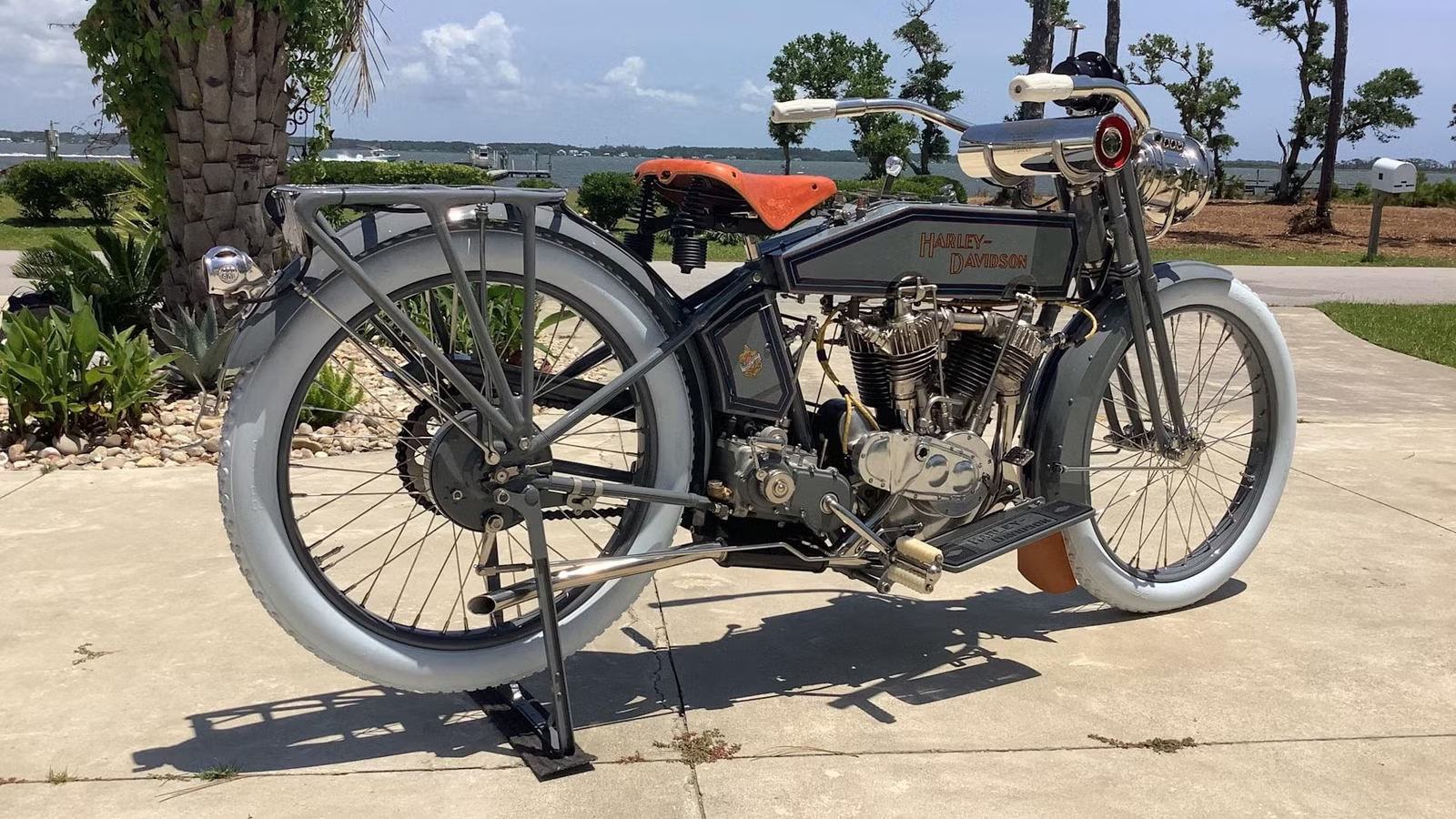
Mecum Auctions has listed a concours-condition 1915 Harley-Davidson J Model that will cross the block on August 15, 2026, at the Monterey 2026 auction. It’s an early production motorcycle, with the engine number 4597K and matching engine-case belly number X678, and given the bike’s condition and period-correct finish, Mecum is expecting the bike to change hands for $80k to $100k, making it one of the, if not the most, expensive examples of the J Model.

This particular model demands such a high price because it’s one of the finest representations of the J Model and, by extension, Harley’s F-head Big Twin era. Mecum says the bike has been meticulously restored to concours condition and was part of a longtime AMCA member collection. To preserve the bike’s concours-quality nickel plating and restoration, the bike has not been started since its completion.

The bike is powered by the 61ci F-head V-twin paired with the 3-speed handshift gearbox, both of which are set in a one-year-only frame. The bike also features some of the highest standard components of its era, including the Presto-Lite acetylene headlamp, Old Sol tail light, and original Steward horn, reflecting the top-of-the-line bike you’d find in a Harley showroom back in the day.

It also features some 1915-only components, such as cylinders, rocket oilers, shift gate and handle, and a coffin-style fuel tank. Other rare details on the bike, according to Mecum, include the new-old-stock Rentz spark plugs, Schrader valve stems, and Payne carb air horn. The bike has been painstakingly restored, and the cherry on top is an original 1915 Massachusetts license plate. This bike represents a crucial turning point in the motor company’s history, and now it’s your chance to grab it.
Source: Harley-Davidson, Mecum Auctions, Classic.com, National Motorcycle Museum, Moto Gallery

Related posts
Latest Post


No Comments