
NHTSA Investigates Comma AI Openpilot After Fatal Crashes
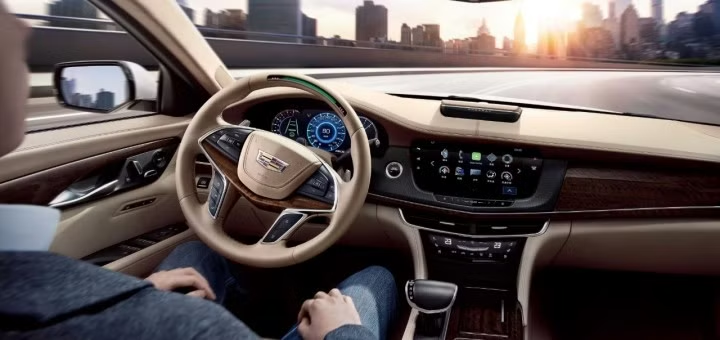
NHTSA’s Office of Defects Investigation opened a formal Preliminary Evaluation into Comma AI’s aftermarket driver-assistance devices on September 24, 2026, after five crashes in which equipped vehicles struck stopped or slow-moving vehicles in their own lane. Two of those crashes killed three people. Four of the five caused serious injuries to eleven others.

The probe covers an estimated 30,000 comma three, comma 3X, and comma four devices, along with the open-source openpilot software that runs them. It’s the biggest regulatory problem the company has faced since NHTSA pushed George Hotz to cancel Comma AI’s first product back in 2016. For anyone running a $999 plug-in box that promises hands-free driving in a car that never came with it, this is the moment that box gets a hard look from the federal government.
What Comma AI’s Openpilot Actually Is
Comma AI sells hardware, not a full self-driving system. The company’s comma four device costs $999, plugs into a compatible car’s wiring harness in about 15 minutes, and pairs its own camera with the vehicle’s stock sensors to run openpilot, an open-source Level 2 driver assistance system. It handles adaptive cruise control and automated lane centering, and Comma says it supports more than 350 models across 27 brands.

The pitch is aftermarket Autopilot for cars that never got a factory version. Comma’s marketing leans on lines like “hands-free driving for the car you already have” and software that “can drive for hours without intervention.” The company’s own fine print says the opposite in practice: drivers are required to stay alert and ready to take over at all times, and the system includes a driver-monitoring camera that flags distraction.
The Crash Data NHTSA Is Digging Into

ODI opened Preliminary Evaluation PE26007 on September 21 after learning of the incidents through crash reports, a consumer complaint, and outreach to police. Investigators confirmed the comma system was powered on or engaged in multiple crashes, and preliminary data suggests openpilot “may not have adequately detected or responded to the in-lane vehicles.”
One crash in the public record happened in February 2026 in Ascension Parish, Louisiana, when a 2022 Toyota RAV4 running Comma hardware struck a stopped first-responder vehicle on a highway, killing two passengers. Others followed the same pattern: a 2020 Honda Accord rear-ended a stopped car on a Missouri highway at 82 mph in September 2025, and a 2021 Toyota Corolla hit a stopped passenger car at 56 mph near Mona, Utah, in July 2026. Every incident NHTSA is examining involves highway speeds and a vehicle sitting still in the same lane.
Camera-Only Systems Keep Missing Stopped Cars

This is the same failure mode that got Tesla Autopilot investigated in 2021, when Teslas struck vehicles stopped at first-responder scenes. That probe eventually led to a recall covering roughly two million Teslas to add more driver alerts. Comma’s system, like Tesla‘s, relies on cameras rather than radar or lidar, and stopped or slow vehicles in a lane remain the known soft spot for that approach.
There’s also a wrinkle specific to Comma that Tesla doesn’t have to deal with: openpilot is open source, and popular community forks like FrogPilot and sunnypilot run on the same underlying driving model. At least one of the crashes under review, including the fatal Louisiana incident, reportedly involved a vehicle running a third-party fork rather than Comma’s official release. NHTSA says it will factor in shared code between openpilot and its forks when evaluating those cases, but the arrangement raises a harder question than a typical recall: how do you fix software that anyone can modify and redistribute on GitHub?
The Gap Between Marketing And The Warning Label

Comma requires drivers to stay alert and ready to intervene, and the system’s own support material lists stationary in-lane vehicles among the conditions that can trip up its adaptive cruise control. That warning sits awkwardly next to a customer testimonial Comma features on its own site, describing a driver “watching the rain, sipping coffee while it handles the road like a champ.”
That gap between what the fine print says and how people actually use these systems isn’t unique to Comma. It’s the same complacency problem that’s dogged Tesla owners for years, including a widely reported case of a driver who fell asleep in self-driving mode and hit a police car. Until Level 2 systems either work flawlessly in every edge case or drivers fully internalize their limits, incidents like these are likely to keep generating investigations.
What It Means For The Aftermarket ADAS Market

A Preliminary Evaluation doesn’t establish a defect, and it can close quietly or escalate into a full engineering analysis and a recall. But with roughly 30,000 devices on the road and three confirmed deaths, this is the first serious federal test of the retrofit ADAS category as a whole, not just one company. Comma has built its reputation on being more transparent than the big players, no subscription paywalls, no false claims about full autonomy, and Consumer Reports once ranked openpilot as the best driver assistance system it tested. None of that changes how a stopped car in a highway lane looks to a camera-only system doing 80 mph. Anyone running one of these boxes, official or forked, should treat the alert-and-ready warning as the actual spec sheet, not the marketing line above it.

Related posts




Latest Post


No Comments