
The Vincent V-Twin That Broke Harley’s American Speed Record
The record run started with a wardrobe malfunction, which sounds hilarious but the wardrobe is leather, the motorcycle is already deep into triple digits, and the surface underneath is Utah salt waiting to sand a man down like a bar snack. Rollie Free certainly had the pace, but he also had a problem. His leathers tore, puffed up, and started catching air at the worst possible moment.

So he did the only thing that made sense to a speedy man in 1948, which is to say something that makes almost no sense to anyone with skin. He stripped down, borrowed shoes that didn’t fit, lay flat across a motorcycle, and trusted British engineering to finish a job that American motorcycle royalty had kept locked down for more than a decade.
Harley’s 136 MPH Record Had Become The Number Everyone Chased
By 1948, Harley-Davidson’s land-speed mark had turned into considerably more than a number. Joe Petrali’s 1937 run had given Milwaukee ownership of American motorcycle speed, and every year it stood made the achievement feel less like a record and more like a property deed. You could chase it, talk about it, swear at it, and build toward it, but the Harley mark stayed there like a steel fence across the salt.

Speed records worked differently back then. A factory couldn’t hide behind lap-time fine print, tire strategy, or a software mode named after a weather event. A motorcycle either went faster through the timed mile or it didn’t. Not to sound too dramatic, but the argument ended when the clocks stopped.
Rollie Free had his own reason to care. He’d been around racing long enough to know what factory pride smelled like, and he had little affection for Harley-Davidson after earlier experience left him sour on the brand. A long-standing Harley record sitting out there in public was exactly the sort of thing that could keep a man awake at night.
The World’s Highest Mileage Harley-Davidson
A former state senator covered over one million miles on this Harley, earning him an all-time honor.
John Edgar Went To England For The Bike America Couldn’t Build

John Edgar was not a man who treated speed as a casual hobby. He’d raced boats, survived a serious crash, owned interesting machinery, and generally behaved like someone who believed life was best experienced with a throttle pinned somewhere near poor judgment. By the late 1940s, he was already into British machinery, but that only made him want something faster (naturally).
Edgar’s idea was wonderfully simple and deeply annoying if you happened to be Harley-Davidson. If America had the record, that didn’t mean America had to keep it. The fastest motorcycle in the country could come from England, arrive by ship, and embarrass everyone on their own salt. That was a properly bold bit of postwar mischief.
So Edgar went to the Vincent-HRD factory, where Phil Vincent and Phil Irving had built a reputation for motorcycles with engineering far ahead of their polite British manners. The project that followed was a proper factory job. Irving set the bike up to run on alcohol, made high-lift cams by hand, fitted special Amal carburetors, and put the machine on racing tires with Avon alloy rims. Before it crossed the Atlantic, it reportedly ran close to 143 mph at an aerodrome before running out of runway, which is a very nice way of saying the thing needed more planet.
Harley-Davidson Once Made A Superbike
What made this Harley different? A liquid-cooled DOHC 60-degree V-twin engineered for one purpose. Racing!
A Factory-Tuned Vincent V-Twin Finally Pushed The Record Past 150 MPH

|
Engine |
Power |
Top Speed |
|
998cc OHV V-Twin |
70 hp |
150.313 MPH |
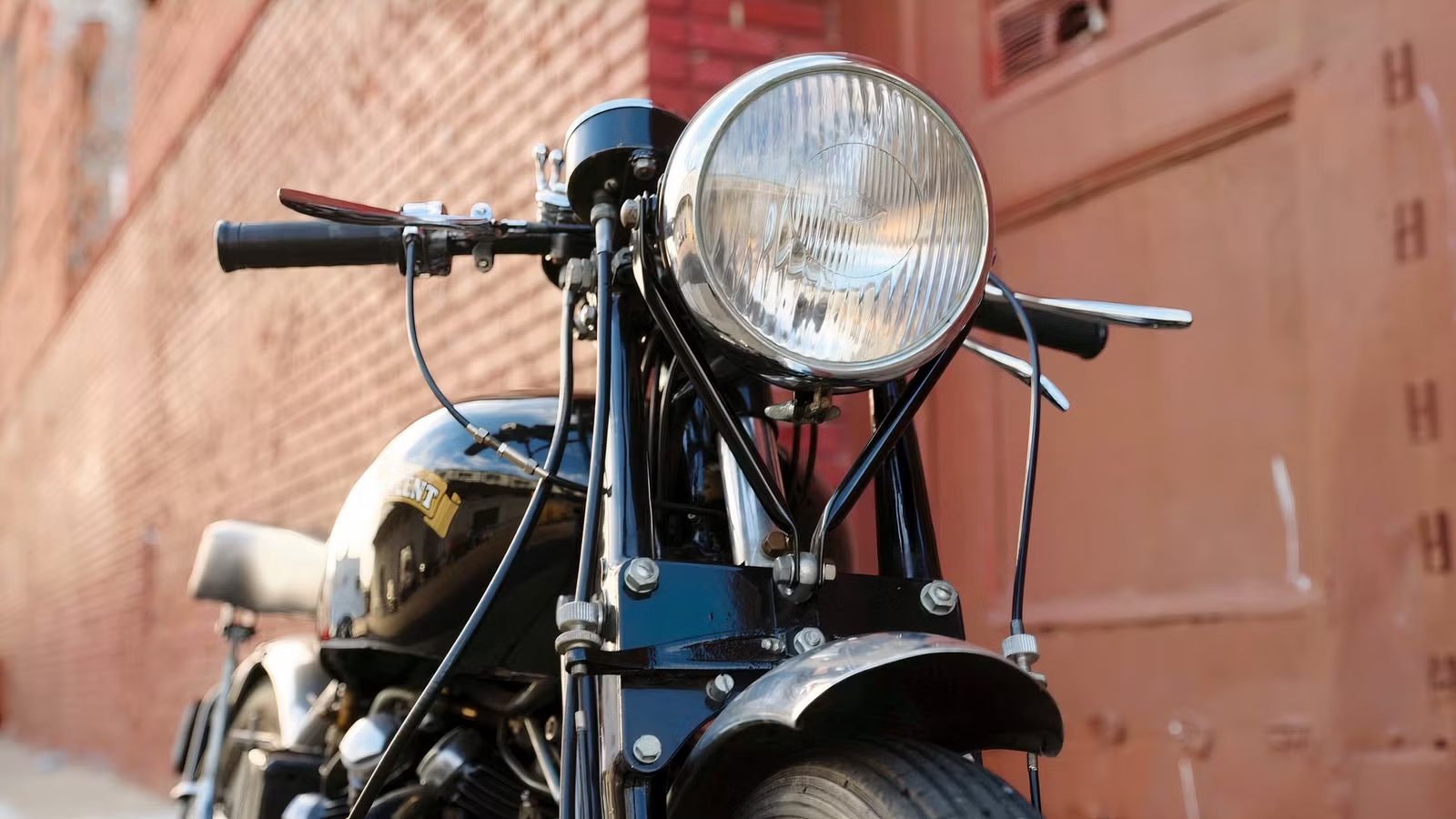
The motorcycle that arrived in California was a factory-tuned Vincent-HRD prototype closely tied to what became the Black Lightning. What’s curious is that the record bike’s been described in different ways over the years, sometimes as a Black Shadow, sometimes as a Black Lightning, and sometimes as the prototype that fed the Lightning legend. The safest read is probably the most interesting one: this was a special machine built from Vincent’s fastest road-bike thinking and sharpened for one dirty job.
Underneath it sat a 998cc OHV V-twin, the kind of engine that made Vincent famous. The standard Black Shadow was already advertised with a 125 mph top speed, which was absolutely stupid for a production motorcycle in 1948. The Black Lightning idea took that foundation and stripped it toward racing purpose, with roughly 80 pounds taken out compared to the heavier road machine and output pushed to around 70 hp.
Free first tested the machine’s promise in a set of leathers, stretched out prone across the tank and rear fender to cheat the wind. It worked, mostly. The run was fast enough to beat the old mark, with one account putting the first pass at 148.6 mph and another describing it as 149-plus, but the magic 150 mph line still sat just ahead. Worse, the torn leathers had puffed out like a parachute, which is exactly what you don’t want when the only thing holding you to the motorcycle is commitment and questionable footwear.
For the next run, Free reduced drag with the sort of solution that makes safety officers age in real time. He wore a bathing suit, a cap, and borrowed tennis shoes, then lay flat again with his feet kicked back behind him. The bike was still pulling hard in top gear, the salt line became his guide, and when the timers did their work, the number was 150.313 mph. Just like that, Harley’s long American hold had been broken by an English V-twin built 5,000 miles away.
The Swimsuit Made The Photo, But The Engine Made The Pass
The photograph is impossible to ignore, and that’s part of the problem. Free looks like a man who escaped a swimming pool, stole a motorcycle, and discovered terminal velocity on the way home. It’s brilliant, absolutely mad, brave, and instantly memorable. It’s also been so heavily repeated that the engineering underneath sometimes gets treated like a footnote.
Free needed nerve, no question, but nerve doesn’t average 150.313 mph without hardware. Vincent’s postwar architecture gave the record bike a head start because the engine wasn’t merely carried by the frame. It helped form the structure. The 50-degree V-twin layout allowed the engine to work as a stressed member, with Vincent eliminating the usual full cradle and using an upper frame member that also served as the oil tank.
That thinking was pure Vincent: remove what doesn’t need to be there, make the parts left behind do more work, and spend the weight savings on speed. The Bonneville bike was stripped of its street equipment, ran on alcohol fuel, breathed through special Amal TT carburetors, and used handmade high-lift cams. The front brake was removed, the bars were narrowed, the fork was tape-wrapped for cleaner airflow, foot-pegs were taken off, and the rear fender had to help support Free’s prone position. This was still recognizably a motorcycle, but every piece had been bullied into serving the stopwatch.
Bonneville Became America’s Speed Temple On A British Motorcycle

In case you didn’t catch it, the irony is that one of America’s great motorcycle speed moments didn’t belong to an American motorcycle. It happened in Utah, with an American rider and an American backer, but the machine that ended Harley’s grip came from Stevenage, England.
After the run, the factory leaned into the moment with the sort of confidence only a stopwatch can buy. The record bike became tied forever to the claim that Vincent built the world’s fastest standard motorcycle, and the machine itself became one of motorcycling’s great artifacts. Edgar even rode the record bike on the street after it was detuned from alcohol back to gasoline and fitted with more conventional equipment. Imagine taking the 150 mph bathing-suit bike out for errands. Milk, bread, mild terror.
Turning A Motorcycle Into A Legend

The run also helped give Bonneville its modern mythology. The salt had already seen speed, but Free’s run added theater, danger, engineering, and one awesome image. The flats could turn a motorcycle into a legend in the space of a measured mile, and it showed that the difference between folklore and fact was sometimes a set of timing lights.
Sources: Motorcycle Museum, National Motorcycle Museum, RoadDirt, Silodrome, TopSpeed.

Related posts

Latest Post


No Comments