
The V-Twin That Outlived Almost Every Rival
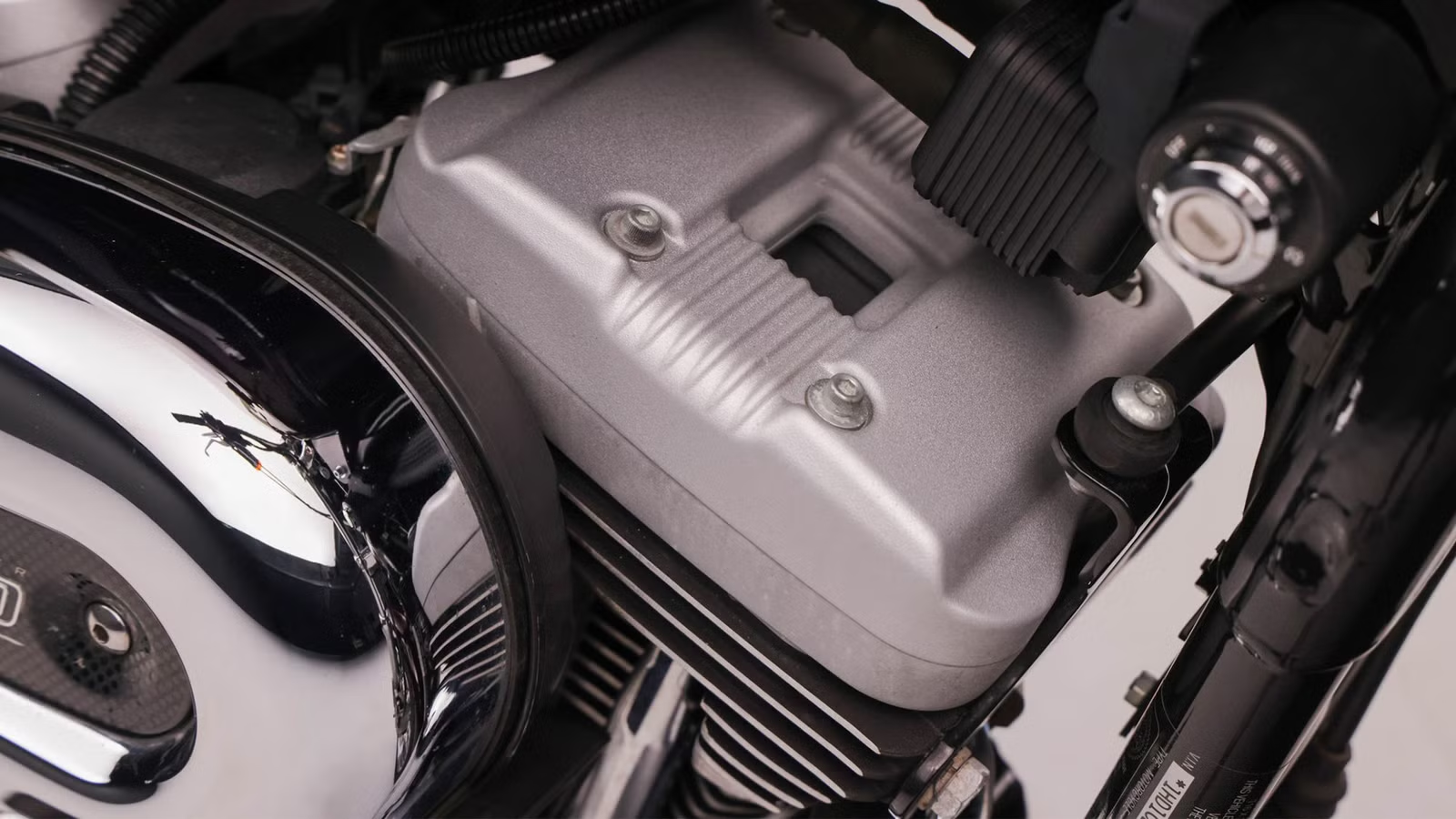
When most motorcycle manufacturers replace an engine, the outgoing power plant usually disappears into history. Technology advances, emissions regulations tighten, and riders move on to something newer. However, an American V-twin followed a very different path. It arrived during one of the darkest periods in its company’s history and went on to become the foundation of a remarkable turnaround.

Over more than three decades, the Evolution engine family powered everything from entry-level motorcycles to some of the brand’s most iconic models. While competitors introduced new designs, liquid cooling, and increasingly complex technology, this V-twin continued evolving while retaining the character that made it famous.
The Engine That Arrived When Harley-Davidson Needed A Lifeline
By the late 1970s, Harley-Davidson was fighting for survival. The company that had built its reputation on character and durability was struggling with declining quality control, financial losses, and a growing image problem as Japanese manufacturers delivered faster, more refined, and more reliable motorcycles. Under AMF (American Machine and Foundry) ownership, production increased, but many enthusiasts felt the brand had lost some of its identity.

In 1981, a group of Harley-Davidson executives purchased the company back from AMF in one of the most significant moments in its history. Harley-Davidson needed a modern engine that could restore faith in its motorcycles, improve durability, and prove that the company’s future was worth fighting for.
How The Evolution V-Twin Changed Harley-Davidson Forever

In 1984, Harley-Davidson introduced the Evolution V-twin. The 1,340-cc Evolution replaced the Shovelhead Big Twin in 1984, while the Sportster Evolution replaced the Ironhead Sportster beginning in 1986.
Unlike its predecessors, the Evolution featured aluminum cylinder heads, improved oil circulation, stronger internal components, and tighter manufacturing tolerances, which dramatically improved reliability. The Evo gave riders improved starting performance, better oil control, improved cooling, and significantly greater reliability. Rather importantly, it restored confidence in the company and became the foundation of Harley-Davidson’s modern revival.
The Technology Behind Harley’s Most Important V-Twin

The Evolution engine may have looked familiar, but underneath its traditional Harley-Davidson styling was a collection of engineering upgrades that transformed the company’s big-twin motorcycles.
Retaining the iconic 45-degree air-cooled V-twin layout, the Evo introduced aluminum cylinders and redesigned cylinder heads that improved heat management compared with the earlier Shovelhead design. Its redesigned combustion chambers improved efficiency, while the continued use of hydraulic lifters helped reduce valve-train maintenance by automatically compensating for wear.
During the Evolution era, Harley’s new generation of motorcycles also benefited from a smoother belt final-drive system. Combined with improved manufacturing tolerances, stronger internal components, and better oil control, the Evolution became significantly more durable than the Shovelhead it replaced. It was still unmistakably a Harley-Davidson V-twin, but it was finally engineered for the demands of modern riders.
From Sportsters To Softails: The Engine That Powered Harley’s Comeback

The Evolution engine did more than replace outdated Harley-Davidson power plants; it became the foundation for an entirely new generation of motorcycles. While the 1,340-cc Big Twin Evolution arrived in 1984, Harley expanded the Evolution family two years later when the Sportster received its own version. Available initially in 883-cc and 1,100-cc forms before expanding to 1,200-cc, the Sportster Evolution brought improved reliability and modern engineering to Harley’s smaller performance models.
Beyond this, the Big Twin Evolution quickly became the center of the company’s comeback, powering the iconic Softail range before finding its way into Dyna and Touring models. By offering a dependable engine platform that could be adapted across multiple motorcycle families, Harley-Davidson was able to rebuild its lineup around a single proven design philosophy. The Evolution was not just an engine replacement; it was the mechanical foundation that helped transform Harley-Davidson from a struggling manufacturer into a revitalized American motorcycle icon.
The V-Twin That Watched Its Rivals Disappear

While Harley-Davidson continued refining the Evolution V-twin through the 1980s and 1990s, many of its Japanese rivals struggled to maintain the same level of influence in the cruiser market. Motorcycles such as the Honda Shadow (still produced, but with many engines used over the years), Yamaha Virago (1981–2007), and Suzuki Intruder (1985–2005) offered buyers smooth V-twin power, competitive pricing, and modern engineering.
However, many of these motorcycles eventually evolved into different platforms as manufacturers moved away from simple air-cooled designs toward more advanced liquid-cooled engines. Harley-Davidson took a different approach. As rivals were replaced or redesigned, the Evolution remained in production, becoming the V-twin that survived while many competitors changed course.
Three Decades Of Refinement Without Losing Its Character

One of the reasons the Evolution V-twin became so successful was Harley-Davidson’s ability to improve it without changing the personality that made it popular. Over its more than three decades of production across different applications, the Evolution family received continuous refinements to meet changing customer expectations and stricter regulations. Carburetors remained part of the engine’s identity for much of its life, but electronic fuel injection gradually became available across Harley-Davidson’s range during the 1990s and became increasingly common in the 2000s, improving starting, consistency, and emissions.
Manufacturing processes also improved, further increasing reliability and reducing the maintenance concerns associated with earlier Harley-Davidson engines. However, Harley-Davidson understood that its customers were not simply buying transportation; they were buying the sound, feel, and character of a traditional American V-twin. Rather than abandoning the air-cooled 45-degree formula in pursuit of modern performance figures, the company refined it carefully.
Why The Evolution V-Twin Still Has A Dedicated Following Today
More than four decades after its introduction, the Evolution V-twin remains one of Harley-Davidson’s most respected engines, offering a rare combination of classic character, improved reliability, and mechanical simplicity. Early Evo-powered motorcycles are becoming increasingly collectible, especially first-year 1984–1985 Evolution models and early Softail variants such as the 1984 Softail Standard (FXST) and 1985 Softail Custom (FXSTC), which represent the beginning of Harley-Davidson’s recovery era.
Unlike newer engines with greater electronic complexity, the Evolution remains relatively easy to service, making it popular among owners who enjoy maintaining and customizing their own motorcycles. Decades of aftermarket support have also ensured a huge supply of replacement parts, performance upgrades, and accessories.
The End Of An Era: How The Evolution Was Finally Replaced

After decades of production, the Evolution V-twin reached the end of its remarkable journey. While the Big Twin version was replaced by the Twin Cam engine at the turn of the century, the Sportster Evolution continued carrying the nameplate forward until 2022, making it one of the longest-running motorcycle engine designs in modern history.
However, stricter emissions regulations, changing customer expectations, and the demand for improved performance and technology eventually forced Harley-Davidson to move in a new direction. The arrival of the liquid-cooled Revolution Max engine in the Pan America and Sportster S marked a major shift away from the traditional air-cooled Evolution formula.
Yet the Evo’s importance goes far beyond its production numbers. It was the engine that restored Harley-Davidson’s reputation during its darkest period, rebuilt customer confidence, and created the foundation for the company’s modern success. Few motorcycle engines have left a more lasting legacy.
Sources: Harley-Davidson,

Related posts

Latest Post


No Comments