
The V-Twin Engine That Gives Riders Big Power Without Big Ownership Costs
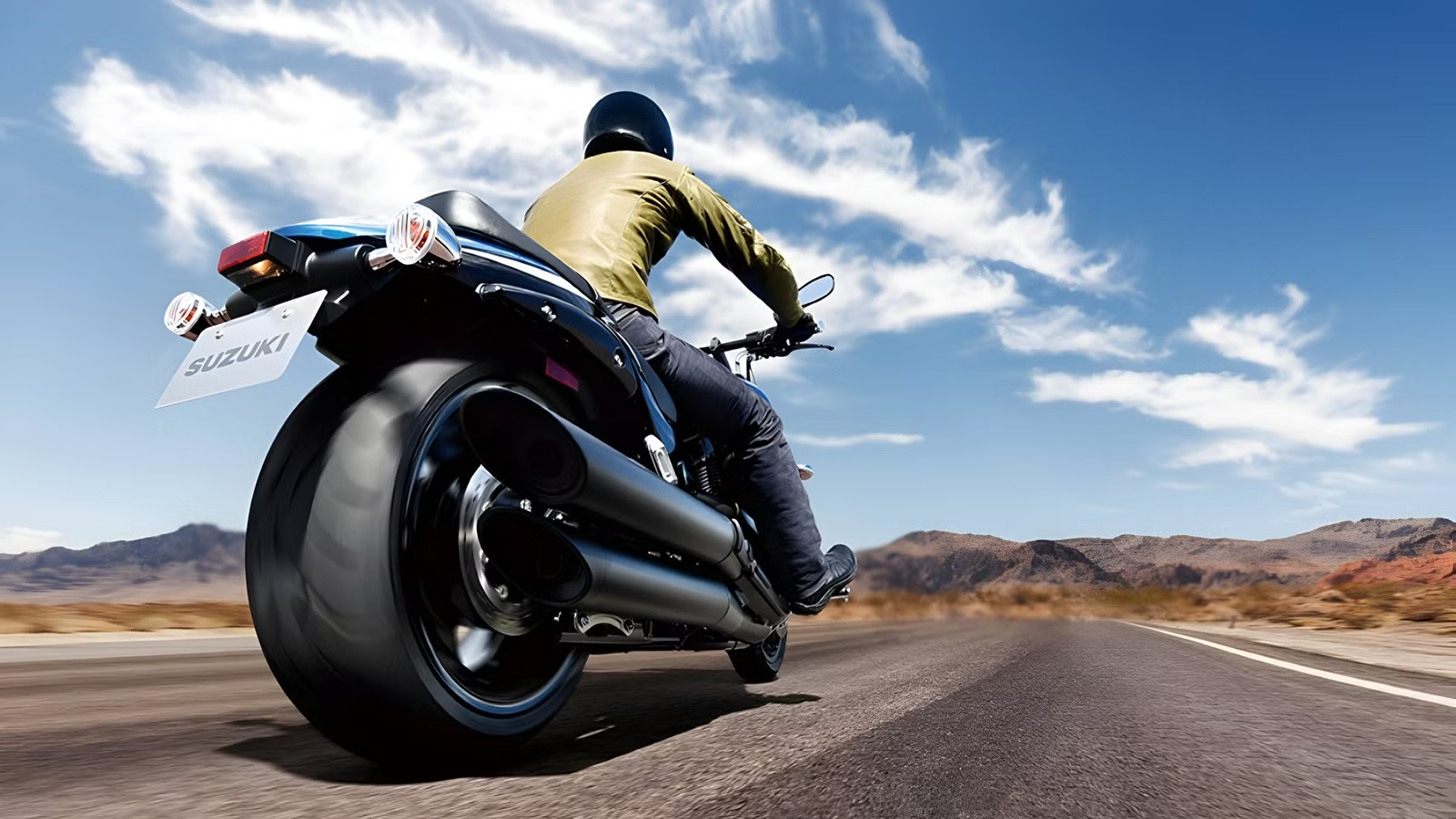
Big displacement has always meant big bills. It’s an old rule of thumb in motorcycling that most riders absorb without ever being told. After all, a huge engine needs a huge purchase price, a huge service invoice, and a shelf of expensive parts waiting for their turn to fail. Therefore, general wisdom says that if you want a cruiser that whisks you along the road with real authority, you should be ready to pay for the privilege. It’s a reasonable assumption that exists because it is the reality for plenty of bikes. However, a well-engineered V-Twin, built by a company that built durability above all else, can deliver serious muscle without turning ownership into a second job.
Why V-Twin Power Usually Comes With A Price Tag

The charm of a big V-Twin is obvious. They make torque you can feel in your chest, they sound like authority on the road, and they give a cruiser a presence that smaller engines can’t fake. However, premium cruisers tend to arrive with premium price tags before you’ve ridden a single mile.
Complex engines can mean long service visits and expensive labor. Modern cruisers come with sensors, modules, and displays that are wonderful when they work and painful when they don’t. Specialized parts also cost more, and a lot of routine maintenance ends up being something only the dealer is able to handle.

Then there are the tires, brakes, and consumables sized for a big V-Twin cruiser. Everything is a little bigger, a little stronger, and a little more expensive than it would be on a smaller bike. Most riders accept this as the cost of entry. If you want big power, you budget for big upkeep and hope for the best. The interesting question is whether that bargain is really unavoidable.

The Suzuki Boulevard M109R Breaks The Pattern

Suzuki’s Boulevard M109R is one of the more convincing arguments that it isn’t. It arrived in 2006 as the company’s flagship power cruiser, and it was aimed at riders who wanted V-Twin muscle and were happy to get it from a Japanese manufacturer known for building things that last. The formula is straightforward: a large liquid-cooled engine, shaft drive, and a conventional cruiser layout with no unnecessary drama.
A Muscle Cruiser With Suzuki Engineering Behind It

The M109R didn’t take its engine from the usual cruiser playbook. Suzuki borrowed fuel-injection technology from its GSX-R sportbikes, and the design shows it. The engine uses liquid cooling, four valves per cylinder, and two spark plugs on each cylinder, all managed by a modern engine computer. The cylinders are lined with Suzuki’s own SCEM coating, which helps shed heat and lets the pistons run with tight clearances.
The internals are just as ambitious. The forged aluminum-alloy pistons are among the largest ever fitted to a production motorcycle, at 112 mm across. It’s sport bike thinking applied to a cruiser, and it’s a big part of why the engine feels so sturdy. An engine that’s strong and well cooled from the start is an engine that can live a long, unfussy life. You don’t need constant attention when the hardware is built for the work.
The M109R’s Numbers Are All Juicy

The M109R runs a 1,783 cc, V-Twin with a 112.0 x 90.5 mm bore and stroke and a 10.5:1 compression ratio. Suzuki’s claimed output is 128 horsepower, with 118 lb-ft of torque arriving at just 3,200 rpm. These numbers put the M109R in serious company. Plenty of cruisers make lots of torque, but few pair it with triple-digit horsepower, and the combination is what gives the bike its personality. You get the low-rpm shove that cruiser riders love, plus a strong pull as the revs build.
It’s big too. The Suzuki Boulevard M109R weighs 764 pounds wet and features a 5.2-gallon fuel tank, and the wheelbase is a long 67.3 inches. A seat height of just 27.8 inches helps balance that, keeping the bike approachable at a standstill and putting your feet flat on the ground when it matters most.
How The Boulevard M109R Delivers That Power

The power reaches the road through a five-speed gearbox and a shaft final drive. It’s a simple, sturdy layout, and it suits an engine that makes most of its muscle low in the rev range. You rarely need to work the gearbox hard, because a twist of the throttle in almost any gear gets the bike moving with authority.
Suzuki also made sure the hardware around the engine could handle the output. Later models get radially mounted twin front discs, ABS, and LED lighting, and the rear end wears a 240/40 R18 tire to put all that torque on the ground. The result is a cruiser that feels effortless. It isn’t trying to be a sportbike, and it doesn’t need to. It just pulls, smoothly and steadily, in a way that makes a long stretch of highway feel like a short one.
How The Boulevard M109R Remains Affordable To Own

Routine service is simple. Maintenance charts commonly list oil and filter changes at about 3,500 miles or once a year, with plugs and air filter checked at the same time. Shaft drive removes the chain from the equation entirely, so there’s no cleaning, lubing, or adjusting, and the final drive just needs its oil changed at longer intervals.
The engine’s most significant scheduled job is the valve clearance check, which Suzuki’s service information puts at roughly every 14,500 miles. That’s a real task, and it’s not free. Some rivals use hydraulic valve systems that skip this step entirely. But it’s an infrequent job, the interval is long, and a few hundred dollars every few years is hardly a budget-breaker for a bike this size. Tires are the honest exception. Those wide 130/70 R18 and 240/40 R18 tires are expensive, and replacing a set can often cost beyond $500. They also tend to wear out faster if you have a heavy throttle hand.

The purchase price is where the M109R really stands out. The 2025 model has an MSRP of $15,799, which is not little money but is a long way from the price of a fully-loaded flagship touring cruiser. The cruiser’s reliability also means that a lot of buyers are shopping the used market for the M109R, and buyers’ guides have listed typical asking prices in the range of roughly $9,500 to $14,000, depending on year, mileage, and condition.
Why The Boulevard M109R Makes The Case For Value

No motorcycle with 1,783 cc of displacement is going to be free to own, and the M109R doesn’t pretend otherwise. It’s heavy, its tires cost real money, and its valves need attention on a schedule. Anyone telling you a bike like this costs nothing to run is selling something. But the details add up to a convincing case. The engine is well-built, with sport bike-derived engineering underneath. The service schedule is long and easy to follow. Shaft drive takes away one of the most annoying chores in motorcycling. And Suzuki’s reputation for durability counts for something when you’re buying a machine this big and this powerful.
Add it up and the pattern-breaking idea holds. The M109R gives riders the muscle, the sound, and the presence of a big V-Twin, and it does so without the expensive electronics and dealer-only service that usually come with that territory. For the right buyer, that’s a rare combination. Big power doesn’t have to mean big bills. Sometimes it just means finding the engine that was engineered to make the trade-off unnecessary.
Source: Suzuki

Related posts



Latest Post


No Comments