
The Hybrid Under $30,000 With The Best Mileage For Long-Distance Travel
Hybrid vehicle sales in the United States are at record highs, and it’s easy to see why. As the charging network for fully electric vehicles continues to expand and new EV models keep arriving, hybrids are doing the heavy lifting in the meantime — cutting tailpipe emissions and trimming fuel costs without asking drivers to change their habits. They’re the pragmatic choice for right now, and the market has noticed.
One underappreciated benefit of a hybrid’s superior fuel efficiency is sheer driving range. Fewer fuel stops means more miles between breaks — and that matters enormously on a long haul. And while crossovers and SUVs dominate showroom floors, a loyal segment of buyers still wants a low-slung sedan with the crisp handling that body style uniquely delivers. The good news: the best hybrid sedan on the market today pairs that driving character with segment-busting fuel economy that makes truly epic road trips not just possible, but easy.
The 2026 Toyota Prius Can Achieve Up To 57 MPG Combined
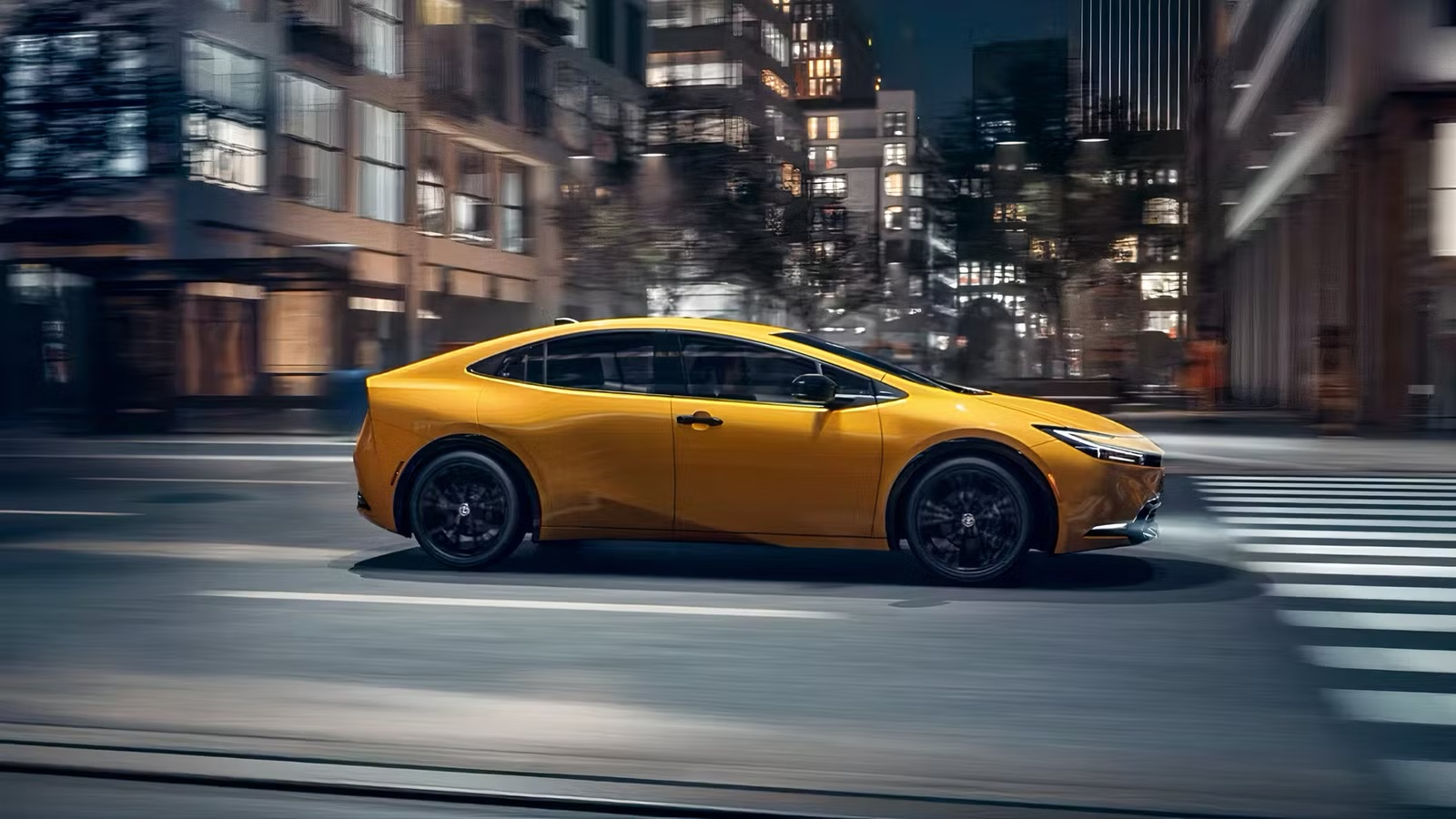
Perhaps to the surprise of only a few, the hybrid with the best mileage for long-distance travel would be the Toyota Prius. As the world’s pioneering hybrid sedan, the Prius has always set a high bar in terms of fuel efficiency. However, not all Prius models are created equal. To get the best mileage in the lineup, you’ll need to choose one specific variant.
But, You’ll Have To Stick To The Base LE Trim

In order to get the sedan with the best mileage, you’ll have to go with the base LE. As logic would dictate, bigger wheels make a car less efficient due to the increased rotational mass. The base LE rides on 17-inch wheels — a respectable size in most contexts, but one that looks almost modest given how dramatically the current Prius prioritizes style, with its wide, sculpted wheel arches. For reference, the previous Prius LE came with 15-inch wheels, while higher trims of the current Prius ride on larger 19-inch wheels.
2024 Toyota Prius LE Fuel Economy Specs
|
Fuel Economy (City) |
57 MPG |
|
Fuel Economy (Highway) |
56 MPG |
|
Fuel Economy (Combined) |
57 MPG |
|
Fuel Tank Size |
11.3 Gallons |
|
Overall Driving Range |
644 Miles |
Furthermore, if you opt for the higher trims with 19-inch wheels, sourcing replacement tires can be a challenge. While 19-inch tires are common enough, those in the narrow 195/50 size are not — most 19-inch fitments run 225 or wider, not the skinny 195s the Prius uses in the name of efficiency and aerodynamics. Sticking with the base LE is what earns you the combined 57 MPG EPA rating, which is a full MPG better than the previous-generation Prius Eco variant’s 56 MPG combined.
To Be Fair, Any Prius Is Still Efficient

Even if you move up to the higher trims, the models with 19-inch wheels still achieve 54 MPG combined. Adding optional all-wheel drive (AWD) to the base LE drops its figure from 57 MPG to a still-impressive 54 MPG, while 19-inch-wheel models with AWD still return 49 MPG. Those numbers either beat the previous-generation Prius by 1 MPG or match it outright — remarkable given that the current car is substantially more stylish and more rewarding to drive, as we’ll explore further on.
Thanks to its impressive fuel economy, the Prius LE with its 57 MPG city and 56 MPG highway ratings can travel up to 644 miles on a full tank according to the EPA — a distance that will test your bladder long before it tests the fuel gauge. Adding AWD to the LE reduces that to 567 miles, while a Prius with 19-inch wheels and no AWD will cover up to 588 miles, aided by its 54 MPG highway rating versus 52 MPG for the LE AWD. The least efficient configuration — 19-inch wheels plus AWD — still delivers a 514-mile range.
|
Combined MPG |
Driving Range |
|||
|
FWD |
AWD |
FWD |
AWD |
|
|
Prius LE |
57 MPG |
54 MPG |
644 miles |
567 miles |
|
Prius SE, XSE |
52 MPG |
49 MPG |
588 miles |
514 miles |
What Else You Get In A Prius

If you’re going to push the Prius to the limits of its impressive driving range on a long road trip, it’s worth knowing whether this fastback-style sedan is actually a pleasure to spend time in. After all, what’s the point of class-leading efficiency if the car itself is a chore to drive?
Stylish Looks Inside And Out

The Toyota Prius received a complete redesign beginning with the 2023 model year, and it fundamentally changed the trajectory of the nameplate. Where buyers once chose a Prius purely on the merits of its fuel economy, there’s now a genuine emotional pull to the car. Its signature monoform body has been made sleeker and sportier, with a lower roofline that, while not ideal for rear headroom or outward visibility, dramatically raises the style quotient. As noted, the base LE rides on 17-inch wheels, while SE and XSE trims get the larger 19-inch units.
The interior has been equally transformed. The old centrally mounted digital gauge cluster is gone, replaced by a more conventional, driver-focused layout. Instrumentation is displayed on a 7-inch screen, while multimedia and vehicle functions are handled by Toyota’s Audio Multimedia infotainment system, available in either an 8-inch or 12.3-inch configuration. Throughout the cabin, the design features sharper, more purposeful lines, backed up by noticeably improved materials and build quality. Higher trims add premium touches including synthetic leather upholstery, power-adjustable front seats, and a JBL premium audio system.
Better Driving Dynamics, Too

The more compelling design is matched by across-the-board improvements in driving performance. Toyota’s fifth-generation hybrid system pairs a larger, more powerful 2.0-liter four-cylinder Atkinson-cycle engine — featuring high thermal efficiency — with stronger electric motors, lifting system output to 194 horsepower in FWD form and 196 hp with AWD. That’s a dramatic leap from the previous generation’s 121 hp.
Handling has improved just as meaningfully, courtesy of the heavily revised TNGA-C platform. Additional spot welds, retuned suspension, a new steering rack, and a host of other engineering refinements make the current Prius noticeably more engaging to drive, without sacrificing the comfort and refinement that have always defined the nameplate.
The planetary gear-type e-CVT transmission still produces noticeable engine drone under hard acceleration — that’s a characteristic of the setup rather than a flaw — but in everyday driving the Prius is a polished, capable mile-eater. There’s also a plug-in hybrid variant, the Prius Prime, though its heavier battery pack actually reduces total driving range compared to the standard model, to around 600 miles.
|
Toyota Prius |
Toyota Prius PHEV |
||
|
Engine |
2.0-liter four-cylinder hybrid |
2.0-liter four-cylinder plug-in hybrid |
|
|
Drivetrain |
Front engine, FWD |
Front engine, AWD |
Front engine, FWD |
|
Horsepower |
194 hp |
196 hp |
220 hp |
|
Torque |
N/A |
||
|
Transmission |
e-CVT |
||
|
EPA Combined MPG |
57 MPG (LE) 52 MPG (SE, XSE) |
54 MPG (LE) 49 MPG (SE, XSE) |
52 MPG (SE) 48 MPG (XSE, XSE Premium) |
|
EPA Combined MPGe |
N/A |
127 MPGe (SE) 114 MPGe (XSE, XSE Premium) |
|
|
EPA EV Range |
N/A |
45 miles (SE) 40 miles (XSE, XSE Premium) |
|
|
Base MSRP |
$27,950 |
$32,975 |
|
Americans Want Hybrids

The broader electrification picture in the United States is also working in the Prius’s favor, as hybrid sales have climbed to record levels. As of July 2026, Toyota (excluding Lexus’ 83,173 hybrids) has sold 707,675 hybrids in the U.S. — a 13.1 percent increase year-over-year — making electrified models the primary engine of the brand’s domestic sales growth.
According to Cox Automotive, electrified vehicles overall — combining hybrid, plug-in hybrid, and battery-electric — accounted for 20.2 percent of total U.S. vehicle sales in 2024. Hybrids alone hold a 9.8 percent market share, up from 8.1 percent in the same period the prior year. Toyota commanded roughly half of all hybrid sales at 50 percent, with Honda second at 19 percent and Ford third at 11 percent.
Sources: Toyota, EPA, Cox Automotive

Related posts






Latest Post



No Comments