The Used Hybrid SUV To Buy If You Have A Budget Of $20,000
6 minutes reading
Friday, 2 Oct 2026 22:01 0 41 autotech
Hybrid SUVs have never been more compelling — or more competitive. With fuel prices remaining unpredictable and an ever-growing roster of electrified crossovers crowding dealership lots, finding the right balance of efficiency, value, and everyday usability takes real homework. Hybrid vehicles now dominate the crossover and SUV segment, consistently sitting at the very top of quarterly sales charts, and the options available to American buyers have never been broader. The Honda CR-V Hybrid and Toyota RAV4 Hybrid are the most logical and popular choices, as they reliably lead the sales charts, but there are several strong alternatives that tick all the necessary boxes. One particularly compelling option is an often-overlooked competitor that hails from South Korea.
It may not lead the segment in EPA-estimated fuel economy or range, but it strikes an impressive balance between performance and efficiency. It also pairs a futuristic exterior design with a well-equipped, contemporary interior. The manufacturer offers this SUV as a capable PHEV as well, but this feature focuses exclusively on the HEV variation. Here’s why it makes a strong case for itself.
Hyundai Motor Company, founded in 1967 and headquartered in Seoul, South Korea, is a global automotive manufacturer known for producing a wide range of vehicles, from compact cars to SUVs and electric vehicles. Renowned for its innovation, quality, and affordability, Hyundai has made significant strides in automotive technology, including advancements in fuel efficiency, safety features, and electric mobility. The brand emphasizes sleek design, reliability, and competitive pricing, appealing to a broad market. Hyundai’s commitment to sustainability is evident through its investment in eco-friendly technologies, such as hydrogen fuel cell and electric vehicles, positioning it as a leader in the evolving automotive industry.
The 2022 Hyundai Tucson Hybrid is one of Consumer Reports‘ highest-rated hybrid SUV options, boasting an impressive 82/100 overall score, which includes a 94/100 road test score. Its overall rating is tempered by a 38/100 reliability rating and a 3/5 owner satisfaction grade. The testing site highlights the model’s strong fuel economy, sharp handling, and smooth ride as standout characteristics, while its usability falls short primarily due to a clumsy gear selector.
J.D. Power combines all Tucson drivetrain derivatives in its valuation, resulting in a 78/100 overall score, which includes 77/100 for quality and reliability, 85/100 for the driving experience, and 81/100 for resale. Used examples of the 2022 Tucson Hybrid can be found for well under $20,000 depending on mileage and trim, making it one of the best-value options in its class.
Edmunds’ True Cost To Own Calculator
Year 1
Year 2
Year 3
Year 4
Year 5
Total
Insurance
$1,209
$1,245
$1,283
$1,321
$1,361
$6,419
Maintenance
$534
$2,132
$1,135
$805
$2,821
$7,427
Repairs
$0
$836
$428
$524
$643
$2,431
Taxes & Fees
$2,103
$197
$186
$176
$166
$2,828
Financing
$1,666
$1,350
$1,005
$634
$230
$4,885
Depreciation
$3,244
$1,673
$1,596
$1,590
$1,663
$9,766
Fuel
$1,920
$1,977
$2,037
$2,098
$2,161
$10,193
True Cost to Own
$10,676
$9,410
$7,670
$7,148
$9,045
$43,949
According to Edmunds, the 2022 Tucson Hybrid will cost approximately $43,949 to own over five years, factoring in $9,766 worth of depreciation, $4,885 in financing, and $2,828 in insurance. Another strong motivator for the Tucson Hybrid’s viability as an ideal urban SUV is its impressive safety record across the range. All derivatives feature the brand’s SafetySense suite, which bundles all essential advanced driver-assist systems, including adaptive cruise control. These features help the entire Tucson range earn a Top Safety Pick+ award from the IIHS, as well as a five-star overall crash test rating from the NHTSA.
Pros
Exceptional fuel economy
Dazzling exterior styling
Impressive ride
Cons
Clumsy gear selector
Distracting touchscreen interface
Cargo space not on par with rivals
The Hyundai Tucson Hybrid Produces 231 Horsepower
Driving shot of a red 2024 Hyundai Tucson Hybrid on a dusty road in front 3/4 viewHyundai
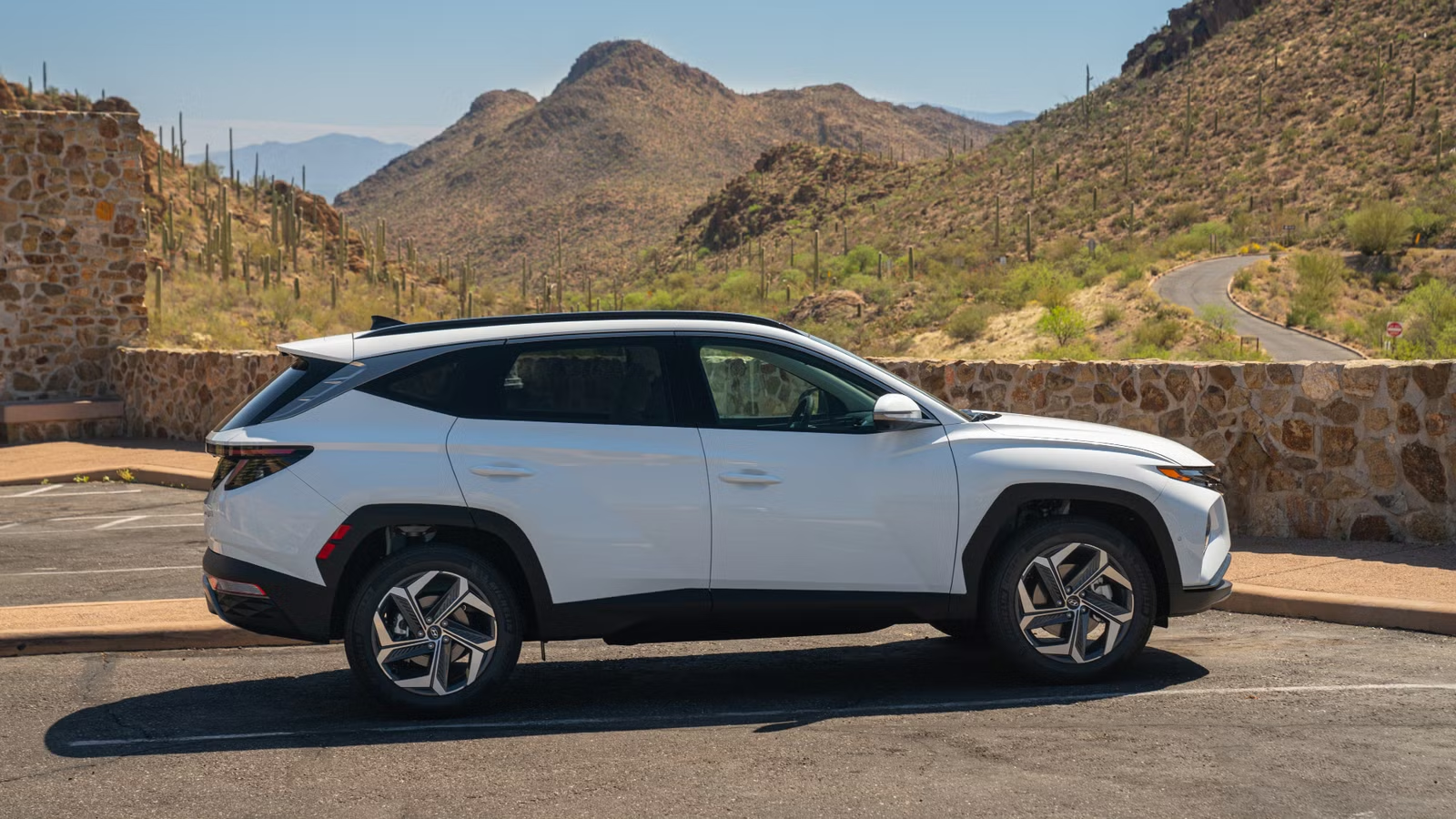
The Hyundai Tucson Hybrid is one of the best budget-friendly hybrid SUV options available on the used market today. The highlight of the package is its turbocharged 1.6-liter four-cylinder powertrain — a relative rarity in the segment, where most rivals favor a naturally aspirated Atkinson-cycle engine. This unit produces 178 horsepower at 5,500 RPM and 195 pound-feet of torque between 1,500 and 4,500 RPM.
Assisting this system is an electric motor that generates 64 horsepower and 195 pound-feet when operating independently. Hyundai claims that the combined system output is 231 horsepower and 271 pound-feet, which a six-speed automatic transmission transfers to all four wheels via the brand’s HTRAC all-wheel drive system.
Turbocharged 1.6-Liter Four-Cylinder And One Permanent-Magnet Motor
Horsepower
231 HP
Torque
271 LB-FT
Transmission
Six-Speed Automatic
Driveline
All-Wheel Drive
Battery
1.49 kWh
Range
480-521 Miles
Fuel Economy
35-38 MPG
0-60 MPH
7.7 Seconds
Top Speed
125 MPH
Towing Capacity
2,000 Pounds
Despite a slight bump in power over its predecessor, the Tucson maintains a 7.7-second 0–60 MPH acceleration time and a 125 MPH top speed. The EPA estimates that the most efficient Blue derivative returns 38/38/38 MPG on the city/highway/combined cycle and covers a total of 521 miles thanks to its 13.7-gallon tank and 1.49 kWh battery pack. This model can save you $2,250 in fuel costs over five years, with an estimated annual gasoline spend of $1,200 and a cost of $2.02 to drive 25 miles.
The rest of the range returns 35/35/35 MPG and covers 480 miles on a single tank. You can expect to save $2,000 in fuel costs over five years, spend $1,250 on fuel every year, and $2.07 to drive 25 miles. You’ll be able to tow up to 2,000 pounds worth of cargo, regardless of which derivative you opt for.
The Tucson Hybrid’s Comprehensive Features List
Hyundai
As you might expect, the Tucson Hybrid Blue is the most stripped-back offering in the range. It comes standard with aerodynamic 17-inch alloy wheels, Bi-LED headlights with DRLs and high-beam assist, rear privacy glass, solar control front glass, and a hands-free smart liftgate with auto-open and adjustable height settings.
The cabin features cloth seat upholstery with an electrically adjustable driver’s seat, front seat heating, and a 60/40-split folding rear bench. Hyundai’s 12.3-inch touchscreen infotainment system with wireless Android Auto and Apple CarPlay is standard across the range. The Blue adds a 4.2-inch LCD instrument cluster and a wireless smartphone charger alongside USB ports at both the front and rear. Dual-zone climate control is another key comfort feature that Hyundai makes standard on all derivatives.
The SEL Convenience adds 18-inch alloy wheels, LED taillights, turn signals on the door mirrors, and a panoramic sunroof. Inside, you’ll find H-Tex seat upholstery, leather-trimmed drive controls, navigation, voice recognition, and the 12.3-inch digital instrument cluster. The N Line comes standard with a unique set of exterior fitments, including 19-inch alloy wheels and Premium LED headlights.
The interior features a combination of leather and fabric seat upholstery, alloy sports pedals and scuff plates, and the Bose premium audio system. As expected, the Limited is the most comprehensively equipped variant, with its unique 19-inch alloy wheels, projector bi-LED headlights, acoustic-laminated front side windows, full leather upholstery, an eight-way electrically adjustable passenger seat, front seat ventilation, rear seat heating, a fingerprint scanner, 12-inch heads-up display, heated steering wheel, and HomeLink on the auto-dimming rearview mirror.







No Comments