
The Sport-Touring Bike With Bagger Comfort And Inline-Four Speed
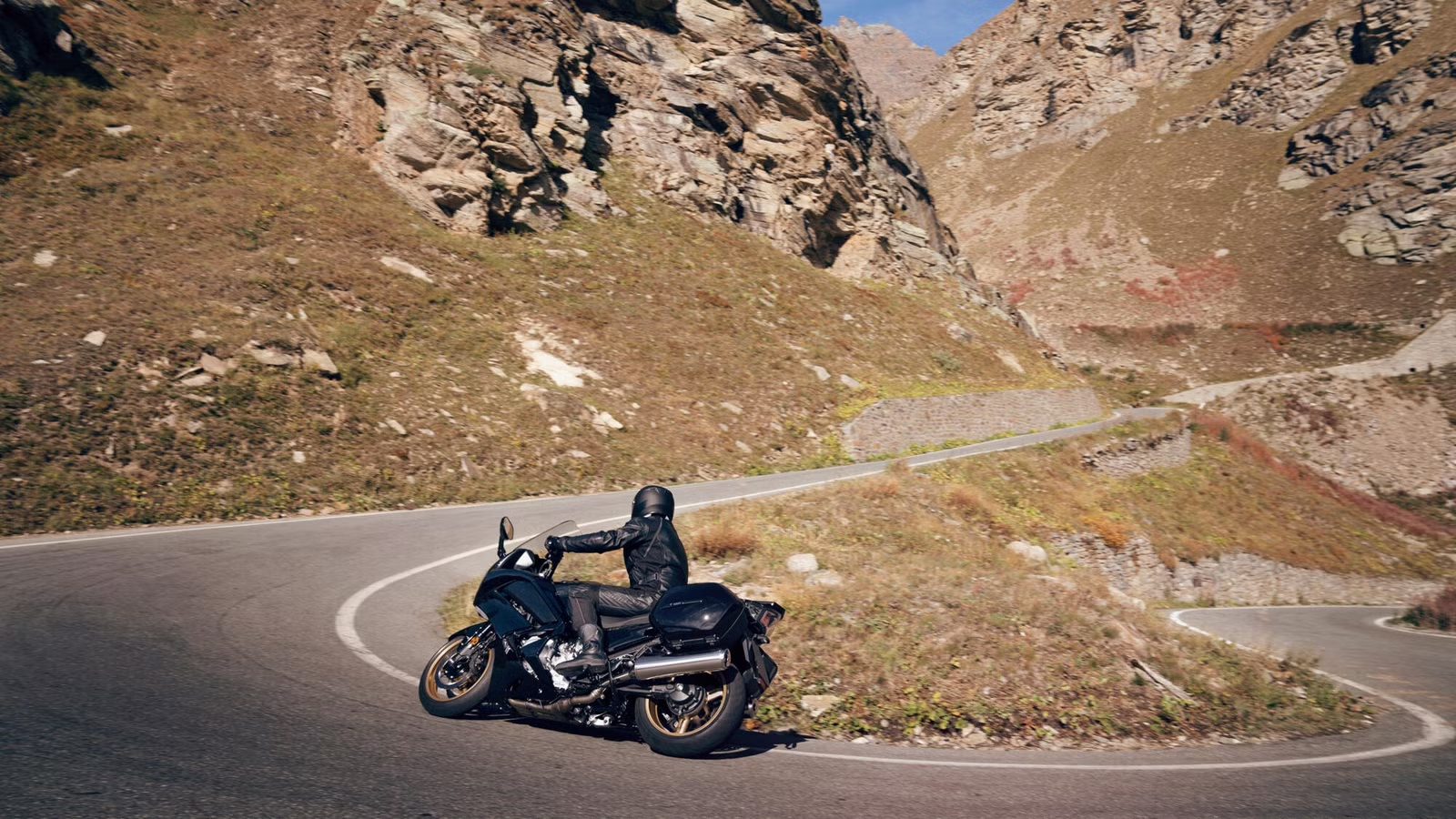
In recent times, the touring bike segment has truly flourished with variety. Traditional examples like baggers and full-dressers have increased their focus on tech and power, while sport-touring examples are more versatile and accessible than ever. That inevitably means there’s an overlap of segments where you can simply have the best of both worlds in one machine.

This ‘best’ usually means comfort and stability of traditional examples, topped with the speed and tech of sportier counterparts. So can you get bagger comfort and inline-four speed in one package? The answer is yes, and it comes from the Land Of The Rising Sun.
Why Bagger Comfort Is The Gold Standard For Touring Bikes
We all know baggers are popular worldwide, serving as the dream purchase for touring fanatics. Harley’s Street Glide/Road Glide, Indian’s Challenger, and Honda’s Gold Wing are all prime examples of such globally renowned baggers. Credit for that usually goes to their comfort quotient. Massive fairings, feet-forward ergonomics, sizable seats, and luxurious features are all part of the package in most cases. Add to that the sturdy construction, and you’re looking at a machine that lets you sit at freeway speeds for several hours.
But It Rarely Comes With Outright Speed


As impressive as all that is, one thing you might miss on these traditional baggers is outright speed. That’s because such bikes usually have large-capacity, highly understressed engines with a focus on torque to lug around all that heft. This is true for nearly everything in the segment, be it Harley’s flagship CVO Street Glide with a 121ci, ~115-HP engine or the massive six-cylinder powerhouse in the Gold Wing with 126-HP. BMW’s K 1600 B is an exception with 160 horsepower, but again, outright speed and performance are still not comparable to lighter, sportier inline-four examples.
How do you tackle this then? The obvious solution to this problem is picking a new-age sport-tourer. Something like the Kawasaki Ninja H2 SX or BMW S 1000 XR has ample inline-four performance, thanks to their superbike-derived engines and underpinnings. But that often comes at the cost of comfort, which won’t be anywhere near comparable to an OG bagger. Neither of these has saddlebags as standard, either. That then points us to the used market, where a recently discontinued Yamaha sport-tourer shines.
The FJR1300 Has Yamaha’s Inline-Four Kick With Supreme Touring Comfort

We’re talking about the iconic FJR1300. This is one of the greats of the Japanese sport-touring segment, ticking nearly every necessary box for a capable long-haul machine. Hard saddlebags as standard? Check. Relaxed ergonomics with a massive perch? Check. A spirited inline-four engine and sporty riding dynamics? Check and check. All that helps make this an easy recommendation if you want traditional touring comfort with modern-day speed in one package.
There is a catch, though. The FJR is no longer on sale as a new bike today, as Yamaha took it off the shelves in 2024. That means you’ll have to either settle for a used example from a few years ago, or look really hard at Yamaha dealers country-wide to find brand-new underlying stock. A quick look at KBB and CycleTrader suggests a 2020 example of the FJR should be between $10,000 and $13,000.
A Deep Dive Into The Yamaha FJR1300

While we’ve touched upon what makes the FJR1300 a good tourer, it’s the nitty-gritty that really helps make its case. After all, this was Yamaha’s flagship sport-touring bike between 2001 and 2024. In fact, the package was so good, several police forces around the world used this as their steed of choice. On that note, let’s dive into the details of the latest model.
An Over-1000cc Inline-Four With Almost 150 HP

We start with the engine. The FJR1300 features Yamaha’s 1,298cc inline-four powerhouse–a unique engine for Team Blue that powered no other machine. This has a 79 mm bore, 66.2 mm stroke, full liquid cooling, a final shaft drive, and Yamaha’s chip-controlled throttle, alongside lightweight forged pistons with carburized connecting rods.
All that helps produce 145 horsepower at 8,000 RPM and 101 pound-feet at 7,000 RPM. Those RPM figures are some of the lowest for an inline-four engine, ensuring there’s ample shove at all speeds. Speaking of which, the FJR does 75mph at just under 3,500 RPM in sixth gear. Keep it pinned, though, and you’re looking at a top speed of over 160 miles per hour.
Electronic Suspension And Relaxed Ergonomics Bring The Comfort

During those speeds, you’ll appreciate the FJR1300’s chassis, ergonomics, and suspension. All of these are put in place with comfort in mind. The suspension is the real USP here, thanks to its electronically adjustable nature. You can choose between four pre-load settings, three damping presets, and an additional seven damping settings to fine-tune how your FJR feels on the go. Also, the 48 mm USD forks and monoshock have around five inches of travel at each end.
Joining the suspension is an aluminum chassis derived from the sports bike world. This pairs with a sturdy subframe for handling luggage and pillion heft, while the 17-inch alloy wheels bump up the sportiness. Braking, meanwhile, is via dual 320 mm front discs and a 282 mm rear disc.

Coming to ergonomics, this is where things get even better. Yamaha claims the saddle has toolless adjustment to drop the seat height as low as 31.7 inches (or max of 32.5 inches), while the handlebar can be set in three positions. That should allow you to find your own sweet spot for the riding position–one that seats you in the comfiest position. You will also appreciate the electronically adjustable windscreen, mid-set footpegs, and adjustable air vents once you swing a leg over.
The Feature List Revolves Around Long-Haul Comfort, Too

Finally, there is a long list of features backing up the FJR’s sport-touring power and comfort. And considering this bike hasn’t had an update in a decade, the tech will only impress you more. We start with the cockpit, which comprises a three-gauge layout. In the center is a large LCD for showing speed, mode, and odometer. This is paired with an LCD on the right (for other bike info) and an analog tachometer on the left.
Then come the electronics and creature comforts. The ride-by-wire and six-axis IMU work together to enable traction control, two throttle maps, ride modes, and cruise control. The IMU also helps the cornering lights to do their thing. Rounding things off are two hard saddlebags, a fairing-integrated cubby space, a charging socket, heated grips, and Yamaha’s Unified Braking System.
Source: Yamaha Motorsports

Related posts

Latest Post


No Comments