
CarBuzz Says Your Family SUV Now Outweighs A 2005 Full-Size Pickup: Here’s What’s Driving The Bloat
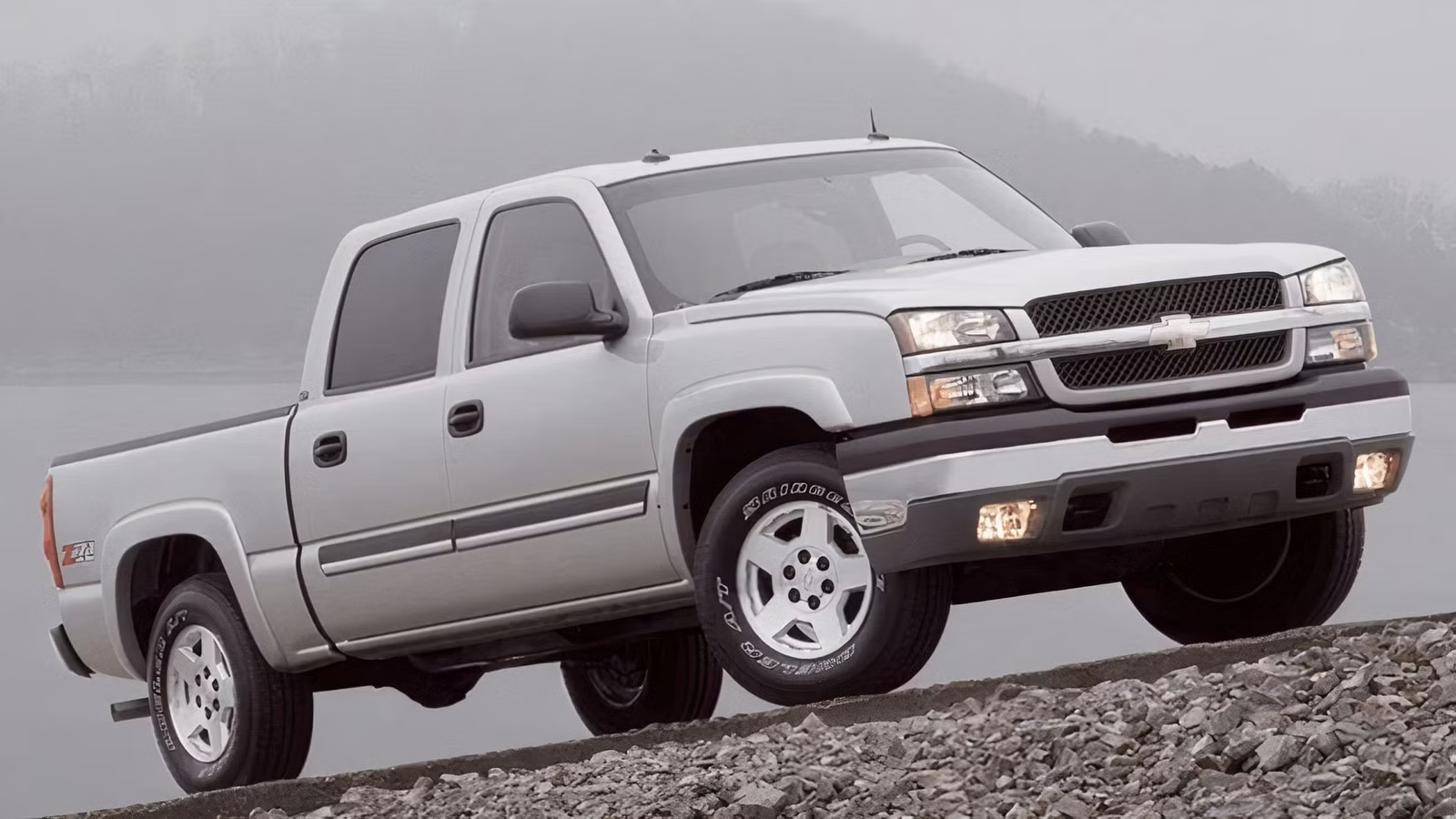
A new archive comparison from CarBuzz lays out a number that’s hard to shake: the Ford Mustang Mach-E Rally, a two-row electric crossover, weighs 5,038 pounds. That’s roughly 20 pounds heavier than two McLaren F1 supercars combined. It’s also heavier than the average full-size, half-ton pickup truck sold in the United States back in 2005.

That comparison isn’t a fluke or a cherry-picked outlier. CarBuzz put a whole lineup of modern three-row family SUVs on the scale against 2005-era trucks like the Dodge Ram SRT-10, Chevrolet Silverado, and Toyota Tundra, and found the same pattern again and again. The Chevrolet Traverse, Mazda CX-90, Toyota Grand Highlander, and Jeep Wrangler 4xe all land in the same weight class as the pickups your parents drove two decades ago, or heavier. For anyone shopping a crossover expecting it to be lighter and more efficient than a truck, that’s a real gut check.
The Numbers Behind The Reversal
CarBuzz’s baseline is straightforward: average out every configuration of every half-ton pickup sold in the U.S. in 2005, and you land around 5,000 pounds, about equal to two Honda Civics of that era. That figure now works as a floor, not a ceiling, for a lot of modern family haulers.

The Toyota Grand Highlander’s base trim weighs 4,290 pounds, essentially tied with a 2005 Tundra Regular Cab V8 4×2 at 4,275 pounds. Push into the Hybrid MAX Platinum AWD trim, and it climbs to 4,905 pounds, a dead-even match with a 2005 Dodge Ram 1500 ST Regular Cab 4×4. The Chevrolet Traverse AWD comes in at 4,795 pounds, just 205 pounds under that 5,000-pound 2005 median, and it already outweighs a 2005 Nissan Titan. The Mazda CX-90 averages 5,011 pounds across its lineup, and its plug-in hybrid version jumps to 5,243 pounds, within striking distance of a V8, four-wheel-drive 2005 Silverado 1500 Crew Cab at 5,299 pounds. The now-discontinued Jeep Wrangler 4xe averaged 5,180 pounds, roughly 50 pounds heavier than that Dodge Ram SRT-10 from the intro.

None of this weight gain is accidental, and it isn’t really about size creep alone. Hybrid and plug-in hybrid battery packs are doing a lot of the heavy lifting, literally. CarBuzz’s numbers show the hybrid system in the Grand Highlander adding 340 pounds over the base gas model, with the Hybrid MAX powertrain tacking on another 275 pounds beyond that. The CX-90’s PHEV version picks up nearly 400 pounds over its base configuration once the battery, motors, and supporting hardware are added.
Fully electric models carry an even bigger penalty concentrated in one place. The battery pack in the Kia EV9 alone accounts for 1,250 pounds of curb weight, which is most of an entire first-generation Honda CR-X. The Mach-E’s battery packs run as large as 98.8 kWh, and that mass sits low in the floor, which changes how the vehicle handles and brakes compared to a traditional gas crossover.
Beyond electrification, modern crash structure is doing quiet work too. Reinforced pillars, additional crumple zones, more airbags, extra sound deadening, and bigger infotainment and electrical architectures all add pounds that don’t show up as a single line item on a spec sheet, but they stack up across the whole vehicle.

This weight class shift has consequences that go beyond trivia. A crossover carrying truck-class mass needs truck-class brakes and tires to stop and handle safely, which is part of why heavier trims on vehicles like the Durango and Wrangler 4xe come with beefier hardware than buyers might expect from a family SUV. It also means EPA-rated efficiency numbers can be harder to hit in real-world driving, since a heavier vehicle simply takes more energy to accelerate and stop, regardless of how efficient its powertrain is on paper.
None of this makes these SUVs bad vehicles. Hybrid and electric powertrains bring real efficiency and performance gains, and modern safety structures save lives in ways a 2005 truck’s design simply couldn’t match. But buyers comparing a three-row crossover against a pickup on the assumption that the SUV is the lighter, more efficient choice should know that assumption doesn’t hold up the way it used to. The scale doesn’t care what body style is printed on the window sticker.
Source: Carbuzz

Related posts



Latest Post


No Comments