
The Toyota Hybrid That’s Suddenly Becoming A Sales Dud
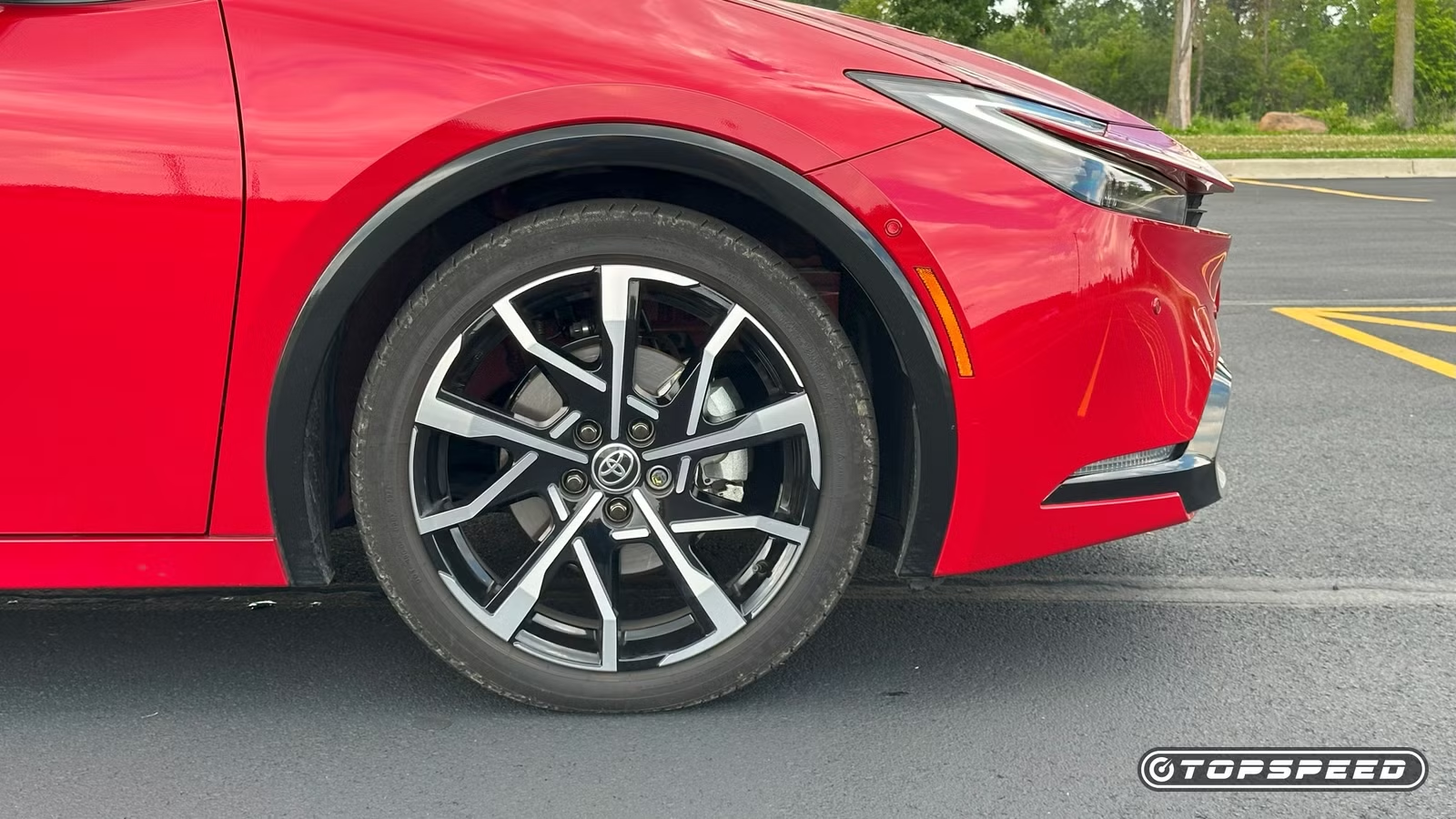
Toyota has long been the gold standard for gasoline-electric hybrids in the U.S., and for good reason. The Japanese brand has built an impressive portfolio of hybrid models creating accessible and dependable HEVs, spanning everything from compact commuters to three-row family haulers. Yet even as the broader hybrid market hits record highs, one of Toyota’s most storied nameplates is quietly losing ground — and the sales numbers make for sobering reading.

For many drivers, this model is the car that put hybrids on the map. It occupies the tight subcompact segment, however, which has always capped its ceiling. Despite softening demand, it remains one of the most affordable and fuel-efficient hybrids Toyota sells — making it one of the most underappreciated vehicles in the entire lineup.
Hybrids Are Gaining Massive Popularity Lately
As of 2026, the demand for hybrid cars in the U.S. has reached a historic peak, with the market estimated to be valued at approximately $778 billion and capturing a dominant 42 percent share of the global hybrid sector. This surge is primarily driven by a shift among American consumers who want meaningful fuel savings and lower emissions without the range anxiety or charging-infrastructure hurdles that still accompany fully electric vehicles. Major industry players include Toyota, Honda, Ford, Hyundai, and Kia, all of whom have capitalized on this trend by standardizing hybrid powertrains across their most popular lineups. Over the last decade, these vehicles have evolved from niche, economy-focused commuters into sophisticated machines that can genuinely compete on performance. Modern hybrid systems now benefit from advanced power electronics and lightweight materials to deliver better acceleration and, in some cases, greater towing capability than their gasoline-only counterparts — effectively positioning hybrids as the new mainstream standard for the American road.

Toyota built its reputation on hybrid success, but in 2026, its most iconic hybrid is quietly falling behind in showrooms. While the hybrid market reaches historic heights and Toyota’s other hybrids fly off lots, one unexpected model is becoming a cautionary tale about even the most successful brands having blind spots. What was once a torchbearer — virtually synonymous with the word “hybrid” — is no longer moving the needle, if sales records are anything to go by.
The Prius’ Sales Are Declining Majorly Despite A Tempting Starting Price

According to the Japanese brand’s September 2026 sales report, it was only able to sell 1,897 examples of the 2026 Toyota Prius. Through the nine months of this year, the brand has sold 16,731 copies — 51.1 percent fewer than the same period last year.
While the 2026 Toyota Prius is an accomplished hybrid, its declining demand over the past three months is not entirely surprising. The Prius has always occupied a niche corner of the market, owing to its compact dimensions and limited cargo versatility. That limitation cuts deeper today, as buyers increasingly gravitate toward practical crossover SUVs rather than compact hatchbacks. Toyota also hasn’t applied significant updates to the model since its launch, giving existing owners little reason to trade in for a newer example.
Pricing Remains Appealing

Toyota makes the 2026 Prius available at an attractive starting price, with the LE kicking things off at $28,550, followed by the XLE at $31,995, the Nightshade at $32,800, and the Limited at $35,565. Adding the all-wheel drive system raises the price by $1,400 across applicable trims. All figures exclude the $1,195 destination charge applied to every sale.
57 MPG Combined Makes The Prius The Most Fuel-Efficient Hybrid

The current-generation Toyota Prius is the standout choice if you want a hybrid that keeps fuel costs to an absolute minimum while maximizing range. The most efficient variant is the front-wheel-drive base trim, which returns 57/56/57 MPG on the EPA’s city/highway/combined cycle and covers 644 miles on a single tank. Compared with the average new vehicle sold in the U.S., you can expect to save as much as $3,750 on fuel over five years, or roughly $750 per year. That works out to $1.23 to drive 25 miles and around $32 to fill the 11.3-gallon tank.
Opting for the available all-wheel-drive configuration brings the efficiency figure down to 53/54/54 MPG and trims the range to 567 miles on a single tank. The reduction in range is partly due to the smaller 10.5-gallon fuel tank required to accommodate the additional rear electric motor.

The XLE and Limited trims, with their larger wheels, return 52/52/52 MPG and offer a range of 588 miles. Five-year fuel savings drop to $3,500, annual fuel costs edge up to $800, and a 25-mile trip will cost you $1.35 at the pump.
Choosing all-wheel drive on those trims yields a 49/50/49 MPG estimate and a 514-mile range on a single tank — still impressively frugal by any measure. Expect to save $3,250 in fuel costs over five years, spend around $850 on gasoline annually, or pay $1.43 per 25 miles driven.
You’re Not Trading Performance For Efficiency

The Toyota Prius range is only available with the brand’s Dynamic Force M20A-FXS naturally aspirated 2.0-liter four-cylinder Atkinson cycle gasoline engine. In isolation, the engine produces 150 horsepower and 139 pound-feet of torque, but combined system output rises to 194 hp when the powertrain works with the permanent magnet motor located in the eCVT. Opting for the electronic on-demand all-wheel drive system yields a marginally higher 196 horsepower output, courtesy of an additional rear motor.
Toyota claims the front-wheel-drive model will sprint from 0 to 60 mph in 7.2 seconds, while the all-wheel-drive variant trims that to 7.0 seconds. Both configurations are electronically limited to a top speed of 112 mph. The front permanent magnet motor generates 111 hp, while the optional rear unit contributes a more modest 40 hp. These motors can operate in full EV mode, though only under specific low-speed conditions.
The Prius Is Reliable And Retains Its Value Well

According to J.D. Power‘s consumer-verified rating system, owners of the 2026 Toyota Prius give it a 75/100 quality and reliability score, as well as 76/100 for the driving experience, 87/100 for resale, and 77/100 for the dealership experience, bringing its overall score to 78/100. Those figures make a compelling case for the Prius as one of the best hybrid compact cars on the market.
iSeeCars assigns the same model an 8.8/10 overall score, which breaks down to 8.0/10 for reliability, 8.5/10 for retained value, and a perfect 10/10 for safety. On the longevity front, the publication estimates it will cover an average lifespan of 12.9 years of 176,133 miles, with a 34 percent probability of reaching 200,000 miles. The Prius also ranks first in iSeeCars’ Best Family Hybrid Cars, Best Hybrid Cars, Most Reliable Hybrid Cars, and Best Family Hybrid Small Cars categories, among others.
According to Edmunds, owning a base LE Prius will cost $40,491 over five years and 60,000 miles, which includes $5,361 on maintenance, $773 on repairs, $11,860 on depreciation, and $6,804 on fuel. CarEdge puts the five-year ownership cost for the full range at $35,934, factoring in $12,670 on depreciation, $4,055 on fuel, and $1,437 on maintenance. RepairPal, meanwhile, estimates annual maintenance costs at just around $408.
A Class-Leading Warranty Adds Appeal

On the subject of mechanical integrity, the Prius features a relatively recent powertrain, so long-term dependability is still difficult to fully assess — even given Toyota’s bulletproof reliability reputation. That said, the model has not been subject to any recalls relating to core mechanical components. Over the long run, it is also likely to cost considerably less to maintain than a conventional EV, largely because owners avoid the prospect of an expensive high-voltage battery pack replacement after roughly 15 years of regular use.
The Prius range comes standard with the company’s comprehensive warranty package. Toyota also covers all hybrid components for 96 months or 100,000 miles, while the battery pack carries a class-leading warranty of 120 months or 150,000 miles. Owners have the option of extending the basic warranty up to 10 years or 125,000 miles through Toyota, though pricing varies by dealership.
Sources: J.D. Power, Edmunds, CarEdge, iSeeCars, and the EPA

Related posts






Latest Post


No Comments