Buying an SUV has always been about compromise—you get all-weather confidence, larger and more flexible space for people and cargo, and better visibility from a higher seating position, but you accept more frequent fuel stops and higher running costs. Those compromises have changed, though, as SUVs that once roamed wide stretches of farmland or scurried through the wilds have become domesticated to suburban life. Many have become smaller with lower stances, to allow easier loading and unloading of provisions and children, and the once-common, thirsty V-8 engines have been replaced by smaller, more powerful hybrid powertrains. The frontier days of the gas-guzzling SUV are mostly gone, and none exemplifies that evolution better than this one.
40-Series Toyota Land Cruiser Tackling A TrailToyota
Dating back nearly a century to the first Chevy Suburban, early SUVs were built around rugged truck frames designed to navigate ranches, construction sites, and remote trails. Durability mattered more than comfort, and fuel economy ranked well down on the list of priorities. For about 50 years, they were big, heavy brutes built on rugged ladder frames, and it usually, but not always, took a lot of fuel to keep them running.
Rear shot of 2025 Toyota Land Cruiser parked on driveway being loaded upToyota
The evolution from yesteryear’s SUV to today’s crossover SUV was swift, essentially scaling down the SUV from a full-sized Chevy Suburban to a compact Kia Sportage in the early 1990s. Compact SUVs were more family-friendly but didn’t go the full distance until the turn of the century, when unibody construction started to invade the SUV landscape, and this new car/truck hybrid quickly crossed over from “Born To Be Wild” into “Our House.”
Side 3/4 shot of 1966 Chevrolet Suburban Carryall in blue parked in parking lotBring A Trailer
Compact SUVs like the 1993 Chevrolet S-10 Blazer and subcompact 1995 Kia Sportage were created as urban-friendly alternatives to full-size SUVs, and they were still considerably thirstier than their passenger-car counterparts of the time. The big SUV change came in the late 1990s with the introduction of the unibody Honda CR-V and Toyota RAV4.
Initially described as compact SUVs, they soon acquired the CUV label to differentiate them as a crossover between car and SUV, and then simply as crossover to drop the “utility vehicle” designation. Today, the terms crossover and SUV are mostly interchangeable, depending on who you’re reading, with the “scientific” differences by and large ignored (and city-friendliness has little to do with what they are labeled).
High-angle front 3/4 shot of 1994 Chevrolet S-10 Blazer Tahoe in blue parked on grassBring A Trailer
Regardless, today’s crossover SUVs are the extent of that evolution, though they would still be less economical than their car counterparts were it not for electrified powertrains, which developed at roughly the same time around the turn of the century.
How The Compact SUV Became Today’s Default Family Vehicle
A 2005 Ford Escape Hybrid driving on a roadFord
Once steel ladder frames were removed from the SUV equation, the vehicles became lighter and required smaller engines, which reduced fuel costs impressively and made them considerations for the one-vehicle family driveway, but their budget integration didn’t quite take off until they took advantage of the newly developed hybrid technology, first seen in the 2005 Ford Escape Hybrid.
Hybrid systems proved especially effective in clearing the one hurdle SUVs always stumbled over—idling in the stop-and-go traffic that was common to around-town driving. Electric motors could act as a starter motor, shutting down the engine during wasteful idling; they could propel the vehicle at very low speeds before bringing the ICE back online; and they could ease engine workload during low-demand driving, like highway cruising. The result, as evidenced today in one particular SUV, is dramatic.
The 2026 Kia Niro Is The Most Economical Hybrid SUV In 2026
EPA-Rated 53 MPG Combined Is 10 MPG Better Than Runner-Ups
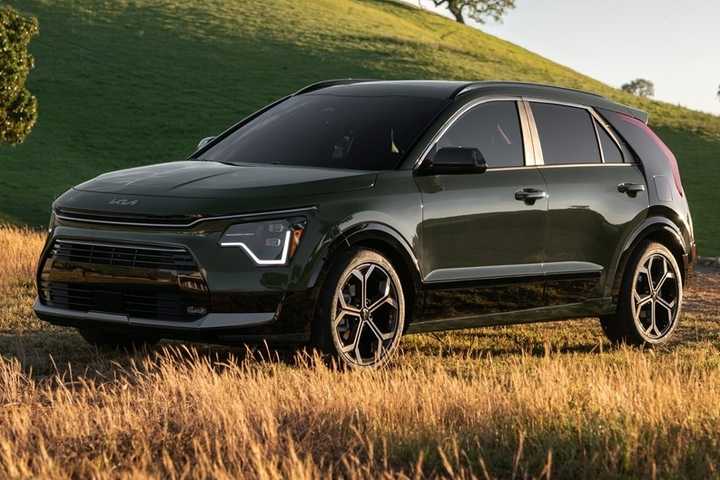
2026 Kia Niro Hybrid Front 3/4 Driving ShotKia
The 2026 Kia Niro Hybrid stands apart in a market crowded with increasingly efficient SUVs, rated by the EPA at 53 mpg combined, which makes it the most fuel-efficient non-plug-in hybrid SUV with an advantage that is by no means marginal—up 10 points on the next most efficient models, the 2026 Toyota RAV4 Hybrid and 2026 Lexus UX 300h (each EPA-rated at 43 mpg combined).
Designated Niro FE by the EPA, its achievement is particularly impressive because it doesn’t rely on PHEV or oversized battery technology. It just sips as little fuel as possible and saves thousands of dollars during everyday driving, from a carefully balanced combination of lightweight engineering, aerodynamic optimization, an intelligently calibrated hybrid system, and drivetrain refinement.
Teamwork Is The Secret To The 2026 Kia Niro’s Efficiency
Long-shot of 2026 Kia Niro Hybrid lineupKia
Unlike vehicles that rely on breakthrough features, the 2026 Kia Niro succeeds with existing technologies that collectively contribute to lowering fuel consumption—a light, compact footprint that requires less energy to move, airflow management, rolling resistance, and software calibration—ensuring no single system overworks itself.
That balanced engineering philosophy has become increasingly relevant to consumers who place greater value on saving fuel than on how quickly an SUV reaches 60 mph. In today’s wildly fluctuating gasoline-price landscape, fuel economy has become of prime importance to commuters with long daily treks and to families driving thousands of miles each year one around-town circuit at a time.
Kia Niro Was The Hybrid That Rewrote The Efficiency Manual
2017 Kia Niro front shot driving on the roadKia
Kia introduced Niro for the 2017 model year as an electrified-only model, starting with the hybrid version (that later welcomed a PHEV and EV). Rather than challenge conventional compact SUVs on performance or size, Kia took a different approach by putting fuel economy in the center of the blank design-sheet. That decision immediately paid off, as the Niro debuted with fuel economy figures that placed it at the top of the hybrid SUV segment.
That was particularly impressive in a hybrid market dominated by Toyota, with some heavyweight models like the long-serving Highlander Hybrid and widely popular RAV4 Hybrid. The focused approach on efficiency allowed designers and engineers to adapt every facet, from packaging to propulsion, toward making the Niro stand out. From there, subsequent updates refined the formula, rather than rewrite it. Today, it stands as the benchmark for newer, more efficient SUVs.
The 2026 Kia Niro’s Systems Work Toward One Goal
Rear 3/4 action shot of 2026 Kia Niro Hybrid driving on roadKia
The 2026 Kia Niro’s approach to fuel-economy supremacy is a result of systems that work well together, resulting in a whole that is greater than the sum of its parts. Its hybrid system is tuned to maximize electric operation at lower speeds and under acceleration, where gasoline engines are historically least efficient, with regenerative braking capturing energy during deceleration or constant cruising.
The Niro also forsakes the traditional hybrid continuously variable transmission, choosing a dual-clutch automatic whose gears are calibrated for further efficiency. Combine that with lightweight construction, low-rolling-resistance tires, and aerodynamic tuning, and you have a vehicle that maximizes efficiency by wasting as little energy as possible.
Reduced Power, DCT And FWD Add To Kia Niro Efficiency
Close-up shot of 2026 Kia Niro Hybrid engine bayKia
At the heart of the 2026 Kia Niro is a naturally aspirated high-compression 1.6-liter four-cylinder gasoline engine, the smallest ICE in a hybrid SUV, so it’s inherently the most economical. Most competitors use engines of two-liter displacements or bigger. Naturally, horsepower is drastically reduced, with the Niro’s 139 horsepower trailing both the CR-V (204) and the RAV4 (236), once you factor in each hybrid’s motors.
The Niro’s engine is further tuned to optimize combustion and makes extensive use of friction-reducing measures. Available only in FWD, Niro takes advantage of a six-speed dual-clutch automatic (DCT) that aids in eking the most out of the engine’s power and also in getting the most efficiency, balanced in city and highway use, whereas most hybrids use continuously variable transmissions that are often criticized for their lazy driving manners.
Thermal Management Plays A Big Part In The 2026 Kia Niro’s Efficiency
Profile shot of 2026 Kia Niro Hybrid parkedKia
Although the 2026 Kia Niro retains the upright profile of an SUV, it factors in subtle aerodynamic refinements to reduce drag and minimize turbulence around the vehicle—carefully sculpted body panels, strategically placed air channels, and active panels. Less aerodynamic resistance means the powertrain expends less energy to move the vehicle.
The technology behind the electric part of the powertrain also plays a big part in overall efficiency, in things like thermal management. Naturally, that phrase brings to mind the battery, but Kia’s system regulates operating temperatures for that, and also the motor and the engine, making sure all hybrid components are operating at their ideal temperatures, from an engine cold start to maintaining speed in scorching desert climates.
The 2026 Kia Niro Outdistances Itself From Efficiency Runners-Up
Front 3/4 view of a 2026 Toyota RAV4 Limited parkedIsaac Atienza | TopSpeed
2025 Lexus UX 300h driving in an urban areaLexus
The 2026 Kia Niro’s closest competitor when it comes to size-relative efficiency is probably the Toyota Corolla Cross Hybrid, whose combined 42 mpg rating lags 11 mpg behind the Niro. In between them sit Toyota’s most efficient hybrid SUVs—the FWD versions of the 2026 Toyota RAV4 and 2026 Lexus UX 300h that are both rated at a combined 43 mpg by the EPA.
Both models use larger engines—the Lexus uses a 2.0-liter four-cylinder, the RAV4 a 2.5—but their battery storage is comparable. The RAV4 battery holds 1.59 kWh and the Lexus’s 0.91, compared to the Kia’s 1.32 kWh, so the Niro doesn’t have the advantage of harboring more electric energy. The RAV4 is noticeably bulkier than the Niro, so that explains its lower efficiency rating, but the UX is about the same size (roughly equal to the Corolla Cross), so the Niro simply has a stronger hybrid system.
The 2026 Kia Niro Is The Hybrid SUV Efficiency Leader
Nearly ten years after it first arrived, the Kia Niro continues to prove that thoughtful engineering delivers meaningful gains in everyday usable efficiency. The SUV market has changed dramatically since the 2017 Kia Niro arrived in hybrid form, and nearly every manufacturer today has a hybrid SUV. It will be interesting to see whether a refreshed HEV-only 2027 Kia Niro retains its efficiency benchmark with its new exterior and updated interior.
2027 Kia Niro front 3/4 shotKia
It achieves that lofty goal without relying on a single technological breakthrough, but rather by using all the engineering available to it—from its cleverly calibrated hybrid powertrain to its expertly geared transmission, smooth-flowing aerodynamics, weight management, and thermal efficiency. It debuted at the top of the ranks, and has stayed there for the past decade. Its only consumer complaint has been the absence of AWD, so buyers can shop for alternatives if rough-road or weather management is a priority.
The 2026 Toyota RAV4 Is The Face Of The Hybrid SUV Market
2026 Toyota RAV4 GR Sport Front 3/4Toyota
The 2026 Toyota RAV4 is the go-to hybrid SUV for buyers who value interior space and versatility without giving up exemplary fuel economy. Its 2.5-liter four-cylinder engine pairs with Toyota’s proven hybrid system to deliver an EPA-estimated 42 mpg combined in AWD (43 mpg in FWD) while providing stronger acceleration and remaining one of the most economical family-sized SUVs available.
The Ford Escape Hybrid Was The Founder Of The Hybrid SUV Market
2025 Ford Escape front 3/4 shotFord
The Ford Escape Hybrid (available only in AWD) will not proceed beyond 2026, but there are units available on dealership lots, and it’s still widely revered as the founder of the hybrid SUV market. Its combined 39 mpg rates it as the most efficient American SUV, though it trails both the Niro and the RAV4. It borrowed Toyota know-how in developing its hybrid system and also uses a 2.5-liter four-cylinder.
Base Trim Engine
1.6L I4 Hybrid
Base Trim Transmission
6-speed auto-shift manual
Base Trim Drivetrain
Front-Wheel Drive
Base Trim Horsepower
103.5 HP @5700 RPM
Base Trim Torque
106.3 lb.-ft. @ 4000 RPM
Base Trim Fuel Economy (city/highway/combined)
53/54/53 MPG
Base Trim Battery Type
Lithium polymer (LiPo)
Make
Kia
Model
Niro
Sources: Kia, the EPA, Kelley Blue Book, Edmunds, Cars.com












No Comments