
The Forgotten Dirt Bike A Motocross Champion Built With His Own Prize Money
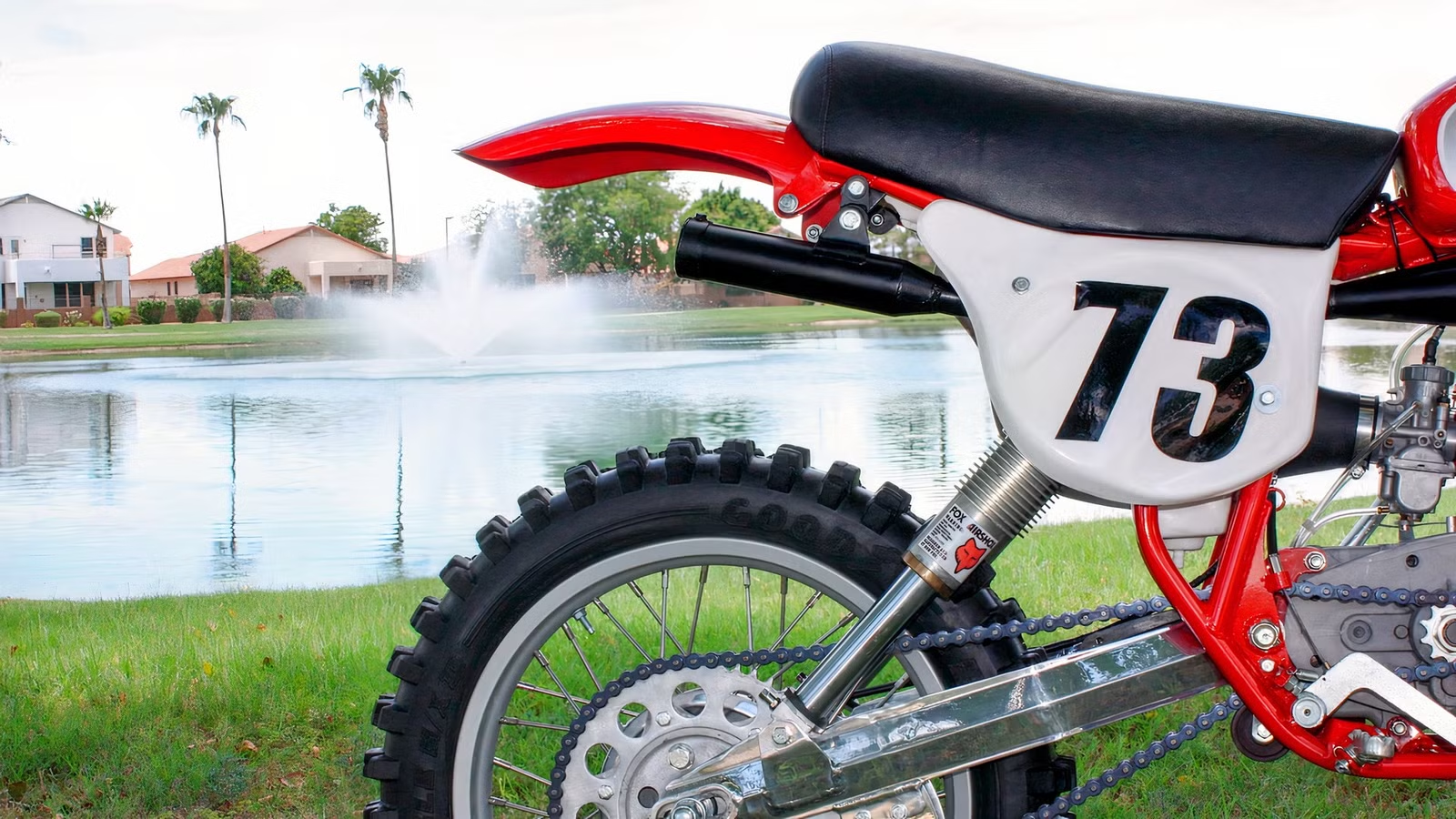
Most legendary motocross bikes are remembered for the championships they won or the innovations they introduced. Some are remembered because they simply couldn’t compete. Others disappear for reasons that have nothing to do with their engineering. One such machine was created by one of America’s most successful motocross champions. He believed he could build something better than the factory bikes he had spent years racing. He had championship-winning experience and a talented engineer. The project had all the ingredients for success. However, despite its promising potential, it became one of the sport’s greatest forgotten “what if” stories. It wasn’t because it failed on the track. It was because circumstances beyond human control brought the dream to an end.
A Champion Bet $70,000 On Himself

By the 1970s, Gary Jones had already established himself as one of the defining figures in American motocross. He was a three-timeAMA 250 National Champion. He was the first rider to win consecutive championships in the premier class. These accomplishments placed him among the sport’s all-time greats. More impressively, he captured national titles with Yamaha, Honda and Can-Am, proving that his success came from talent rather than loyalty to a single manufacturer.
That kind of resume made Jones one of the most valuable riders in motocross. During the era’s factory wars, manufacturers fought hard to sign championship-winning talent. Victories on Sunday translated directly into showroom sales on Monday. Riders who consistently won championships rarely struggled to find another factory-backed ride.
Jones appeared destined to follow that path until his career took an unexpected turn. While recovering from a leg injury, Can-Am bought out his factory contract. He was left without a ride just as he was preparing for the best phase of his career. For most riders, the obvious move would have been to negotiate another factory deal, but Gary Jones wasn’t interested in taking that route.

After racing for several manufacturers, he had developed clear ideas about what made a motocross bike truly competitive. Years of testing and racing factory machines had shown him where manufacturers compromised. He knew what design features worked under race conditions. He knew what he would change if given freedom.

Rather than waiting for another company to hand him a motorcycle, Jones decided to build one himself. To make that vision a reality, he invested $70,000 of his own prize money into launching a new motorcycle company. He did this alongside his father, Don Jones, a mechanic and engineer. Don played a major role throughout Gary’s racing career and became the force behind the ambitious project.
The partnership was built on decades of experience. Gary contributed the perspective of a rider who knew what it took to win national championships; Don translated those ideas into engineering solutions that could be manufactured and raced.
It was a financial gamble and Gary risked virtually everything he had earned. He bet on the belief that he could build a motorcycle and beat the industry’s biggest manufacturers at their own game. No other AMA professional champion has ever personally founded a motorcycle company to compete against the factory establishment. It remains one of the riskiest bets ever made by a rider in motocross history.
The Ammex 250 Was Built To Beat Factory Bikes

The result of that gamble was the Ammex 250. It was a purpose-built motocross motorcycle. It was designed from the outset to challenge the factory machines. To build an entirely new production facility, Gary and Don Jones acquired the struggling Cooper Motorcycles operation in Mexico. The acquisition provided an existing manufacturing base. It allowed the new company to focus its resources on refining the motorcycle without having to construct a factory from scratch.
The Ammex 250 reflected everything Gary had learned during years of factory competition. Rather than pursuing radical or experimental technology, the Jones family combined proven motocross engineering with carefully chosen innovations. The focus was on building a motorcycle that was lightweight, durable, easy to maintain and capable of winning races.
That philosophy also meant knowing when not to reinvent the wheel. Gary understood that successful race bikes were often the product of refinement rather than unnecessary complexity. Wherever proven solutions already existed, he was happy to incorporate them. He devoted development resources to areas where genuine improvements could be made.
The result was a machine built by a racer for racers. It was shaped by experience at the highest level of the sport, not by suit-wearing marketing departments or production targets.
The Clever Manufacturing Trick That Made The Project Possible

The engineering behind the Ammex 250 was impressive. The fascinating part of the story was how the motorcycle was actually built. Because production took place in Mexico through Moto Islo, the project had to satisfy a government requirement. The motorcycles had to contain 68% locally sourced content. For a company determined to produce a race machine using premium materials, that posed a significant challenge.
Gary Jones devised a very clever workaround. Instead of relying on locally sourced steel and aluminum, he shipped high-quality American chromoly steel and aluminum to Moto Islo. Once the materials arrived in Mexico, they were melted down and recast into new components. Since the finished parts were manufactured locally, they complied with Mexico’s local-content regulations while also retaining the quality of the imported materials. It was a clever solution that allowed the company to meet requirements without compromising the motorcycle’s structural integrity or racing potential.
The same practical thinking extended throughout the motorcycle itself. Rather than designing every mechanical component from scratch, Jones adopted proven ideas wherever they made sense. The transmission featured a Maico-inspired shift mechanism. The CZ kickstarter and shift shaft were selected for their simplicity and durability. The engine also incorporated Yamaha YZ250 top-end compatibility. This made replacement parts significantly easier for racers and mechanics to source.
Those weren’t shortcuts. They were engineering decisions. Every borrowed component had already earned its reputation under race conditions. This allowed the Jones family to focus on areas where original engineering would deliver the competitive advantage.
For an independent manufacturer taking on global motorcycle giants, that balance between innovation and practicality may have been the project’s greatest strength.
A Currency Collapse Killed The Company—Not The Engineering

Despite the ingenuity behind the Ammex 250, engineering wasn’t what determined its fate. The motorcycle itself showed promise. The company appeared to have laid the foundation to challenge the established factory brands. Its business model depended on manufacturing in Mexico. This left it exposed to forces that no amount of engineering could overcome.
Then everything unraveled. In less than a week, the Mexican peso collapsed from roughly 12 to 120, per USD. This instantly destroyed the economics that supported the operation. Manufacturing costs skyrocketed, and pricing became unsustainable. The financial model that had made the project viable disappeared overnight. The Ammex 250 hadn’t been beaten by rival motorcycles, unreliable engineering, or lack of rider interest. Instead, it became a casualty of a currency crisis. Moto Islo was eventually acquired by Honda in 1982. It later transitioned into appliance manufacturing, bringing an end to a factory that had once helped produce an ambitious motocross racer.
Today, the Ammex 250 remains one of the greatest forgotten “what if” stories in motocross. Its downfall wasn’t the result of engineering or disappointing performance. It was the result of a currency collapse, which ended the project before it ever had the chance to realize its full potential.
Source: Gary Jones Hall of Fame, RacerX

Related posts





Latest Post


No Comments