
The Stripped-Down 1965 Chevy That Embarrassed Its SS-Badged Cousins
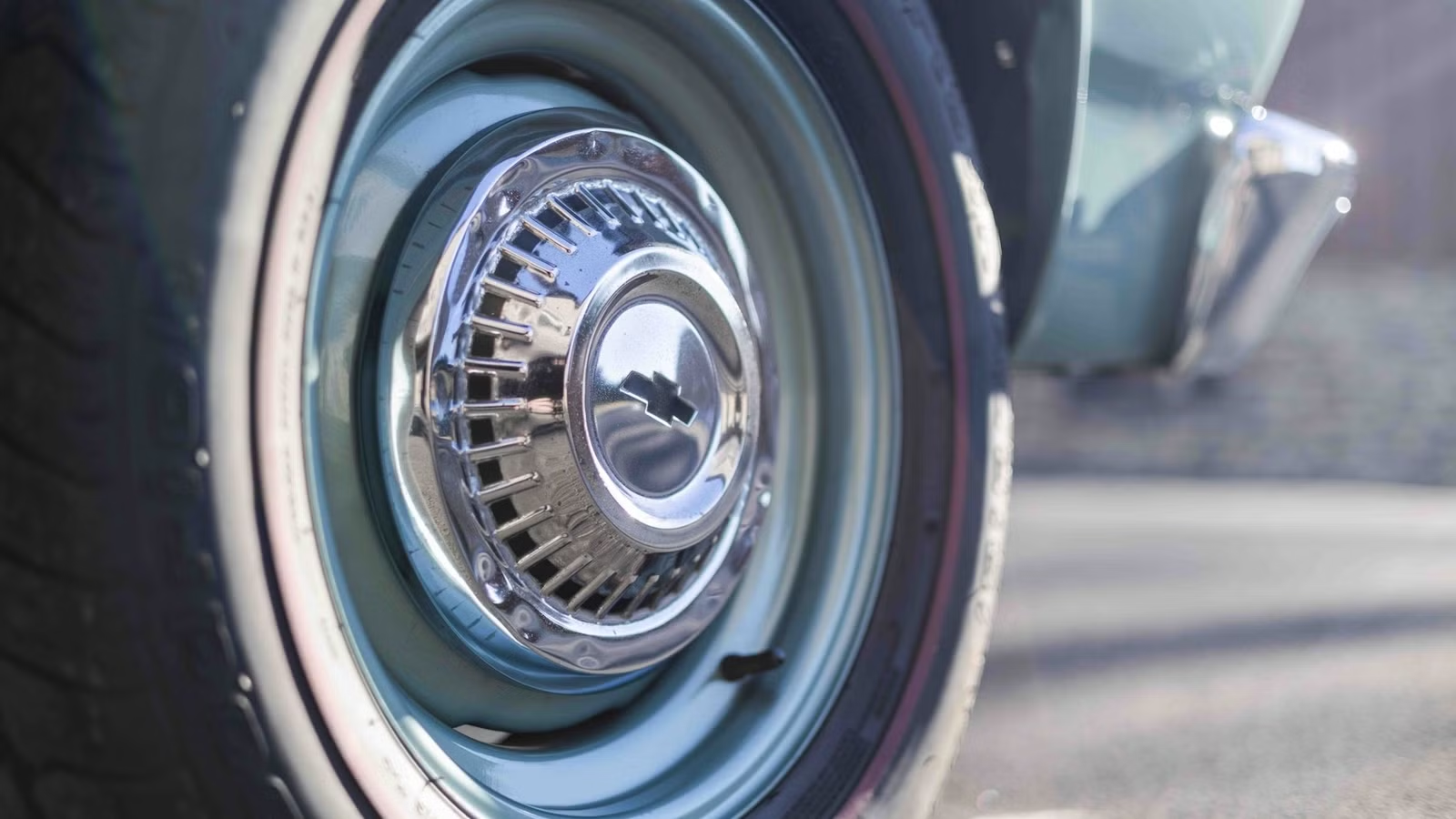
Imagine it’s 1965 and your buddy comes home with a stripped-down, base-trim midsize Chevy. The car’s so basic, it looks like a sedan with the back doors deleted. Then he tells you what’s under the hood and you realize he’s bought an absolute drag racing monster of a muscle car.

For just a few months, Chevrolet enthusiasts in the know could custom-order a legendary factory sleeper. The Bowtie soon realized its mistake and closed the loophole, ending an era forever.
Some Of The Best Muscle Cars Cruise Undercover
Sleeper drag racing cars have always had a certain appeal. When Gordon Rohde was a teenager, he worked at a Chevrolet dealership in Wisconsin. He ordered himself the ultimate sleeper car. A friend of his loved to drive it for one reason alone.

Rohde remembered, “He wanted it to race it. In Three Lakes there was a bar — The Modern Aire — and a lot of people all of the way from Chicago went there. When people got drunk, he raced them for money.”

The young Rohde had already lost his license once, so he kept his racing on the drag strip. He ordered the bare-bones brawler for a more philosophical reason. “I had this thought that if it didn’t make the car go, it didn’t belong in there.” And it didn’t hurt that he could run with the big boys while keeping his car payment to $75 a month.
“There were a lot of Corvettes that ran that class, heavier Impalas with a bigger motor.” Meanwhile, the teenager was laying down quarter-mile times as low as 13.09 at 96.77 mph.
The Chevy Engine So Powerful It Came In A Plain-Looking Car
The 2014-2017 Chevrolet SS packed a 415-hp Corvette V8 in a boring-looking sedan that fooled everyone on the road.
Chevrolet Built A Small Block That Spoke For Itself

Chevrolet released the 1964 model year Corvette with a truly legendary engine option: a 327 cubic-inch small block that made 365 horsepower at 6,200 rpm and 350 lb-ft of torque at 4,000 rpm. Chevy muscle car fans drooled over the powerful and comparatively lightweight V8, but GM only ever offered it in “America’s sports car.”
For the 1965 model year, Chevrolet built a version with the same displacement, same compression ratio (11:1), same basic heads, and a similar 4-barrel carb setup. But the L79 had one major difference. For drivability, it tossed the raucous, solid lifter cam and swapped in a cutting-edge hydraulic high-performance cam.

The result was 350 horsepower at 5,800 rpm. As if that wasn’t enough, the new V8 upped the torque to 360 lb-ft at 3,600 rpm. Yup, this thing could pull.
Robert Holland was serving in the Air Force and stationed in California when Chevrolet debuted the L79. He immediately knew the engine was “very special.”
Detroit Hid Its First 500 Horsepower V8 In Plain Sight
Dealerships may have even talked customers out of buying this historic engine.
Checking All The Wrong Boxes Built A Stripped-Down 1965 Chevelle That Could Embarrass A Malibu SS

|
Engine |
“L79” Small Block V8 |
|---|---|
|
Displacement |
327 cu in (5.4L) |
|
Bore × Stroke |
4.00 × 3.25 in |
|
Compression Ratio |
11.0:1 |
|
Horsepower |
350 hp @ 5,800 rpm |
|
Torque |
360 lb-ft @ 3,600 rpm |
|
“151” Camshaft |
High-performance hydraulic flat-tappet |
|
Carburetor |
Single Holley 4-barrel, 585–600 cfm |
In 1965, you could custom-order any Chevelle trim level with any engine. So while most Corvette-caliber L79s powering Chevelles left the factory in Malibu SS cars, decked out with bucket seats and a cascade of chrome badges, a few were in factory-built sleepers.
The kicker is that with extra roof supports and a huge fastback rear window, the Malibu SS weighed 110 pounds more than the cheapest car. That car was a two-door notchback that was badged as the Chevelle 300. You could option either trim level with an identical 350-horsepower L79 V8, Muncie four-speed transmission, and positraction rear end. The cheaper car technically offered a better power-to-weight ratio, but that’s not all.

The real irony is that in 1965, the SS trim was not yet a performance badge. It was basically an appearance package. Paying the surcharge just added chrome quarter panel badges, interior emblems, exterior brightwork, a blacked-out grille, and SS wheel covers. It also included some true upgrades, namely vinyl bucket seats, a center console, a full gauge cluster, and the option of a dash-mounted tachometer. But you could order the SS package on a car with a 120-horsepower six-cylinder base engine. So all in all, you could order a 1965 Chevelle SS that would struggle to finish the 1/4 mile in 20 seconds. You could also custom-order a bare-bones sleeper with a Corvette engine that would absolutely demolish an I6 SS.
Living With Chevrolet’s Legendary Factory Sleeper

Holland went right to the Chevrolet dealership to trade in his 1960 Chevrolet Biscayne and found that Chevrolet was only offering the L79 in the Corvette and the Chevelle/Malibu. He didn’t mind the recently redesigned Chevelle: “I liked the look of them.” But there was only one problem, “I didn’t have a lot of money.”
So the Chevelle Malibu SS coupe with the L79 sitting on the showroom floor was out of the question. There was still a silver lining: “I found out from looking at the sales books that you could get the engine in a low-priced four-door car.” Holland was usually the designated driver on base and wanted a four-door so he could haul the other guys to town.

He made the mistake of asking a salesperson to custom-order a cheap L79, and they sent him packing. He tried several other dealerships before a fellow airman sent him to his uncle, who worked for a dealership. The uncle let Holland check all the wrong boxes on the order form, custom-building a base model Chevelle 300 sedan with a cutting-edge Corvette engine.
Meanwhile, in Wisconsin, an 18-year-old Gordon Rohde was going through a similar process. The only difference was that he worked for the dealership and could check any boxes he pleased. He didn’t hesitate to order the Chevelle 300. “It was the lightest package and it was what I could afford.”
‘Every Six Months I Was Going Through A Set Of Rear Tires’

He ended up with the fastest small block in the catalog, but no radio and rubber floor mats instead of carpets. “I know [my car] came with a heavy-duty battery, but I don’t know if that was an option or included.”
He kept his 300 configured as a two-door “sedan,” which was essentially Chevrolet’s notchback body style. The budget-friendly people mover had an MSRP of $2,215—with a 120-horsepower straight-six. Rohde ended up with nearly three times as much power, for $2,480 out the door.

Rohde immediately got down to business, installing a set of 5.33 gears in the rear end and homemade lifters on the front springs to improve his 1/4-mile times. Multiple dates complained about the battery-powered Zenith transistor radio he’d toss in the backseat if they wanted music. But they’d have to wait: he was still saving for headers and an aftermarket carburetor.
“That didn’t go over too well, so when I got enough money, I installed a radio and put an antenna at the rear.”
Meanwhile, Holland and the other servicemen in California were having a grand old time in his L79-powered Chevelle 300 four-door. “Every six months I was going through a set of rear tires.” The only limitation was the speedometer that topped out at 120 mph. “It’s been past that. They have a lot of nice freeways in California.”
What SD-455 Truly Meant During Pontiac’s Stealth Muscle Era
Pontiac’s stealth muscle weapon defied regulations when everyone else surrendered to emissions rules.
The End Of The Sleeper Chevelle Era

The party didn’t last long. Rohde remembers that he had the most powerful Chevelle available for just six months. Then Chevrolet debuted a big-block Chevelle. “The Z16 came out mid year.”
The Z16 featured a new big-block V8 so large that Chevy had to reinforce the Chevelle with heavy-duty suspension and a reinforced boxed frame from the convertible version. Still, the 396 cubic-inch engine made just 375 horsepower at 5,600 rpm. It wasn’t even available with positraction. But it did finally get the 160 mph speedometer that the L79 had so desperately needed.

The Z16 was only available in the top-trim Chevelle Malibu SS. By the end of the year, the automaker had quietly deleted the L79 from the Chevelle’s order sheet. It would finally return to the Chevelle for 1967, but detuned by 25 hp, as if not to crowd the big block. And it wasn’t available in the 300 trim or even in the next level: the 300 Deluxe. The SS badge would evolve from an appearance package to become synonymous with GM’s most potent engines. The downside was that the era of the factory-built Chevelle sleepers was officially over.
But it’s not over for Bob Holland. He jokes, “If I’m in the hospital and I need an operation that’s going to require selling the L79 to save my life, I’m going to tell my wife, ‘Don’t sell the car.’” And it’s not over for Gordon Rohde. At the urging of his son, they restored his 300 Chevelle together. They never considered making it original. Instead, they kept his aftermarket rear end and the homemade suspension spacers from his teenage drag racing days.
Sources: Chevelle Stuff, Old Cars Weekly, and Aberdeen News

Related posts




Latest Post


No Comments