
The Shelby Le Mans Weapon Ford Killed To Protect The GT40
Some racing cars lose because they simply are not fast enough. Others lose because they never get the permission to race. The mid-1960s turned into all-out corporate warfare on the racetrack. When Henry Ford II failed to buy Ferrari, he declared war. Everyone knows the legendary GT40 was his weapon of choice, but behind the scenes, there was another machine. A car so terrifyingly capable that it was quietly executed by the same executives it was meant to protect. This is the story of America’s most overlooked supercar.
Early Days Of The Shelby-Ford Partnership In Endurance Racing

Carroll Shelby did not start his relationship with Ford as the boss of their premier racing division. The foundation of the Shelby-Ford alliance was built entirely on grassroots grit. Shelby started by dropping reliable American V8 engines into lightweight British AC chassis, giving birth to the legendary Cobra.
That scrappy sports car dominated tracks across America, but Shelby had his sights set on international glory. He wanted to take the fight directly to Ferrari at the grueling 24 Hours of Le Mans. To achieve that, Shelby American evolved the open-top roadster into the aerodynamic Daytona Coupe. It was a genuine success on the world stage, proving that a small team from California could build a world-beating race car.

Ford executives took notice of Shelby’s capability, but their own top-tier Le Mans prototype class was struggling. Their answer was to ship the whole GT40 program overseas, into the hands of John Wyer and his Ford Advanced Vehicles crew in England. Those first GT40s were a disaster. They fought terrifying aerodynamic lift at high speed, chronic mechanical failures, and a humiliating 1964 season.

Frustrated by the lack of results and burning through millions of dollars, Henry Ford II realized he needed help. The irony was thick. Ford trusted Shelby completely with the Cobras and Daytona Coupes, but executives were hesitant to hand him the keys to the multi-million dollar GT40 program. They wanted an in-house victory. Shelby knew he had to protect his own team’s future, preparing for the worst-case scenario.
Shelby’s Plan To Continue 24-Hour Endurance Seasons In ’65 And ’66

Carroll Shelby was never naive. Even with the Daytona Coupe capturing the FIA World Sportscar Championship, Shelby understood that middle management at Ford was heavily political. Dearborn executives were long-time backers of Holman Moody and the other established outfits. Nothing guaranteed Shelby American would ever get full control of the struggling GT40 program. In early 1965, Shelby was granted only a partial contract to work on the GT40, leaving his team in a precarious position.

Shelby needed a contingency plan. If Ford decided to award the premier GT40 contract to someone else, Shelby American would still need a lethal new weapon to dominate the 1965 and 1966 endurance seasons. He could not afford to sit on the sidelines while his rivals fought for the overall wins at Le Mans. The Daytona Coupe had pushed the front-engine design as far as it could go, but Shelby knew they could squeeze more performance out of a completely fresh chassis.
The mindset inside the Shelby American shop was essentially a declaration of independence. They were operating on the idea that if Ford refused to pick them as the official factory team, they would build a better car and beat Ford anyway. The team secretly developed their own insurance policy against Ford’s indecision. This project was meant to compete in the top prototype class, going head-to-head with whatever Ford or Ferrari showed up with. It was an ambitious, calculated gamble.
Peter Brock’s Type 65 Became The Plan For Domination

Peter Brock, original designer of the Daytona Coupe, was tasked with creating this Le Mans weapon. Brock did not simply want to build a Daytona Coupe with more horsepower. The new car carried the internal designation Type 65, though everyone just called it the Super Coupe. It was a clean-sheet evolution, every aerodynamic and structural lesson Brock had learned poured into a much bigger platform.

AC Cars built the chassis, a Mk II Cobra platform reinforced hard enough to swallow big-block power and widened onto a 92-inch wheelbase. Every dimension was stretched, widened, and flattened to fit. Brock’s original plan called for a lightweight, all-aluminum 390 cubic-inch Ford V8, light enough to keep a 24-hour prototype balanced instead of nose-heavy. That is not the engine sitting in the car today. Decades later, the sole surviving chassis would get a much heavier 427 cubic-inch iron block instead, a different animal entirely from what Brock actually drew up.
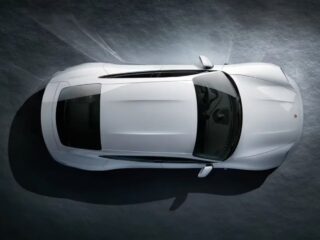
Aerodynamically, the Type 65 was a radical piece of engineering. Brock built in an aggressive Kamm-tail to cut drag, then flattened the roofline and dropped the windshield low. That lowered roof caused its own problem, wrecking the driver’s upward sightline on Daytona’s steep banking, so Brock cut a transparent sunroof panel into the roof to fix it. Ford’s aerodynamic models and Brock’s aerodynamic calculations suggested a theoretical top speed approaching 215 mph. It was built specifically to lock horns with the endurance avatars.
Ford’s Betrayal To Kill The Type 65 To Protect The GT40

The Type 65 was moving fast, and that speed is exactly what got it quietly sabotaged. Brock had planned for the aluminum bodywork to be built in Italy, by Carrozzeria Grand Sport, the same shop responsible for five of the six original Daytona Coupes. Instead, the blueprints were intercepted. Peyton Cramer, Shelby American’s own general manager, secretly passed the Type 65 plans to Harold Radford Coachbuilders in the United Kingdom without Carroll Shelby’s consent.
It is widely suspected that Cramer was acting under orders from Ford executives to derail the project, though this has never been confirmed. Harold Radford carried an elite reputation in the UK, traditionally crafting luxurious coachwork for high-society clientele. Ford had originally contracted them to manufacture interiors for the early GT40s. Radford was claimed to be charging roughly seven thousand dollars per interior, an exorbitant price Ford wanted to cut. To keep their lucrative contract, Radford allegedly offered to build the Type 65 prototype free of charge. The problem was that Radford lacked the fast-paced engineering mindset required to shape lightweight aluminum over a competition chassis.

They were the wrong company for a hardcore racing job. When Shelby engineers visited the Radford facility, they were appalled by what they discovered. The car was roughly eighty percent complete, but so heavy and badly proportioned that Brock barely recognized his own design. He traveled to England himself, and at his urging the unfinished chassis and body were pulled from Radford and shipped to Shelby American in Los Angeles for completion. However, the clock had run out. Ford officially handed Carroll Shelby the exclusive contract to run the GT40 program and demanded all resources focus solely on the GT40.
The Type 65 was shelved immediately, crated up, and shoved into a warehouse in Los Angeles still unfinished. When Shelby American was restructured in the late 1960s, the bare chassis was sold off as part of a package deal. It took roughly fifteen years for the car to see the light of day. Kansas collector Craig Sutherland eventually bought the chassis and commissioned fabricator Mike Dopudja to finish the build, with guidance from Peter Brock.
Dopudja installed a 427 cubic-inch Ford V8, rated at 485 hp. The resurrected Super Coupe made its public debut at the 1981 Riverside Vintage Races. Today, chassis CSB3054 stands as the lone survivor, tucked into the Brothers Collection, a private muscle car museum in Salem, Oregon.
Why Protecting The GT40 Meant Everything For Ford And Shelby

The demise of the Type 65 was not simply a tragic accident of timing. It was a necessary sacrifice. By 1965, Ford’s entry into endurance racing was no longer a hot-rodder’s romantic pursuit of speed. It was a costly corporate war born out of Henry Ford II’s failed deal to buy Ferrari. Ford commanded a bottomless budget to humiliate Enzo Ferrari on the world stage, using the racing program as a high-visibility marketing tool to target a younger demographic. Ford was no longer just building race cars. They were managing budgets, external suppliers, contractors, public relations departments, and shareholders.

The entire operation had morphed into a rigid extension of Ford’s engineering machine. Ford needed the optics of its own proprietary vehicle crossing the finish line at Le Mans in a perfectly orchestrated photo finish. Brock believed Ford had little appetite for another Shelby-developed prototype competing alongside the GT40, although that motivation has never been formally documented. One more prototype program would have diluted their financial and engineering resources at exactly the wrong moment. Nobody has ever proven Cramer acted on direct orders from above, and motorsport historians still argue about how deliberate the whole thing really was.
The hard truth is that protecting the GT40 meant there could be no internal competition. The Type 65 was too fast, too aerodynamically capable, and too much of a threat to Ford’s carefully crafted narrative. It had to die so the corporate GT40 could live. While that decision paved Ford’s road to Le Mans glory, it buried one of Peter Brock’s best designs before the world ever found out what it could really do.
Sources: Mecum, Bring A Trailer, Ford Performance

Related posts


Latest Post


No Comments