
The Roadster That Offers Sports Bike Performance Without The Riding Position
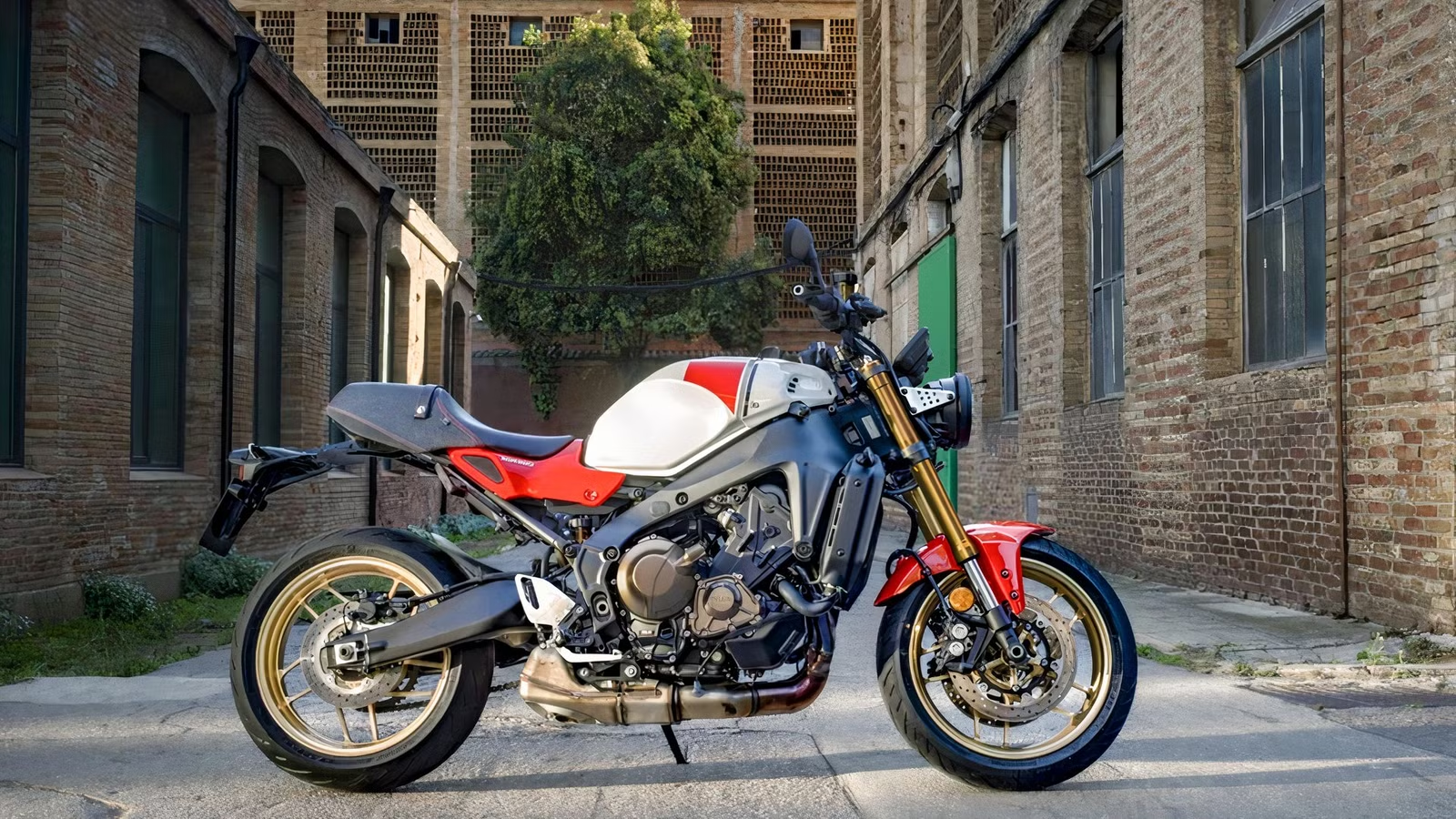
Motorcycle brochures love to sell lap times and high horsepower numbers. On real roads, those numbers do not mean much. An engine that makes all its power near the redline forces you to shift gears constantly just to keep moving. At the same time, low clip-on handlebars put too much weight on your wrists, neck, and lower back. An hour on the highway quickly turns painful. However, one specific roadster skips this spec-sheet vanity entirely. It focuses on strong low-end and mid-range torque, giving you genuine pace without wrecking your body.
Sluggish Vintage Iron Versus Spine-Jarring Track Replicas Is The Compromise

The roadster category is split into two camps. On one hand, retro naked bikes look great and offer comfortable, upright seating. But manufacturers often fit them with cheap steel frames, basic suspension, and weak engines that run out of breath on open highways. On the other hand, modern sportbikes give you sharp handling and high-end electronics. The problem is their aggressive riding position. The arse-over-elbows riding position makes them exhausting to ride over broken pavement. Buyers are stuck choosing between a comfortable bike that lacks performance, or a fast bike that hurts to ride every day.
Uneven Firing Orders And Rigid Spars Anchor Intuitive Low-RPM Drive

Fixing this problem comes down to basic engine design and frame geometry. An engine with uneven firing intervals produces immediate, predictable torque right where you need it on the street. You do not have to rev it out to make quick passes. Dropping that engine into a rigid aluminum twin-spar frame with a long swingarm keeps the bike stable in a straight line without needing low ‘bars. Yamaha used its modular platform strategy to make this work. The company took the six-axis IMU, lean-sensitive traction control, and slide control from its sportier machines, then dropped them into a relaxed, upright roadster chassis with great retro looks.
The Yamaha XSR900 Is The Modern Roadster That Rebalances The Equation


The Yamaha XSR900 proves you do not need race-bike ergonomics to go fast. Yamaha did not cut costs by detuning the engine. Instead, it gave it the 890cc CP3 inline-triple, which delivers immediate torque across the entire rev range. You get fully adjustable suspension, a stiff aluminum Deltabox frame, and a full electronic safety suite. Crucially, the tall handlebars and neutral footpegs keep your weight off your wrists. It delivers supersport pace and top-tier electronics, but leaves you comfortable enough to ride it all day — thus capturing Yamaha’s DNA perfectly.
Why A $10,599 Sticker Represents The Middleweight Market’s Best Math

The XSR900 is priced at $10,599. This is a premium price for what is essentially a middleweight motorcycle, but when you look at the features it offers, along with the neo-retro styling and the fact that it feels more premium than bikes costing $5,000 more, it is quite good value for money. That is because it is based on the MT-09 platform, which is a mature platform, but with the upcoming faired XSR900 GP, expect a small bump in price.
Crossplane Triple Torque Eliminates Constant Gear Changes

The XSR900’s engine is identical to the one powering the MT-09. This is an engine that is over a decade old, but still can hang with the best of them. The CP3 engine is a crossplane inline-three-cylinder engine that displaces 890 cc and generates 117 horsepower at 10,000 RPM and 68.6 pound-feet at 7,000 RPM. This is an extremely flexible engine that always wants to be revved out, but also offers great torque in the low and midrange. Elsewhere, it has a six-speed manual gearbox, an assist-and-slipper clutch, and a two-way quickshifter as standard. The quickshifter is a third-generation one, meaning you can shift either way no matter whether the throttle is open or closed. All of this put together makes the XSR900 feel better every time you ride it.
Deltabox Frame And A Brembo Master Cylinder Anchor Sharp Handling

Like the engine, the XSR900 borrows the MT-09’s chassis as well. This is a twin-spar frame made out of die-cast aluminum. Unlike other chassis, it consists of two longitudinal halves that are bolted together, and an aluminum box-section swingarm is used to locate the rear wheel. KYB suspension is present with inverted front forks and a linkage-type rear shock. The forks are adjustable for preload, compression, and rebound damping, whereas the rear shock has adjustment for preload and rebound damping. There is 5.1 inches of travel available at the front and 5.4 inches at the rear.

There are twin 298 mm brake discs at the front with radial four-piston fixed calipers and a Brembo radial master cylinder. At the rear, there is a 245 mm disc and a single-piston caliper. The radial master cylinder is a pleasantly surprising performance component for the price and ensures that braking is top-notch. Lightweight 17-inch spin-forged alloy wheels are present, and they are shod with tubeless radial tires. The chassis size and balance are so good, it will do the commute, canyon runs, and cafe nights with equal aplomb.
Manageable Proportions And Low Curb Weight Disguise True 890cc Power
The XSR900 is 84.8 inches long and almost 40 inches wide, with a wheelbase of under 59 inches. It has a seat height of just under 32 inches and ground clearance of 5.5 inches. The fuel tank is a little small at 3.7 gallons, but it also gets a claimed 49 MPG, so it does not need to visit the fuel pump often if ridden sanely. It weighs a total of 425 pounds wet, which compares favorably with competition that has parallel-twin engines. The lightweight, short wheelbase, and reasonable seat height all combine to make this a very approachable bike, but open the taps, and you need to know what you are doing to enjoy it fully.
Lean-Sensitive Safety Aids Transform A Classic Silhouette Into A Modern Weapon

The XSR900’s feature set became less retro in 2025. It has a five-inch TFT instrument cluster with Bluetooth and navigation available via Garmin StreetCross. There are also self-canceling indicators with a lane-change feature, and fans of the XSR900 GP, the cafe racer-styled version of this motorcycle, will be happy to know that it will be on sale in the US market for the 2027 model year. It is certainly the most anticipated Yamaha motorcycle in the U.S. in 2027.

The XSR has a complete electronics suite. A six-axis IMU and a by-wire throttle offer ride modes, cornering-enabled traction control, ABS, slide control, selectable wheelie control, and a back-slip regulator. There are three levels of slide control, and cruise control is standard. This can be enabled with a minimum of 25 miles per hour and third gear onward. The feature set, especially the electronics, is a match for any sport bike in the segment, which helps the XSR keep up with them.
High-Dollar European Roadsters And The Z900RS Pressure Yamaha On Premium Kit

The XSR900’s natural enemy is the Kawasaki Z900RS, a roadster that never stops feeling special. The SE variant retails for a fairly steep $14,599, but it offers a 948 cc inline-four-cylinder engine that generates 115 horsepower and 73 pound-feet of torque. It also adds an Öhlins S46 rear shock with a remote preload adjuster and a Brembo front brake package with M4.32 calipers and stainless-steel braided brake lines.

If you prefer to keep things premium and European, the $17,245 BMW R 12 nineT is worth the upgrade. It has the kit to justify the price: four-piston monobloc Brembo calipers for the front brakes, and 109 horsepower and 85 pound-feet from the 1,170 cc boxer-twin engine. It offers a different feeling with its relaxed ergonomics, wide ‘bars, and driveshaft, but loading it with options can quickly drive the price extremely high.

If you want genuine big-bike pace and feel but do not want to spend the kind of money that BMW asks for with options, there is the Triumph Speed Twin 1200 RS that retails for $17,195. The 1,200 cc parallel-twin has more personality than power, pushing out 104 horsepower and 83 pound-feet of torque. It is paired with Marzocchi fully adjustable inverted forks, Öhlins piggyback rear shocks that are also fully adjustable, and Brembo Stylema radial calipers.
Source: Yamaha Motorsports

Related posts



Latest Post


No Comments