
The Real Reason Ford Trucks Still Dominate Every Road In America
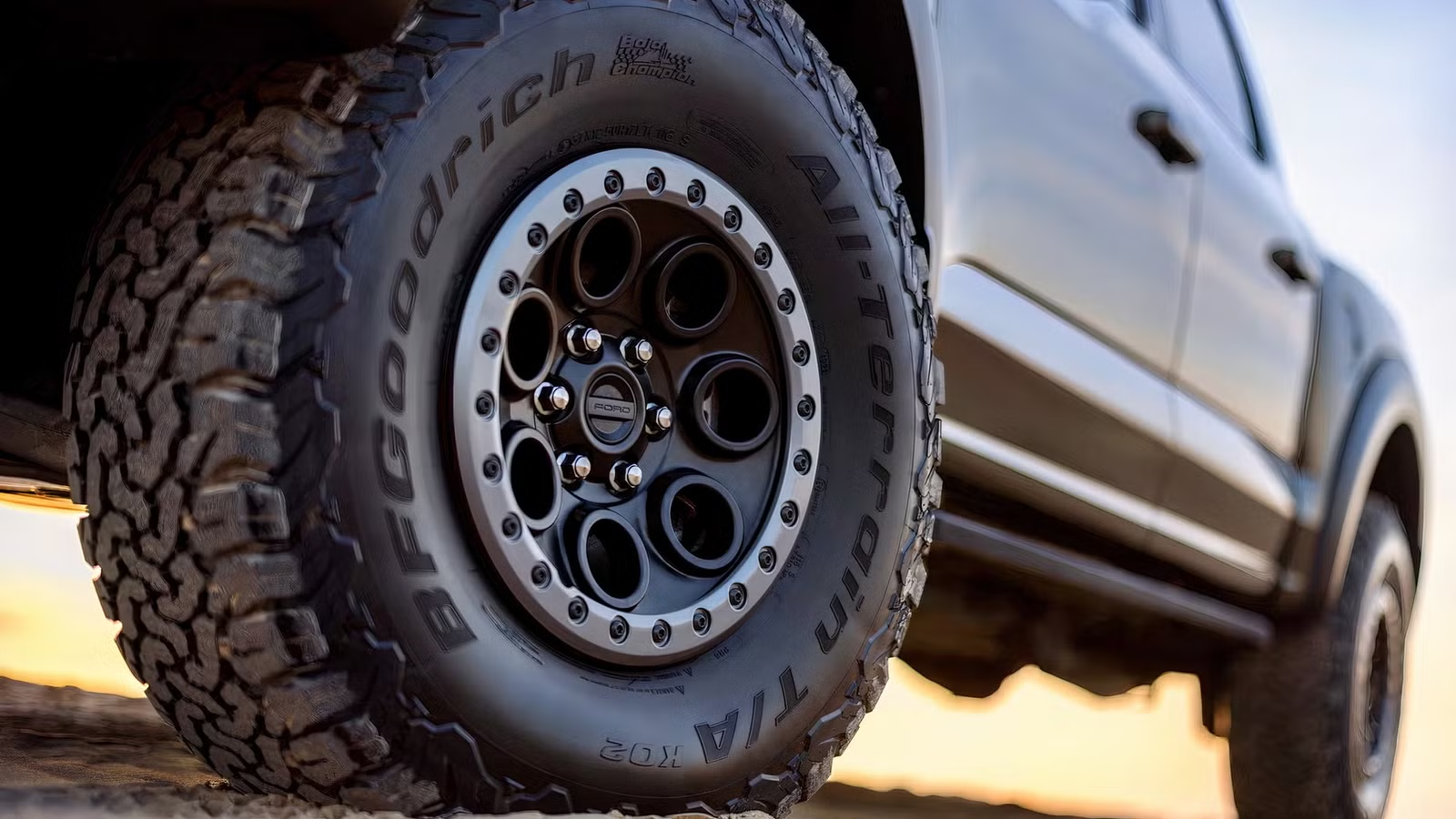
It is no secret to the rest of the world: In the US, we love our trucks. They ooze endless capability, and them being the ultimate utilitarian tool is a fact that seems to be ingrained in the American psyche. Not only that, but in the modern era, pickup trucks have become even more well-rounded. With electrification increasing efficiency in lower-displacement models, luxurious amenities and tech-focused features everywhere, the idea of a truck being a single-purpose tool for the average American is a very outdated viewpoint.

However, given the innovation in powertrains and refinement in trucks over the past decade or two, it’s easy to forget how trucks captured the heart of the nation’s soul so many years ago. It wasn’t sophistication or large displays; it was a feeling of loyalty, reliability, and having ownership of a vehicle that could go anywhere and do anything.
How Ford Proved To The USA Trucks Were Essential
For the majority of the 1940s, trucks were vehicles that were simply used on farms or ranches to carry and tow. But in reality, they were usually modified versions of pre-existing platforms. Manufacturers would take the basis of a chassis and then build a truck shape on top of it, limiting its capability and appeal. In 1948, this all changed when Ford released the F-Series. Ford built this truck from the ground up to be dependable and robust, meaning choices could be made about the vehicle from the very start of production instead of having to work around a car chassis’s limitations.

The personal need for pickup trucks increased alongside America’s post-WWII boom, and Ford was riding the wave of this perfectly. In 1965, the F-100 proved to the world that a truck could feasibly replace a family sedan, combining a more refined ride from its Twin-I-Beam suspension with genuine utility. This pivoted the Ford truck from a lifestyle item defined by hauling and strength to a vehicle that could be used even after the working week was over.
The Ford F-150 Is The Swiss Army Knife Of The Automotive World

It wasn’t until the F-150 was released in 1975 that this reality became mainstream. With plush interiors and luxurious additions like air conditioning, it was no wonder people were consolidating the workhorse truck and the family sedan into a single vehicle: the Ford F-150.
Trim Level Breakdown
- XL & STX is the no-frills, durable workhorse
- XLT & Lariat are the vehicles more dedicated to daily driving, with more tech blended with the existing durability
- King Ranch & Platinum are for people who require luxury in their trucks, with massaging leather seats and a dedication to tech
- Tremor & Raptor are true off-roaders, with upgraded suspension and all-terrain tires
Fast-forward to 2026; the Ford F-150 has taken the “do it all” reality to a whole new level. Overall, the 2026 F-150 is comfortable, capable, practical and fast – but each trim level allows you to tap into a different side of the truck more deeply.
Off-Road Capability And Extreme Utility

Trucks have come a long way since the 1940s models we discussed. The F-150 formula has been expertly crafted over decades to create the most perfected version of what a truck can be. While hardcore off-roading options aren’t necessary on most trim levels, which target more mainstream daily driver markets, the aforementioned Tremor and Raptor options use some incredibly advanced features to make them some of the most capable off-roaders in the business.
Off-Road Capabilities On The Raptor And Tremor models
- FOX live Valve shocks that scans the terrain and is aided by 12 inches of ground clearance
- Trail control and trail turn assist
- The Pro Access tailgate opens wide enough to clear a trailer jack
While a standard F-150 won’t be climbing over enormous rocks or driving over dunes at high speed, it is still a master of traditional off-roading, the type of which benefits the average, adventurous consumer. Whether it is a soaked, mud-filled field where most cars get stuck or navigating dirt trails, the F-150 has more than enough off-roading tech to accommodate all but the most serious enthusiast – and for those consumers, the Raptor exists.
Reliability And Everyday Practicality

The 2026 Ford F-150 achieved a J.D. Power quality and reliability score of 86/100, representing a great result for the legendary truck. Frankly, no matter how capable a truck is off-road, capability means nothing if the core mechanical reliability of the vehicle is lacking. The F-150 is a master at handling the mundane wear and tear of everyday life and has become a loyal companion to many consumers who require a seriously trustworthy, no-nonsense vehicle.
With the hybrid PowerBoost model removing the complex belt-driven starter motor, Ford has managed to simplify this powertrain and remove electrical gremlins. The lingering issue with the F-150 is the 10-speed transmission and its longevity. Without thorough maintenance and routine transmission oil changes, the gearbox has been known to shift prematurely or jolt aggressively. Overall, though, despite gearbox concerns, the F-150 is robust at its core for a highly complex twin-turbo hybrid truck, as is its rugged bodywork.
Performance And Powertrain

The powertrain offerings for the 2026 F-150 present huge versatility. On one end, there is the popular daily driver: the 2.7-liter EcoBoost Twin Turbo V6. Above that, there are several other options, ranging from a 3.5-liter V6, a more traditional Coyote V8, and the utterly insane 5.2-liter supercharged V8, which is more common in high-spec Raptors. This model outputs a colossal 720 horsepower but is beaten in terms of towing capacity by the highly capable 3.5-liter Twin Turbo V6, which can pull an impressive 13,500 pounds.
2026 Ford F-150 Powertrain Comparison
|
2.7-liter EcoBoost V6 |
5.0-liter “Coyote” V8 |
|
|
Transmission |
10-speed automatic |
10-speed automatic |
|
Horsepower |
325 |
400 |
|
Torque |
400 lb-ft |
410 lb-ft |
|
Towing capacity |
8,400 lbs |
12,800 lbs |
|
MPG (combined) |
21 |
18 |
|
0-60 mph |
6.2 seconds |
5.9 seconds |
The Three Most Significant F-150 Generations
Starting With The 10th Generation, 1997 Ford F-150

The 10th-generation F-150 was another huge step in the art of making the F-150 feel more like a daily driver. Before this vehicle, trucks were boxy, utilitarian and mostly work-focused, but the rounded redesign and split models of this generation birthed a new era of choice in pickup trucks. For those consumers who wanted a more traditional workhorse, heavier-duty trucks were available. But for those who specifically chose the new F-150, its independent front suspension, comfortable interior, and improved cabin insulation made huge leaps forward for family use.
12th Generation, 2011 Ford F-150

In 2011, the preconceived idea that towing heavy loads required a V8 was challenged. Ford caused a cultural controversy by introducing a 3.5-liter V6 engine, which produced 365 horsepower and 420 pound-feet of torque. Trucking traditionalists were highly skeptical of whether this powertrain would do the job, but after tireless marketing proving its durability and power, Ford proved to everyone that it was a calculated move. This eventually led Chevy, RAM and Toyota to do the same.
13th Generation, 2015 Ford F-150

The next-generation F-150 executed another risky design choice, with a pivot towards military-grade aluminum instead of steel. Like a big, thumping V8, a steel body seemed somehow intrinsic to the F-150 DNA, but once again, Ford proved itself by slashing 700 pounds of weight, improving fuel efficiency, removing the risk of rust, and proving to be hugely durable.
Sources: Ford, J.D. Power, CarEdge

Related posts



Latest Post


No Comments