
The Rare Pontiac That Made The GTO Look Ordinary
You probably wouldn’t want to work at Pontiac back in the late 2000s. Unless you’re the kind of person who likes to watch everything around you crumble into nothingness while your internal monologue keeps repeating “this is fine” over and over again. Such was the state of things when GM’s government mandated restructuring at the time. In the end, GM’s coolest brand went out with a whimper so pathetic it should be studied in business schools the world over. Well, it wasn’t all bad. There was at least one bright spot mixed in with considerable melancholy.
Pontiac in the 2000s, Not Such a Great Place to Be

In the 140-year history of the automobile, perhaps no automaker in the world went out quite so tragically as Pontiac. After a brief period during the first muscle car wars where there really wasn’t a brand that oozed more machismo than Pontiac did, the company spent the years after the 1973 crisis slowly losing everything about itself that made it special. Firstly, Pontiac was forced to downsize cubic displacements on its in-house-developed V8 engines. The first to go was the iconic 455-cubic-inch motor, and by 1981, the whole Pontiac V8 lineup was discontinued in favor of cheaper, ubiquitous Chevy small-block engines completely bereft of any power or flair.
Meanwhile, Pontiac’s flagship GTO muscle car was a mere shell of itself by the time its third generation rolled around. Relegated to the same A platform as the bloated and underpowered Oldsmobile Cutlass and Pontiac Grand Prix, the Gen-III GTO’s emissions-choked V8 was nothing like the screamer its ancestor used to rock. That third-gen GTO lasted all of one model year, before an even more pathetic X-platform base—the same one the humdrum Chevy Nova and Buick Apollo used—lasted for a single model year before the nameplate disappeared for decades. All the while, Pontiac’s lineup of passenger cars, along with the rest of the American auto industry for that matter, was subject to a series of downsizing efforts that turned the brand into a hollow shell of what it used to be.
Moving into the late ’90s and early 2000s, Pontiac tried and failed to reinvent itself with questionable products like the Montana minivan and the awkward Aztek SUV. Alongside badge-engineered family haulers like the G5 and the Torrent, it really felt like Pontiac was an afterthought. In those days, the best vehicle Pontiac had to offer was arguably the Vibe, a re-badged Toyota Matrix. In every way that mattered, Pontiac was dead in all but name by the late 2000s, but that didn’t mean it didn’t have one last trick up its sleeve.

Taking Inspiration From a Land Down Under

By 2009, it was clear that Pontiac, as well as General Motors as a whole, was on the ropes in a very bad way. Bleeding money at every twist and turn, unable to compete with Toyota, Honda, VW, or Nissan, it seemed as though nothing GM did could make a difference in what looked like a hopeless situation. Then, that very same year, the federal government stepped in. Facing the ragged edge of bankruptcy alongside their rivals at Chrysler, the feds forced General Motors into a restructuring program that compelled the company to discontinue some of its most iconic brands.
The first on the chopping block was Hummer, as well as Saturn a short time later, but there was something of a debate among the feds and GM about the third brand to get the ax. On the one hand, there was Pontiac, a dying brand with almost no redeeming qualities, and one that had just discontinued the only car that had garnered any real acclaim, the revived GTO, a few years prior. On the other hand, there was Buick, a brand that, at least in the US, was effectively in the same dire straits as Pontiac. Even so, Buick sold far more units in China at the time than it ever did stateside, a point that remains true nearly 20 years later.
With that in mind, it was pretty clear which brand the feds wanted cut, but that didn’t mean Pontiac was done innovating quite yet. Leveraging GM’s Australian Holden brand to fast-track a pipeline of new hardware to Pontiac, this was much the same move as when Pontiac imported Holden Monaro hardware for use in the revived GTO. This time around, Pontiac sought to use Holden’s surprisingly American-like, rear-wheel-drive Zeta platform to serve its own ends. Complete with a 6.0-liter V8 and proper performance suspension, Pontiac’s first product on the Zeta platform was the G8 GT. On its own, the G8 GT was a fine automobile, with a zero to 60 sprint in under five seconds. Still, it wasn’t the ultimate of the breed, and Pontiac was sure to show it right before going under.
The G8 GXP: Usurping the GTO Right Before Lights Out

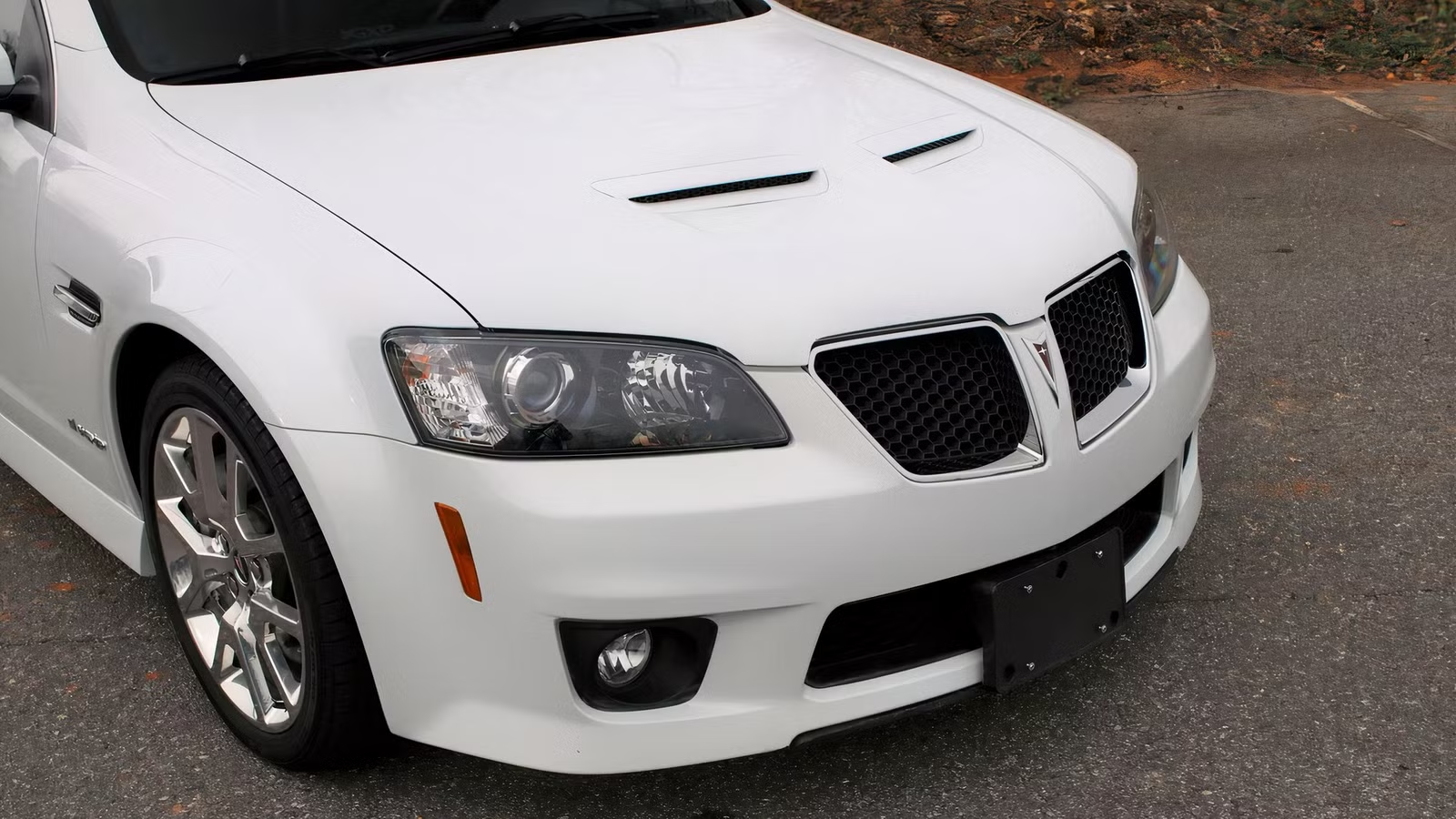
For 2009, its last year of operation, Pontiac managed to reach into its bag of tricks deep enough to pull out the very essence of what the brand used to be. Taking the basic chassis and body from the G8 GT, Pontiac removed the L76 V8 from a standard Holden Commodore and added the 6.2-liter LS3 V8 from a C6 Chevy Corvette. Now producing 415 hp and the same figure in lb-ft of torque, what was ultimately dubbed the G8 GXP sported an optional Tremec TR-6060 six-speed manual gearbox, 19-inch polished aluminum wheels, and substantial four-piston Brembo front brakes.
On top of that, there was stiffer FE3 sports suspension, a limited-slip differential, and all-new exterior sheet metal to make the car look far more aggressive than the average G8. From every angle imaginable, the G8 GXP looked like your average Pontiac sedan fused together with a German sports saloon. In fact, the G8 GXP’s primary rivals were not American at all. Rather, it was international heavyweights like the BMW M5, the Mercedes E63 AMG, the Infiniti G37, and the Lexus IS F. Compared to all of those, the Pontiac was considerably cheaper, starting at $39,900 versus the $56,700 IS F or the $87,000 E60 M5.

In every way that mattered, the G8 GXP was a working-class hero in much the same vein as the original Pontiac muscle cars of the 1960s. Contrasted against the underwhelming output of the preceding 30 years, it makes one wonder what could have been had Pontiac tried something similar decades earlier. For a very short, agonizingly brief period in 2009, the brand was on top of the world one last time. And then, it all came crashing down for good.
An Ultra-Rare, Surprisingly Valuable American Sports Sedan

All in all, Pontiac only managed to deliver 1,829 units of the G8 GXP to American dealerships before the entire brand went bust. Hilariously, a token shipment of ten units in total was imported to Canada, as if to say they’d done it on paper as a token gesture. From that run, fewer than 900 were equipped with the six-speed manual gearbox, making them some of the most desirable Pontiacs of the modern era that didn’t carry a GTO badge.

On the used market, these few-and-far-between examples routinely sell for $30,000 to $40,000 when the odometer reads higher than 50,000 miles. Below that threshold, they can legitimately command more than the very M5s and E63 AMGs the G8 GXP competed with. As a farewell for one of the most important American car brands of all time, the G8 GXP was about as good as it could have been. Rest in peace, Pontiac. There will never be a brand quite like you.
Sources: General Motors, Classics.com

Related posts




Latest Post


No Comments