
The Rare Car That Became BMW M’s Spiritual Predecessor
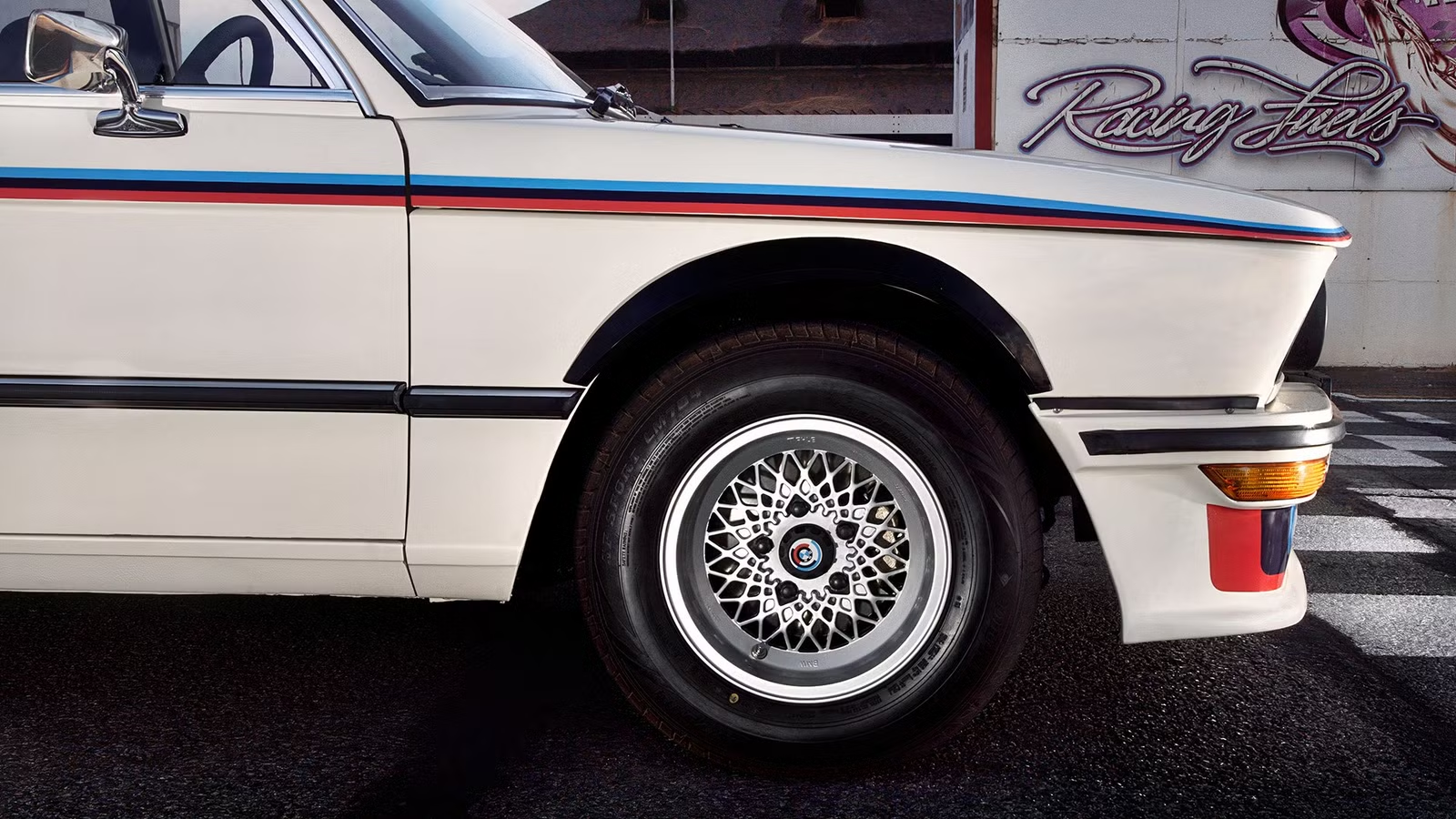
Two years before BMW launched the M1 as its first ‘M’ car, and eight years ahead of the original M5, BMW South Africa built a motorsport-inspired four-door sedan that was developed to win races. It was a small but important chapter in the company’s performance car heritage.
An Eye For Competition

The story began in the mid-1970s, when BMW South Africa decided to enter the country’s fiercely contested Modified Production Series racing category. Rather than developing the project on its own, the company sought the assistance of Jochen Neerpasch, the legendary German racing driver and head of the newly established BMW Motorsport GmbH. Two E12-generation 5-Series race cars were subsequently prepared for competition.
The South African regulations required manufacturers to produce road-going versions of their competition cars for homologation. BMW therefore needed to build at least 100 examples for public sale.
Enter The 530 MLE


In keeping with BMW Motorsport’s philosophy, the road car was considerably more than a normal 5-Series sedan with a few stripes and a larger engine. It was a genuine homologation special, developed with competition in mind and built at BMW’s Rosslyn plant near Pretoria – the company’s first production facility outside Germany, which had opened in 1973.
The first 530 Motorsport Limited Edition (MLE), known as Type 1, was produced in 1976. Just 110 were built, followed by 117 Type 2 cars in 1977, making a total production run of only 227 cars, all of which were produced in right-hand drive.
The Type 1 was particularly uncompromising. Weight reduction was taken seriously in a way that seems almost inconceivable on a modern executive sedan. Body panels were drilled by hand, as were the pedals, while electric windows and air conditioning were discarded. Lightweight Mahle wheels were fitted, and other measures were employed to strip unnecessary weight from the car.
The Type 2 was slightly less race-car-for-the-road, and had more luxury and refinement as well as a more subtle exterior design.
Straight-6 Performance

Under the hood was BMW’s familiar 3.0-liter M30 straight-six, but in MLE specification it received factory modifications that lifted output to 147 kW (200 horsepower) and 277 Nm (204 lb-ft). That was enough to propel the sedan from 0 to 62 mph in 9.3 seconds and on to 129 mph.
Those figures might not sound remarkable today, but in the context of the mid-1970s they represented serious performance. More importantly, the MLE’s character was defined by what happened between the acceleration runs. It was engineered to work on a racetrack.
When the BMW 530 MLE entered the Modified Production Series in 1976, it immediately demonstrated why BMW Motorsport had become involved, embodying the philosophy of what wins on the weekend sells on Monday.

The 530 MLE won 15 consecutive races from its first 15 starts, and gave BMW three consecutive championship titles. It remained active in South African competition until 1985, ultimately becoming the most successful racing 5-Series ever built. This is what makes the MLE so important in the wider BMW M story.
3.0 CSL Batmobile And M1 Supercar

BMW identifies the E9-generation 3.0 CSL ‘Batmobile’ as the first car developed by the fledgling BMW Motorsport GmbH, making it the technical starting point for the M-car lineage. The 530 MLE followed just three years later, before BMW established the M brand in the form we recognize today.
The first official ‘M’ car was the mid-engined M1. Designed by Giorgetto Giugiaro, the M1 debuted in 1978, making it the first vehicle developed entirely in-house by BMW Motorsport GmbH, ensuring its unique place in BMW history.

It was powered by a 3.5-liter straight-six and produced from 1978 to 1981. Only around 400 road cars were built, making it one of the rarest and most exotic BMWs in history. However, while the 530 MLE lacked the ‘supercar’ and official ‘M’ car status of the M1, it was even rarer with a total production run of only 227 units.
Today, BMW M is synonymous with performance cars such as the M3 and M5, but neither existed when the 530 MLE appeared. The first M5 would not arrive until 1984, while the original M3 followed in 1986. This makes the MLE’s timing significant for BMW’s performance car legacy that followed.
Performance Car Pioneer

The South African-built, four-door E12 was being transformed into a competition-bred road car while BMW Motorsport was still in its formative years. The MLE was therefore part of the same early motorsport philosophy that would eventually produce the M1 and, later, the M3 and M5.
The difference was that the MLE was not created for the global market. It was a uniquely South African answer to a uniquely South African motorsport environment.

This locally developed approach was carried through to several other revered special BMWs that were exclusive to South Africa and are now world-renowned and highly collectible. This includes the E23 745i, produced from 1984-1986 with a production run of only 209 cars. It was powered by the M1-derived M88 290 hp engine instead of the turbocharged 3.2- and later 3.4-liter units used in Europe. And, unusually, it was also raced in South Africa in the 1985 Group One championship, and subsequently in the 1986 Modified Saloon Car series. This made it the first and only BMW 7-Series race car in the world.
3-Series Continued The Theme

South Africa never received the first-generation M3, as it was built in left-hand drive only. Once again, the local engineers took matters into their own hands and produced the E30-generation 333i in collaboration with BMW Motorsport and Alpina. It used the 3.2-liter M30 engine from the 733i.

One of the most loved and famous 3-Series models was the 325iS which followed the same race-developed theme created by the 530 MLE. The 325iS was powered by a specially developed 2.7-liter six-cylinder engine that produced 145 kW (194 hp) in Evo I guise and 155 kW (208 hp) in Evo II, which compared favorably against the 192 hp 2.3-liter four-cylinder used in the original US-spec M3. As with the 530 MLE, the 325iS was developed to go racing in the Group N Production Car series, where it was very successful.
Motorsport Engineering For The Road

The 530 MLE and BMW’s trend-setting production performance cars that followed demonstrated the formula that would become central to BMW M: take a production BMW, apply serious motorsport engineering, reduce weight, increase performance, and create something that remains usable on the road. The M3 and M5 would eventually perfect that concept on a global scale, but South Africa had already experienced it a decade earlier.

Today, surviving 530 MLEs are understandably coveted. BMW South Africa eventually acquired car number 100, which had belonged to former MLE racing driver and team manager Peter Kaye-Eddie. It retained matching engine and chassis numbers and became the basis for an extensive factory-supported restoration.
Even more remarkable is the survival of one of the original racing cars. After the MLE race program ended, one competition car was written off, while the other was preserved and subsequently restored. BMW has described it as the only surviving racing 530 MLE.
So, while the BMW M1 may have the exotic looks, the mid-mounted engine, and the undeniable status of BMW’s one and only great production supercar, the 530 MLE tells a different—and arguably more important—story.

It is the story of BMW Motorsport finding its feet, of a manufacturer using racing to establish its sporting credentials, and of South Africa playing an unexpectedly important role in the development of BMW’s performance car philosophy. Accordingly, the 530 MLE was an important car that helped establish the idea of what an M car could be.
Source: BMW

Related posts

Latest Post


No Comments