
The Swedish Plug-In Sleeper That Makes The 330e Look Dated
BMW never threw the 330e a farewell party. There was no final edition and no press release, just a refreshed 3 Series that showed up for the 2025 model year with its plug-in hybrid quietly missing from the US lineup.

That left anyone who wants a compact luxury sedan they can commute in on electricity with one place to shop: the used market. Most of those buyers head straight back to the badge they know. In doing so, they walk right past a sedan with nearly twice the electric range, a 0-60 time the 330e can’t touch, and depreciation that has done its second owners an enormous favor.
The BMW 330e Left America With Just 23 Miles Of Electric Range
On paper, the G20-generation 330e had plenty going for it. It paired a turbocharged 2.0-liter four-cylinder with an electric motor for a combined 288 horsepower and 310 pound-feet of torque, and it carried the 3 Series reputation as the benchmark compact sport sedan. What it never had in America was meaningful electric range.
Why BMW Pulled The Plug After The 2024 Model Year


BMW confirmed the 330e wouldn’t carry into the 2025 model year when it revealed the refreshed 3 Series, but it never published a reason. The cut was also specific to the US. In Europe, the updated 330e picked up a 19.5-kWh battery and up to 63 miles of range on the more generous WLTP test cycle, a version American buyers never got.
The most widely repeated theory, floated by BMWBlog, is that a longer-range 330e would have crowded the i4 eDrive35, the entry point to BMW’s electric sedans. That’s informed speculation, not anything BMW has said on the record. Whatever the reasoning, the result for shoppers is the same. Every 330e on a US lot is the short-range version.
What 20 To 23 Miles Of Electric Range Actually Gets You

The EPA rated the rear-drive 330e at 22 to 23 miles of electric range depending on model year, and the all-wheel-drive xDrive version at 20 miles. That covers a short commute in mild weather. Add a school run, a highway stretch, or a cold morning, and the gas engine is back to doing most of the work.
Performance is respectable rather than memorable. BMW quoted 5.6 seconds to 60 mph for the 330e, the same figure it claimed for the gas-only, rear-drive 330i. The battery and motor bought some efficiency and very little extra excitement, which is a modest return for a sport sedan that’s supposed to deliver the best of both worlds.
The Volvo S60 Recharge Nearly Doubles The 330e’s Electric Range

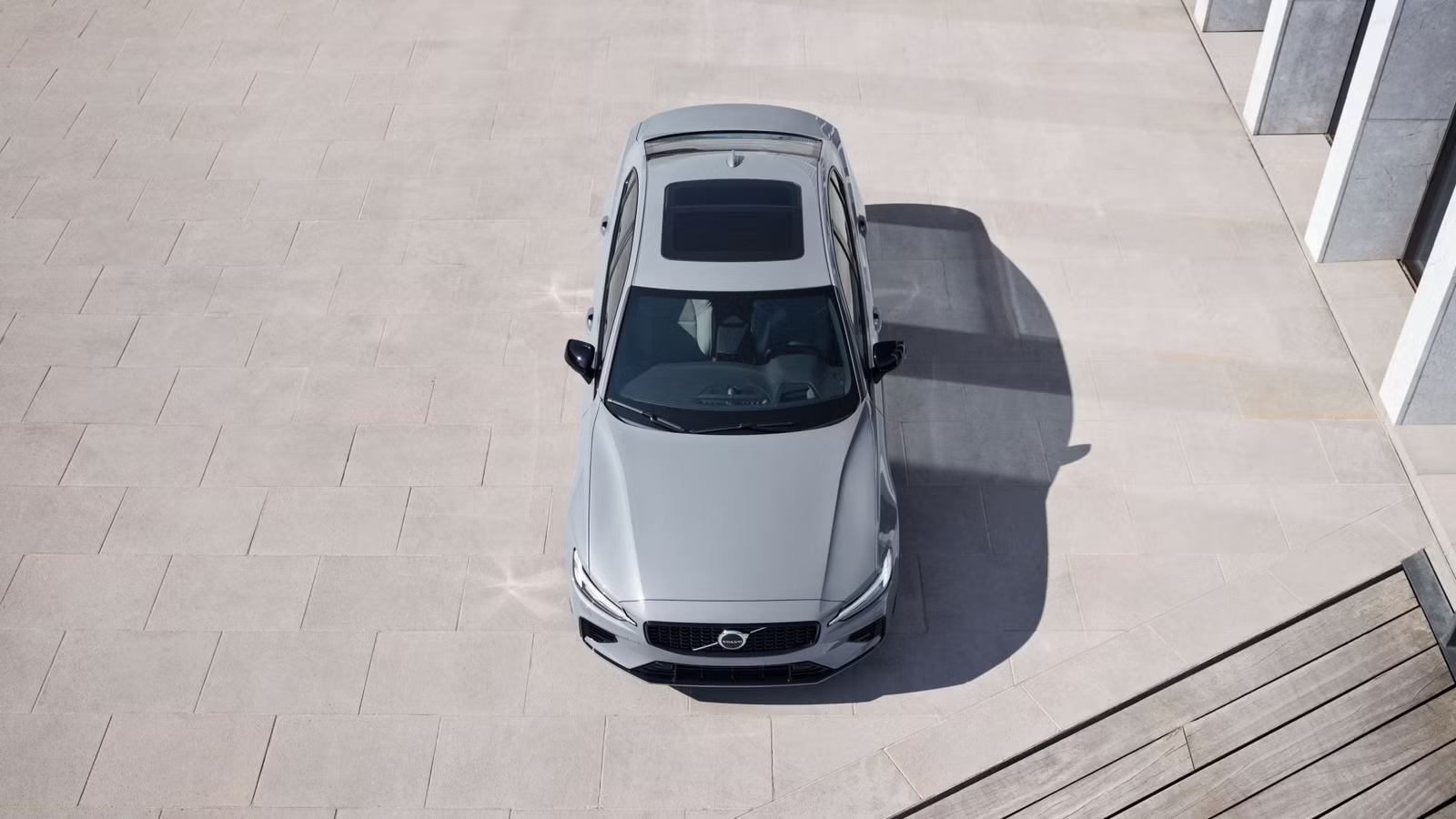
While the 330e made its quiet exit, Volvo’s compact sedan spent its final US years doing everything the BMW promised, and more. From the 2023 model year, the Volvo S60 Recharge carries an EPA-rated 41 miles of electric range, nearly double the best 330e figure, and a powertrain that leaves the BMW behind in every straight line.
455 Horsepower From A Sedan That Looks Like It Makes 250
Under the understated Scandinavian sheet metal sits a 2.0-liter four-cylinder that’s both supercharged and turbocharged, making 312 horsepower on its own. A 143-horsepower electric motor drives the rear wheels, which gives the S60 Recharge all-wheel drive and a combined 455 horsepower and 523 pound-feet of torque from the 2023 model year on.
Volvo claimed 4.3 seconds to 60 mph, already well clear of BMW’s 5.6-second claim for the 330e. When Car and Driver tested a 2023 S60 Recharge, it did even better, reaching 60 mph in 4.1 seconds and running the quarter mile in 12.5 seconds at 112 mph. That’s serious pace from a car that looks like it’s on its way to a parent-teacher conference.
41 Miles On Electricity Changes The Daily Commute Math

The bigger story is what happens on an ordinary Tuesday. The 18.8-kWh battery that arrived for 2023 gives the S60 Recharge an EPA-rated 41 miles of electric range and a 74 MPGe rating. In Pure mode, it runs as a rear-drive EV, and Car and Driver still saw 34 miles during its 75-mph highway range test, comfortably beyond anything the EPA credited the 330e with.
Once the battery is depleted, the S60 reverts to a hybrid that returns 31 mpg combined. A 240-volt Level 2 charger refills the pack in roughly four to five hours, so an overnight plug-in at home is all it takes. AAA’s reviewer used less than a gallon of gas across a full week by keeping daily trips under 41 miles, which is exactly how a plug-in hybrid is meant to work.
Why 2023 Is The Model Year That Matters On The Used Market

Not every S60 Recharge on a used lot is the car described above. The third-generation S60 offered a plug-in hybrid from its 2019 launch, but the version worth chasing arrived for 2023.
The Battery Upgrade That Separates Good S60 Buys From Great Ones
Earlier cars made 400 horsepower and, at launch, managed only around 22 miles of electric range. The 2023 update brought the larger 18.8-kWh battery and a much stronger rear motor, which is where the 41-mile rating and the extra 55 horsepower come from.
There’s a second reason to favor the later cars. In 2025, Volvo recalled certain 2020 to 2022 plug-in hybrids, including the S60, because the high-voltage battery could short-circuit when fully charged and parked, creating a fire risk. Dealers inspect the pack and replace affected modules, so any earlier car should come with proof that the work has been done.
What Depreciation And A Discontinued Nameplate Mean For Ownership Costs


The S60 Recharge has depreciated steeply, which is bad news for its first owners and good news for buyers. A 2023 S60 T8 Recharge Ultimate Bright Theme stickered at $56,700 before destination. As of October 2026, Kelley Blue Book lists its resale value at about $32,400, roughly 43 percent below that original MSRP.
Running costs look reasonable, too. RepairPal rates the S60 nameplate 3.5 out of 5 for reliability, 11th of 31 luxury midsize cars, with average annual repair costs of $750. That figure covers every S60, not just the plug-in, but it’s a useful benchmark. At the brand level, RepairPal puts Volvo at $769 a year against BMW at $968.
The S60 Recharge Is The Plug-In Sport Sedan BMW Stopped Building

The S60 Recharge isn’t a 3 Series, and pretending otherwise does it no favors. The BMW steers with more precision and feels more eager once the road starts to bend. The Volvo’s 11.6-cubic-foot trunk is smaller even than the 330e’s battery-compromised 13.2 cubic feet. Its electronic limiter caps top speed at 112 mph, and Car and Driver found it cutting power at around 110 mph during its quarter-mile run. When the four-cylinder wakes up after a stretch of silent electric driving, it sounds more industrious than inspiring.
But for the commuter who wants to run on electricity all week and still have 455 horsepower waiting for the weekend, the best used plug-in sport sedan doesn’t wear a BMW badge. It’s the one most 330e shoppers never think to look at.
Sources: Volvo, KBB, Cars.com, AutoBlog

Related posts




Latest Post


No Comments