
The Powertrain Everyone Called A Stopgap Just Hit A Record
The automotive industry has been chugging along with the internal combustion engine (ICE) for the past century or so. Even with numerous technological breakthroughs in the ICE in recent years, performance gains and emissions reductions have been incremental at best.

That’s where the next powertrain evolution comes in—electric vehicles (EVs). EVs have proven significantly more powerful and much more energy-efficient (which is different from energy-dense) than ICEs, but in the United States, the EV transition has slowed.
The subject of today’s article is a transitional powertrain technology that many thought would be just a stopgap, but is actually what is driving the sales growth of many brands today. Of course, I’m referring to hybrids, which have become America’s just-in-time powertrain choice as they solve 2026’s unique challenges for vehicle owners.
Just In Time For The United States

In the early 2020s, during the COVID pandemic, EV sales continuously surged, but that is no longer the case in recent years. Here are the hurdles that EV adoption continues to face and why hybrids have stepped in.
Federal Tax Credit Is No More

One of the major reasons why we’re experiencing a significant decline in EV sales from the prior year is due to the removal of the $7,500 Federal Tax Credit for EVs. That’s not an insignificant amount, and it’s enough for many customers to hold off on their EV purchase. At the same time, EVs still aren’t as affordable as they could be. For those who want an EV with three rows, the cheapest so far in the United States is the Kia EV9, which starts at $54,900—even though it’s manufactured locally.
For a similar amount of money, you can already get a fully-loaded, top-trim three-row ICE or hybrid SUV. Features-wise, there is a huge disparity between a range-topping three-row ICE or hybrid SUV, but when comparing apples-to-apples with each model’s entry-level offerings, their price difference of around $10,000 or more is a hard pill to swallow—especially at a time when wages aren’t keeping up with inflation. And it is not as though you save on fuel costs by going fully electric, because these vehicles rapidly depreciate.
High Efficiency, Low Price

And that’s where the advantage of a hybrid comes in. The good news is that, with EVs, despite their rapid depreciation and high purchase price, you could still recoup your costs if you are a high-mileage driver who charges regularly at home. However, even that will not happen instantly, and it will take a considerable amount of time for costs to be recouped, with depreciation being your single biggest expense.
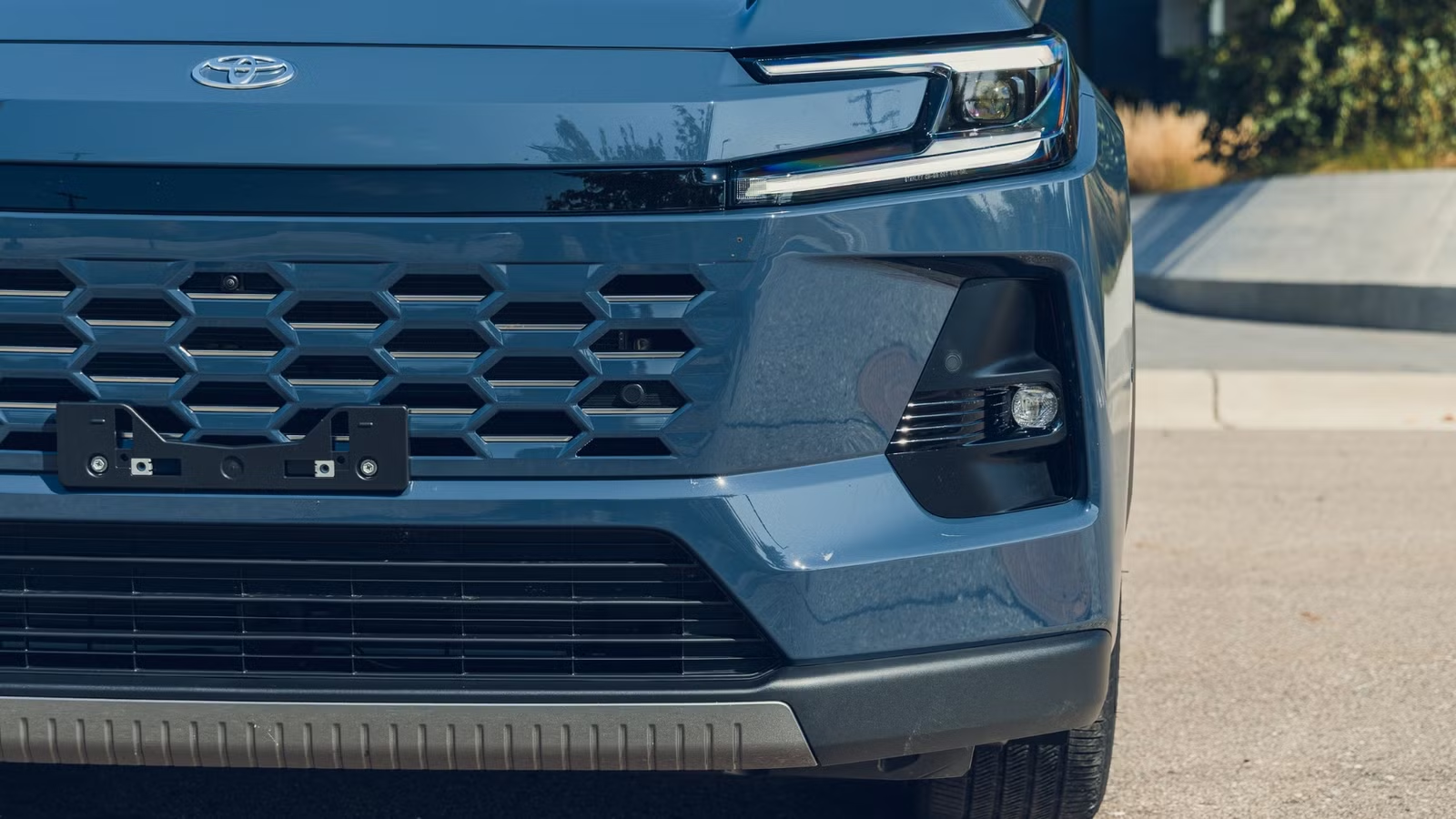
Meanwhile, with a hybrid, this is often your only powertrain option on some models like the new Toyota RAV4, and even if you have a choice between ICE or hybrid, the minimal price differences make it easier to recuperate the additional cost. In fact, Kelley Blue Book says that if a hybrid has a $1,375 premium over a non-hybrid, it would only take three years for the additional cost to be recouped. The speed of cost recovery becomes even faster the higher the gas prices, but let us not hope for fuel to go higher than it already is.
The “Stopgap” Is Now The Right Technology

To say that the pace at which EVs are being adopted worldwide is fragmented is an understatement. The world doesn’t revolve around a single country, and so EV acceptance varies. Hybrids were meant to be a stopgap powertrain, but they are now the fastest-growing powertrain type in the United States.
Now At 16 Percent Market Share

According to the latest available data from the US Energy Information Administration, 16 percent of new light-duty vehicle sales are hybrids as of the second quarter of 2026. This has clearly outpaced EVs, which shrank by one percent to six percent as of the second quarter of 2026. 2025 was the first year of EV sales decline, and it seems that’s set to continue this year. Plug-in hybrids, meanwhile, continue to be a minority (but not as much as hydrogen), shrinking to 1.4 percent versus 1.6 percent from the same period last year.
And These Automakers Are Winning

Unsurprisingly, automakers with competitive hybrid offerings are winning the hearts and minds of consumers. Toyota, which is the king of hybrids, is the clear market leader with 598,160 electrified vehicle sales, though this also combines the sales of all electrified vehicle types. When doing our own math by removing plug-in hybrids and EVs, Toyota sold 557,416 hybrids, and its sales are driven by the RAV4, which became all-hybrid for this model year. Honda, which sells four hybrid models, sold 213,513 hybrids as of the second quarter of 2026—its best-ever first-half for hybrid sales.
Other brands benefiting from the hybrid surge include Kia, whose first-half 2026 hybrid sales grew by an astounding 115 percent. Hyundai also experienced a hybrid sales surge, with its hybrid sales growing by 67 percent. Subaru did not state any numbers, but it reports that 20 percent of its first-half 2026 sales were hybrids, which contributed significantly to the brand’s 18.1 percent growth from the same period in 2025.
Why Hybrids Are Winning In The USA

Hybrid sales are clearly winning in the United States, and it’s why automakers like Nissan are joining the bandwagon just before the hype train is set to leave. Here is why this drivetrain technology is working for Americans.
Low Price Difference, High Benefits

These days, the price difference between a hybrid and a non-hybrid is not as large as it used to be. For reference, the Civic Sport starts at $26,695, while the Civic Sport Hybrid starts at $29,395—a $2,700 price difference. Some models even get redesigned without an ICE version altogether, and that recipe has proven to be successful for models like the Camry and the highly in-demand RAV4.
The RAV4 becoming all-hybrid may be more expensive by more than $3,000 for 2026, but spec-for-spec from the previous base RAV4 Hybrid, it is cheaper by nearly a thousand bucks. And that small difference is easily recuperated, especially for high-mileage drivers, as already reported by Kelley Blue Book. That is especially true if there is a significant difference in fuel efficiency between the models you will be cross-shopping with.

And do not assume that maintenance will be more expensive, because with some hybrids, particularly those by Toyota or Honda, the maintenance costs are roughly the same or even lower. I’ve often explained how Toyota’s hybrids are sometimes simpler than its pure ICE counterparts, and because of that simplicity, they can be cheaper to maintain since the consumables like brake pads last longer thanks to a hybrid’s regenerative braking, among other advantages.
No Lifestyle Change Required

Perhaps the major selling point for hybrids in America is that they require no lifestyle change. For some, that’s a convenience that they prefer. No need to rethink fueling from charging is sometimes a selling point, for better or worse. Maintenance, as mentioned, is no more complex than that of an ICE car. You just start it up, drive it, and just fuel it like you would any other vehicle.
Plug-in hybrids, meanwhile, still need to be charged to reap their maximum benefits, but since they are not committed to being full ICE or full EV, the prospect of managing two different fuel sources is not something every American wants to contend with. It’s why, outside of hydrogen fuel cell electric vehicles (FCEVs), plug-in hybrids are a minority in the United States.

Perhaps the only thing to be concerned about with hybrids at this point is their battery, but the good news is that, particularly with experienced brands like Toyota and Honda, you likely will not even reach a point where the battery needs to be replaced. I wrote an article on the Lexus ES and its battery life and costs, and even if you purchased a 10-year-old used model, your odds of a battery replacement in the fifth year (15-year lifespan) are still extremely low. And with numerous Toyota hybrids being used as taxis with ultra-high mileage, would operators continue using a hybrid if the battery and maintenance costs outweighed the benefits? Of course not.
Sources: Toyota, Honda, Hyundai, EIA, KBB, The EPA

Related posts




Latest Post


No Comments