
The Pontiac Muscle Car That Gave Buyers GTO Power Without The GTO Badge
The Pontiac GTO ignited a revolution by giving buyers more engine than anyone else offered at the price point. Seven years later, Pontiac had turned that simple idea into a famous badge, a dedicated model and one of Detroit’s most recognizable muscle cars. But here’s the strange part: Pontiac never actually made you buy a GTO to get GTO power. For 1971, another Pontiac muscle car offered every engine on the GTO’s menu, including the mighty 455 H.O. You just had to know where to look.
Pontiac Turned Three Letters Into A Muscle Car Legend

The original Pontiac GTO was not supposed to rewrite automotive history. In 1964, it was an option package on the Tempest LeMans, built around a 325-hp 389 V8, dual exhaust, GTO badges, an engine-turned dash insert, and twin hood scoops. General Motors’ own heritage collection puts the base price at $2,852 and says Pontiac sold 32,450 Tempests with the GTO package that first year.
Pontiac’s happy accident did not stay anonymous for long. The GTO became its own model for 1966, then hit a sales peak of 96,946 cars the same year. By then, the obscure Italian initials were no longer a wink between a salesman and a customer who knew how to read an order sheet. They were a brand, a warning label, and a dare—all in three letters. The horsepower war had turned into an artillery exchange, and Pontiac had fired one of its loudest shots.
Then GTO sales fell from 40,149 in 1970 to just 10,532 in 1971. Insurance companies, emissions rules and lower-compression engines were all squeezing the muscle-car market. But the GTO’s reputation had not gone anywhere. If anything, the badge had become more famous just as the business case around it got worse. So what did that famous badge get you under the hood in 1971?


The 1971 GTO’s engine menu was short, blunt, and very Pontiac. The standard engine was the L78 400 four-barrel, rated at 300 gross horsepower and 400 lb-ft of torque. Buyers could step up to the L75 455, good for 325 gross horsepower and 455 lb-ft. At the top sat the LS5 455 H.O., rated at 335 gross horsepower and 480 lb-ft. The numbers were lower than the wildest high-compression cars of 1970, but that torque curve still looked like it had been drawn with a carpenter’s square.
The 455 H.O. mattered because Pontiac did not simply bolt a big carburetor onto a low-compression engine and hope nobody noticed. Its compression ratio had plummeted from 10.75:1 in 1970 to 8.4:1 to accommodate new low-octane gasolines. But it got No. 197 round-port heads, an aluminum dual-plane intake with a cast-iron crossover, a 068 cam, and high-flow exhaust manifolds. In plain English, Pontiac lost squeeze, then bought back power with breathing. The result was a big-inch engine built for the new fuel reality without abandoning the old Pontiac personality.

Period performance backed up the point. An October 1970 test of a 1971 GTO Judge with the 455 H.O., four-speed, 3.55 rear gear, and G60-15 tires hit 0-60 mph in 7.0 seconds. It did the quarter-mile in 14.9 seconds at 95 mph. Surely Pontiac made buyers pay for a GTO to get that impressive engine menu, right? Not quite.
The GT-37 Got Every Engine The 1971 GTO Offered

Pontiac had been rearranging the cheaper end of its midsize lineup at the same time. For 1971, it dropped the Tempest name and made a 6-month-old trim called the T-37 the entry-level A-body. The GT-37 was a $237 performance package on that bargain model. Pontiac advertised it as “The GTO for Kids under 30.” That sounds like a copywriter’s exaggeration until you study the powertrain list.
Every engine offered in the 1971 GTO was also available in the GT-37. The L78 400, the L75 455, and the LS5 455 H.O. all appeared on the GT-37’s 1971 order sheet. The cheaper car was available with downmarket engines the GTO did not offer, including the 350 and the two-barrel 400. But the ceiling was the same. A GT-37 buyer could get the same 335-hp, 480-lb-ft 455 H.O. that sat at the top of the GTO ladder. Pontiac featured the famous GTO in its showrooms but didn’t let its prominence limit other models’ engine options.

The GT-37 package was not just permission to buy an engine. Depending on the source and timing, the package included Rally II wheels, G70-14 white-letter tires, hood pins, body striping, GT-37 identification, dual exhaust with valance exits, and a heavy-duty three-speed manual with a Hurst floor shifter. It could clear the quarter-mile in the mid 14-second range with the 300-horsepower L78 400 V8 under the hood.
Pontiac Spent Money On Straight-Line Speed By Saving Money On The Chassis

Of course, Pontiac did not sell a discount GTO clone at a loss. Period testers pointed out that the GT-37 lacked the GTO’s rear stabilizer bar, noting the car instead used fairly high-rate springs to help it handle. That made the ride harsher than a GTO’s and still left understeer in all-out cornering.
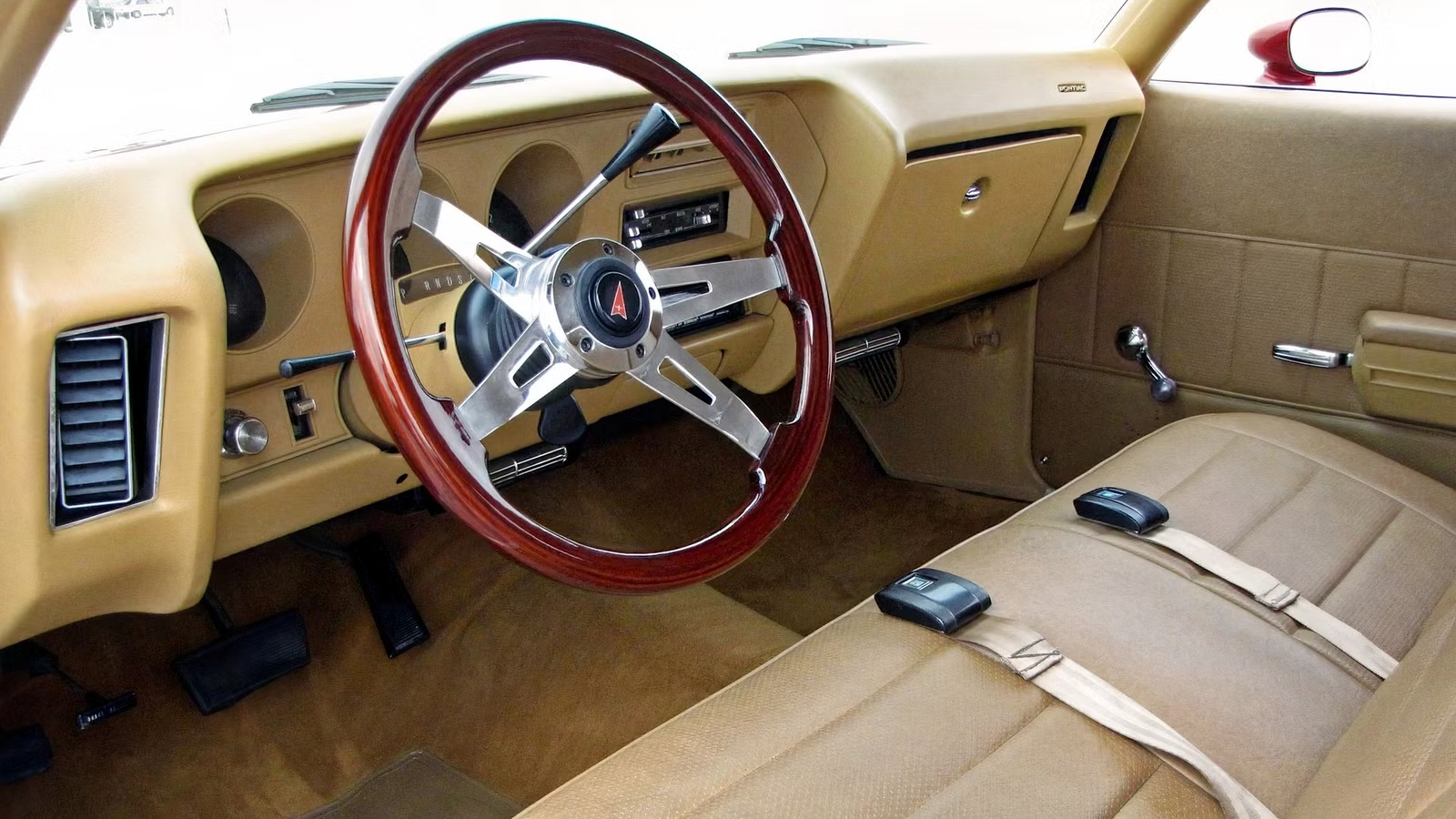
The same logic showed up inside. Reviewers describe the GT-37 as bench-seat basic, with a spartan interior and much of the sound-deadening treatment deleted. Pontiac historian John Sawruk points out that this choice alone saved about 120 pounds. The accountants got the carpet. The engineers kept the horsepower. That is the GT-37 in one sentence, and it is also why the car feels so much closer to the original GTO idea than to later, loaded, personal-luxury muscle machine.

There was drivetrain fine print to navigate, too. The L75 455 was tied to the M40 Turbo Hydra-Matic 400 in 1971. But if you sprang for the LS5 455 H.O., you had your choice of transmissions. You could pair that V8 with the M13 three-speed, M22 four-speed, or M40 automatic.
The GT-37 Let Buyers Pay For Horsepower Instead Of A Badge

A 1971 GT-37 hardtop coupe started at $2,807, while the GT-37 option added $237. Meanwhile, the 1971 GTO had a base price of $3,446 and started with the 400 cubic-inch V8. That does not mean every GT-37 was automatically a bargain-basement 455 H.O. monster, because engines, transmissions, exhaust, axle choices, and other options changed the final number dramatically. But the starting point was lower, and that mattered to the buyer Pontiac was chasing.
The L78 400 V8 was a $221 option in the T-37 and LeMans, while it was standard in the GTO. The L75 455 cost only $58 in the GTO, while the LS5 455 H.O. cost $137 in other GTOs and $358 in the T-37 and LeMans coupes and convertibles. If you were already ordering the big engine, you might as well empty the other barrel. The GT-37 let the right buyer spend less on identity and more on combustion.

Very few buyers actually did. 5,802 GT-37s sold in 1971. Of those, 5,015 had the L30 350, 146 had the L65 two-barrel 400, 572 had the L78 400, 15 had the L75 455 and 54 had the LS5 455 H.O. That makes 641 GT-37s with one of the three 1971 GTO engines.
But the point is that Pontiac offered the option to buyers. Pontiac could have kept its best engines behind the GTO’s velvet rope. Instead, it handed GT-37 buyers the same menu and let them spend their money where it counted. Sure, the cheaper car missed some chassis hardware. But a 480-lb-ft 455 H.O. has a way of making missing carpet and stabilizer bars feel like small problems. The GTO bought you Pontiac’s famous muscle car. The GT-37 proved that in 1971, Pontiac still remembered what had made the GTO special.
Sources: Pontiac, Hemmings,

Related posts






Latest Post


No Comments