
The Plymouth That Was Faster Than Everyone Expected
Detroit sold speed with plenty of drama in 1971. The quickest cars wore awesome badges and usually carried engines large enough to make insurance agents reach for the red ink.

One compact Plymouth, however, arrived with a small-block V8 and a friendly sticker price. But it also had enough speed to make established bruisers look overfed. Its shape came from a bargain development program, while its performance suggested somebody had slipped a race car past accounting. That turned Detroit’s usual hierarchy upside down.
Plymouth’s Heavy Hitters Had A Weight Problem
Plymouth entered 1970 with a glamorous new Barracuda riding on Chrysler’s E-body platform rather than its old Valiant-based underpinnings. The broader mission made sense because the E-body could swallow a 440 or the mighty 426 Hemi. It also brought greater weight and cost, which mattered when the target was a small-block Chevrolet Nova that could leave the dealership ready to cause trouble.

The outgoing A-body Barracuda had shown that Chrysler’s 340-cubic-inch V8 worked brilliantly in a compact shell. The Dodge Dart Swinger 340 proved the same point. Plymouth’s planners understood that beating a quick 327-powered Nova with the heavier Barracuda would often require an expensive engine upgrade, turning an accessible street fight into a contest of checkbooks.
That said, Plymouth couldn’t afford to abandon affordable performance while its new pony car moved upscale. It needed a lighter coupe that could take the 340 and reach the quarter-mile finish without dragging a Hemi-sized invoice behind it.
A $15 Million Shortcut Built A Better Weapon

Plymouth had only $15 million to refresh the Valiant for 1970, half of a $30 million A-body facelift budget shared with Dodge. Rather than spread that money across routine grille and taillight changes, its product planners spent the allocation on a new two-door coupe. Corporate attention was fixed on the E-body program, so the compact project slipped through with limited interference.
The budget forced an approach Plymouth insiders called ‘junkyard styling’. The new coupe retained the Valiant’s 108-inch wheelbase and carried over everything ahead of the windshield. Much of the structure underneath remained familiar, too. Calling it clean-sheet engineering would’ve made the accountants choke on their coffee.
The Lightweight Home It Needed

The cleverness appeared behind the doors. Fresh rear quarters added visual muscle, while a steeply sloped rear window met forward-canted C-pillars. The roofline sat 1.5 inches lower than the sedan’s, making the coupe look more purposeful without requiring an expensive new platform.
As a result of all this, customers noticed. The coupe helped drive a 150 percent rise in Valiant sales for 1970 and pushed Plymouth from fourth to third in overall sales. More importantly, its economical shell gave the company’s high-winding small-block exactly the kind of lightweight home it needed.
The 1971 Plymouth Duster 340 Hit Far Above Its Weight

That car was the 1971 Plymouth Duster 340. It weighed 3,140 pounds and carried a base price of $2,703, only $390 more than the standard fastback coupe. Under the hood sat a 340 cubic-inch V8 rated at 275 horsepower and 340 lb-ft of torque. On paper, those numbers seemed healthy rather than outrageous. The power-to-weight ratio supplied the punch line, especially at a time when larger engines often received most of the attention.
The Duster’s relative simplicity worked in its favor. It didn’t need the expense or extra mass of a 440 or 426 Hemi to deliver proper muscle-car performance. Plymouth had placed one of Chrysler’s most responsive small-blocks inside a compact body, then charged little enough to keep the package within reach of people who couldn’t stroll into a dealership and order a loaded ’Cuda. That accessibility formed a huge part of the appeal. The Duster 340 could play in serious company without demanding serious-money credentials.
What Subtlety?

The 1971 model also stopped pretending it was anonymous. Plymouth’s original sleeper idea gave way to a full-length bodyside stripe capped by large ‘340’ numerals on the rear quarter, while an exclusive blacked-out grille sharpened the nose. People chasing more visual drama could order the flat-black hood treatment with its oversized ‘340 Wedge’ graphic, because subtlety had clearly taken the afternoon off.
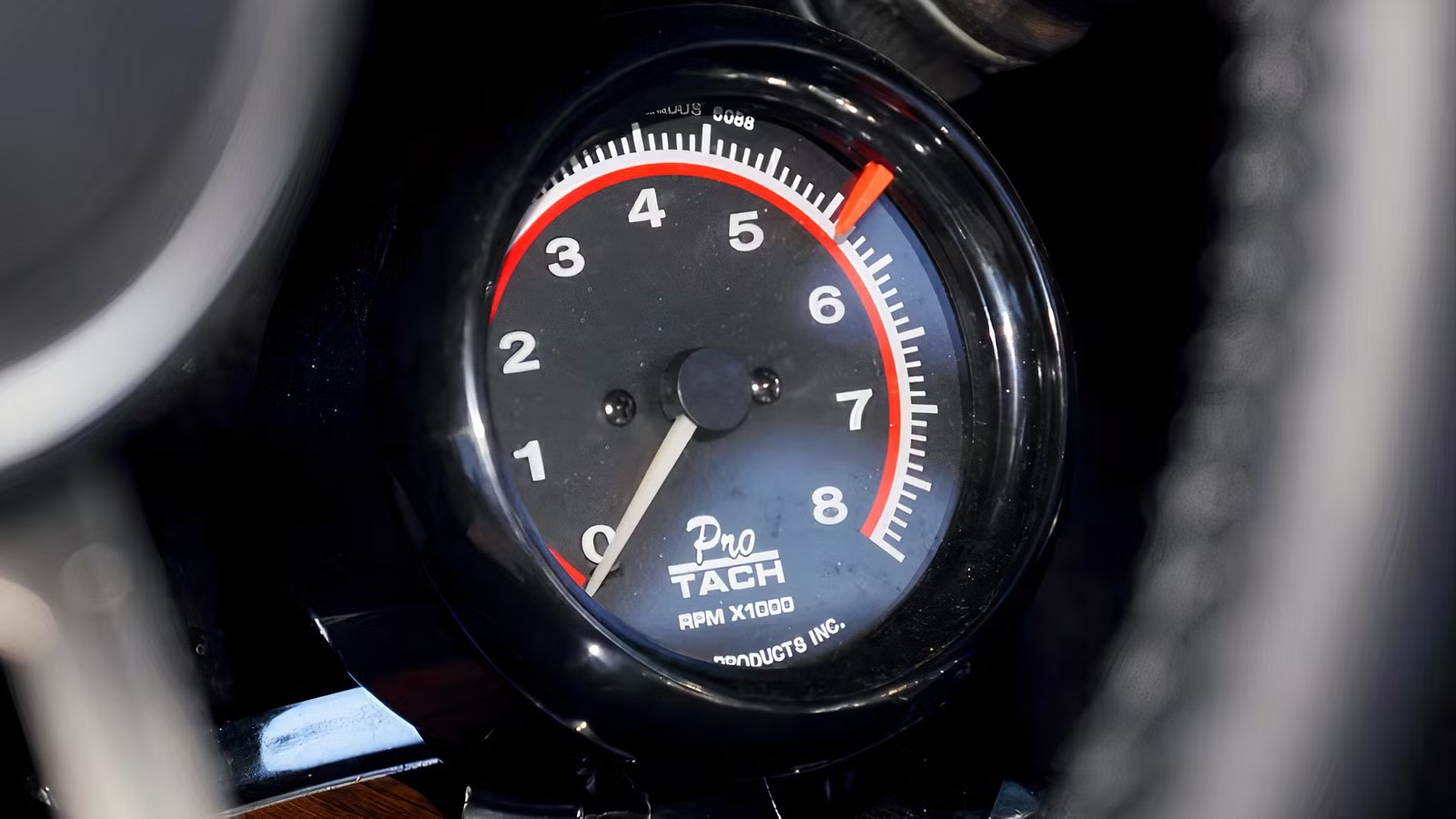
A black decklid spoiler was optional, as were a tachometer and the thick-rimmed Tuff steering wheel. Those touches gave the affordable A-body the showroom presence expected of Plymouth’s Rapid Transit System lineup. It still cost far less than the company’s headline muscle cars, but nobody would mistake it for a six-cylinder commuter borrowing Dad’s nicer wheels. Plymouth had found a way to make an inexpensive compact feel like a proper performance model before the engine had even fired.
Its 275 Horsepower Only Told Half The Story
The 340 earned its reputation through revs rather than sheer displacement. Its 4.04-inch bore worked with a short 3.31-inch stroke, while high-flow heads and large valves helped it breathe. A Carter AVS four-barrel handled induction. Compression dipped slightly to 10.3:1 for 1971, but the engine retained its 275-hp gross rating and could still spin toward 6,000 rpm with enthusiasm. It was the kind of V8 that encouraged drivers to keep their foot down instead of relying on a single low-rpm shove.
That character separated the Plymouth Duster 340 from many larger Detroit engines. Big-block power could feel like being launched from a catapult, while the smaller Plymouth V8 gathered speed with a more energetic top end. The Duster’s low weight allowed the engine to do more with every horsepower it produced. Its official rating also failed to convey how effective the complete package felt once the car was moving.
Crossing The Line First

A floor-shifted three-speed manual came standard, while a four-speed stick was available for drivers who preferred doing their own work. Chrysler’s three-speed TorqueFlite automatic offered the easier route and had the durability to tolerate repeated hard launches. Either way, the rear tires were unlikely to enjoy long lives. The choice also made the Duster 340 adaptable. People could order an old-school manual muscle car or let one of the era’s better automatics handle the shifting.
The performance explains everything. Duster 340s were capable of low-14-second quarter-mile runs, letting this budget Plymouth hassle larger Muscle Cars with bigger engines. A road test of the nearly identical 1970 version produced 0-60 mph in 6.2 seconds and a 14.72-second quarter-mile, better than any stock ’Cuda previously tested. That result was key because the ’Cuda carried a stronger image and offered far more intimidating engine options. The cheaper compact still crossed the line first.
The Bargain Muscle Car’s Getting Noticed

Plymouth built 12,886 Duster 340s for 1971, fewer than the 24,817 sold during the car’s launch year. Production recovered to around 16,000 in each of the next two years before the 340 disappeared. Across 1970 through 1973, 69,115 examples were produced. That makes the performance Duster uncommon without turning every surviving car into a museum piece.
The market has started correcting decades of neglect. Current values place really well-kept examples at about $59,100, while impeccable Duster 340s can stretch to almost $95,000. That top figure is a long way from the original $2,703 sticker, although inflation can’t take all the blame when collectors finally read the spec sheet.
Lesson Learned The Hard Way

In essence, the Plymouth Duster 340 solved the muscle car equation with restraint. Plymouth reused proven hardware and kept the curb weight sensible. The result looked like a bargain because it was one. Rivals learned the harder lesson after the lights turned green: expectations don’t add horsepower, and famous badges don’t shorten elapsed times.
Sources: Hagerty, HowStuffWorks, Plymouth

Related posts

Latest Post


No Comments