
Ford Built Only 531 Of This Mustang Before Emissions Killed The Big-Block

The conventional automotive history narrative tells us that insurance hikes, federal emissions mandates, and the 1973 Oil Embargo choked the American muscle car to death by the mid-1970s. For the Ford Mustang, this transition era birthed a generation of cars that many enthusiasts still treat as a bloated, weak link rather than a performance highlight.

Yet, buried deep within the order books of this widely criticized generation lived a factory option so violently fast it completely shatters the era’s reputation for compromise. To understand how rare this machine truly was, you have to understand exactly what it was hiding from.
Why Cruel Insurance Metrics Ruined The 1971 Mustang’s Reputation
The 1971 redesign fundamentally changed the Mustang’s identity. Borrowing front-end styling cues from the intermediate Torino and Fairlane, the pony car grew larger, wider, and noticeably heavier. Coinciding with a struggling national economy and tightening federal emission regulations, this dramatic upscale shift initially missed the mark with a fanbase deeply divided over the car’s new, substantial footprint.

Compounding the weight issue was an aggressive, pre-emptive strike from the insurance industry. Actuarial research had flagged high-output vehicles as a massive liability years prior, with a major 1964 insurer study revealing that “super-powered cars” generated 56% more financial losses than standard models. By the turn of the decade, premiums skyrocketed for anything pushing over 300 horsepower, crippling high-performance sales before cars even left the showroom floor.
Faced with shrinking demand and an unforgiving regulatory landscape, Ford began gutting its legendary big-block lineup by 1972. This brief, transitional window is precisely why the early-1970s models are rarely invoked for performance bragging rights—but it also makes what snuck through in 1971 all the more legendary.
The Forgotten Big-Block Monster That Deserved More Fame
It beat the Road Runner in period testing, won Motor Trend Car of the Year, and costs a fraction of what a Chevelle SS 454 commands today.
The 531-Unit Factory Option Code Hidden Deep Inside Ford’s 1971 Order Sheets

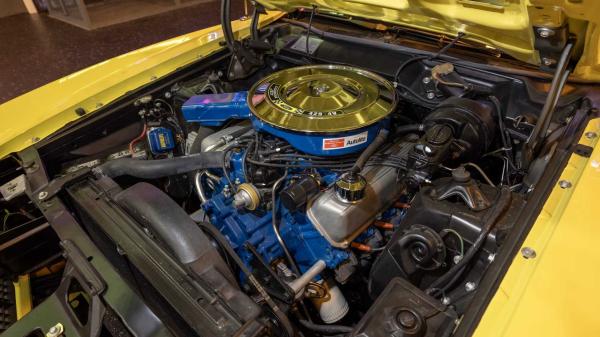
Hidden inside the 1971 ordering guide was a lethal combination: the Mustang Mach 1 equipped with the 429 Super Cobra Jet (SCJ) engine and the factory Drag Pack. This wasn’t a highly publicized, standalone marketing trim like the Boss 302 or Boss 429; it was an engineering order buried deep in the option sheets, easily missed by the untrained eye.
It remains one of the rarest Mustangs ever built. Ford produced a mere 531 units of the Mach 1 featuring the 429 SCJ and Drag Pack pairing for the 1971 model year.
To narrow the historical field even further, only 326 of those 531 cars were ordered with the combination of a four-speed manual transmission and the functional Ram Air induction system. Today, these surviving anomalies are heavily documented and verified through official Marti Reports—using original Ford build sheets and production invoices to separate genuine factory drag racers from period-correct clones.
Inside The Drag Pack: The Choice Between A 3.91 Traction-Lok And A 4.11 Detroit Locker

Checking the Drag Pack box did far more than add a simple badge to the decklid; it fundamentally rebuilt the 429 big-block’s internals using parts pulled straight from Ford’s competition shelf.
The upgrade transformed a standard Cobra Jet into a high-rpm Super Cobra Jet. The package swapped in a high-lift solid-lifter camshaft, heavy-duty cap-screw connecting rods, a forged, modified crankshaft, a specialized flywheel, a unique vibration damper, and an external oil cooler to survive repeated high-heat abuse.
Crucially, the Drag Pack gave buyers a choice of how they wanted to deploy that heavy-duty power to the pavement. It did not mandate a single rear-axle spec; instead, buyers could select either a 3.91 Traction-Lok or a brutal 4.11 Detroit Locker rear end. In fact, modern Marti Report documentation has identified one highly celebrated surviving 429 SCJ as the very first Y-code Detroit Locker example ever assembled for that model year. It was a race car disguised in standard sheet metal.

12 Big-Block Monsters That Defined The ’60s And ‘70s
Discover 10 legendary big-block muscle cars from the ’60s and ’70s that defined the horsepower wars and America’s golden age of performance.
Why Ford Claimed This Big-Block Made Only 375 HP

|
Engine |
Transmission |
Power |
Torque |
|
429 cu in (7.0L) Super Cobra Jet V8 |
4-Speed Close-Ratio Manual / SelectShift Automatic |
375 hp @ 5,600 rpm |
450 lb-ft @ 3,400 rpm |
To protect buyers from the prying eyes of insurance adjusters, Detroit automakers routinely engaged in a game of smoke and mirrors regarding horsepower ratings. Ford officially advertised the 1971 429 SCJ at a conservative 375 hp and 450 lb-ft of torque.
This published factory rating was a deliberate corporate understatement designed to keep insurance premiums manageable. However, modern, independent chassis dyno testing on meticulously restored 429 SCJ Drag Pack examples tells the real story, routinely measuring closer to 416 hp and 475 lb-ft of torque.

This underrating tactic was common practice across Ford’s top-tier power plants of the era. The exact same insurance pressures that were actively killing off the muscle car forced Ford to hide the engine’s true capability behind a wall of conservative paperwork—leaving its real output a secret known only to drag strip regulars.
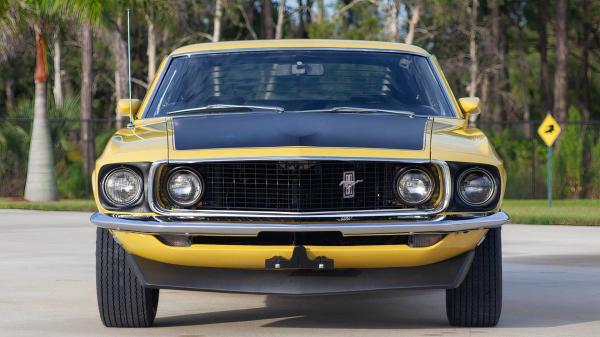
Here’s How Much A 1969 Mustang Boss 302 Is Worth Today
The 1969 Ford Mustang Boss 302 is an iconic muscle car from a bygone era, but it’s still not out of reach.
The Brutal Quarter-Mile Legacy Of Ford’s Final Big-Block Muscle Car

When unchained at the drag strip, the 429 SCJ Drag Pack delivered an unmistakable performance payoff. Period testing and modern historical analysis confirm that a well-tuned SCJ Mach 1 was capable of blitzing the quarter-mile in under 14 seconds. For perspective, a base-model Mach 1 of the same year clocked closer to a lethargic 16.8 seconds—a massive, three-second gulf within the exact same body style.
This absolute peak of performance was incredibly short-lived. By the arrival of the 1972 model year, Ford completely axed both variants of the 429 big-block engine from the Mustang lineup, cementing the 1971 SCJ Drag Pack as the final factory big-block drag package the pony car would ever receive.

Because of their immense rarity and historical finality, these hidden giants now command massive premiums on the collector market. Verified, numbers-matching examples routinely command between $90,000 and $190,000 at major auction houses like Mecum. The generation that casual enthusiasts wrote off as a bloated decline actually produced one of the rarest, hardest-hitting factory muscle cars ever built, right before the garage door slammed shut for a generation.
Sources: Ford, Hemmings, Mecum Auctions, Bring A Trailer

Related posts




Latest Post


No Comments