
The Plymouth Grocery Getter That Seeded Every Mopar Small-Block Since
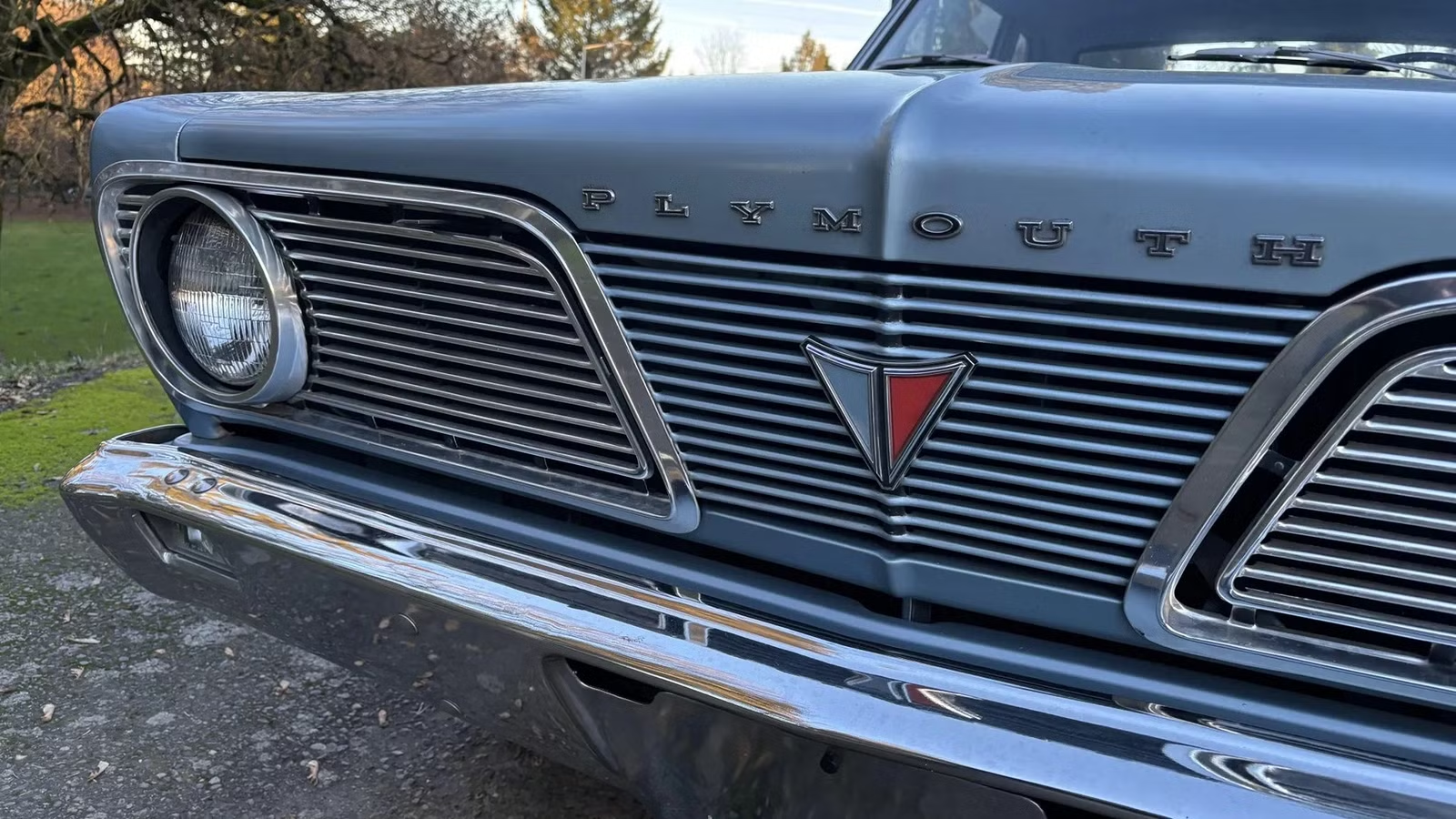
In 1964, the American automotive landscape was shifting; cars outside of Detroit were about to undergo a massive change. Up to that point, compact cars were utilitarian, built on a budget for households to run errands. These cars usually ran on unpretentious six-cylinder engines, but that changed as performance made its way into these daily commuters. Plymouth faced a challenge as the powerful V8s began to strain the six-cylinders designed for these cars’ compact dimensions. To combat this problem, Chrysler made a clean-sheet engineering solution that gave birth to one of the most significant engine families in American automotive history.
The Handling Challenge of Early ’60s Muscle Compacts

Plymouth’s compact lineup built its reputation on nimble handling, agile cornering, crisp turn-in, and great suburban maneuverability. Much of this came from its famous 225 cubic-inch Slant Six engine, tilted 30 degrees to the side for a sleek, low hood line while maintaining a low center of gravity. The standard Detroit method for adding more power was quite simple: take an existing big-block V8 from a full-size car and shoehorn it under the hood.
But this had a major drawback: early 1960s V8s were massive and built from cast iron, adding a weight penalty because the V8 weighed upwards of 500 pounds dry. When engineers dropped this engine into a compact, lightweight chassis, it created what they called the weight trap. Adding an extra 200 pounds directly over the front axle severely reduced suspension and spring travel and affected handling, making the car lazy in turn-in. This made the car understeer and took away the tossable feel of a compact car.
Plymouth’s Unibody Packaging Limitations


Plymouth engineers faced a harsh physical penalty if they wanted to add performance to their compact cars. The engine bay dimensions were dictated by Plymouth’s compact cars being built around Chrysler’s tightly engineered A-body chassis. Unlike traditional body-on-frame vehicles, the unibody structure relied on rigid engine bay panels. The physical clearance between inner fender walls, steering column shafts, and firewalls was cramped and designed specifically to fit a long, narrow inline-six engine.
Widening the engine bay structure or altering the unibody construction would have required millions of dollars in assembly-line overhauls and stamping-plant retooling to fit the traditional wide-block V8, as it was too big a financial risk for a budget-focused commuter line.
Chrysler was trapped in a corner, and to give Plymouth a competitive V8 option, it couldn’t choose an existing engine or redesign the chassis, so it decided to engineer a new engine from scratch that would change the course of performance forever.
The 1964 Valiant 273 V8 That Broke The Mold

Midway through the 1964 model year, Chrysler dropped a brand-new 273 cubic-inch LA Light A-series V8 into the Plymouth Valiant. The 273 LA V8 was an engineering masterpiece: compact and lightweight. It was a 90-degree overhead-valve V8 with thin-wall iron casting techniques and exceptionally tight, compact, wedge-shaped cylinder heads. By casting walls at a precise 0.180-inch thickness without compromising block rigidity, the dry weight stayed low; the weight penalty was roughly 30 to 50 pounds more than the 225 Slant Six engine.
The LA engine had an 8.8:1 compression ratio and a two-barrel Carter BBD carburetor; the 4.5-liter engine produced 180 horsepower at 4,200 rpm and 260 lb-ft of low-end torque at just 1,600 rpm. Period tests show a 0 to 60 mph time of 10 seconds, while still returning 18 to 20 mpg for a V8-powered car.
Yet in the showroom, one would never guess the compact Valiant had a V8 under the hood. Plymouth added no external body cues to suggest the car had extra punch under the hood. It just had tiny, understated V-shaped badges on the front fenders. It remained a true factory sleeper inside a grocery-getter shell.
How 260 Pound-Feet Of Torque Changed The Drive

The 1964 Valiant 273 not only improved straight-line speed but also rewrote the whole driving experience, as it felt uncompromising. Because the weight penalty on the front axle was negligible, the steering still retained a light, communicative, and accurate feel. It still could go in the corners without feeling floaty.
While rivals felt twitchy, front-heavy, and compromised in daily traffic, the Valiant felt well-balanced and effortless. The 260 lb-ft of torque delivered an immediate, smooth pull right off idle. The low-rpm torque gave the car effortless around-town acceleration without demanding high engine revs. Driving onto freeways and overtaking slower traffic required only a touch of the throttle.

Underneath the car, the single-pipe exhaust note, routed through a quiet muffler, was barely a whisper at idle, adding to its refined, unassuming personality. It didn’t demand its owner compromise core commuter duties for extra horsepower. The heavy-duty torsion bar front suspension absorbed rough city pavement without harsh chatter, the cabin stayed quiet on long 70-mph highway trips, and the compact engine bay left plenty of room for routine maintenance like oil filter changes and spark plug swaps.
The car was a perfect around-town suburban mover, with the V8 exhaust note barely audible at idle. The cabin stayed quiet at 70 mph; the compact engine bay still had plenty of space for routine, hassle-free maintenance. It was effortless to drive in suburban traffic. And the little Valiant showed that a small car could have a big V8 and still handle daily driving and chores without a hassle.
The DNA That Built Mopar’s V8 Dynasty

Despite its brilliant engineering, the 1964 273 V8 was still a rare sight on the sales floor. Only about 16% of 1964 Valiant buyers chose the V8 option at its mid-year debut. The modest 273 cu. in. engine was more than a simple upgrade. It laid the foundation for Chrysler’s modern V8 legacy. The thin-wall LA architecture was so strong and compact that Mopar engineers used it as a structural foundation for decades, creating world-class performance engines.
The thin-wall 273 evolved directly into the workhorse 318 LA small-block in 1967, which went on to power millions of passenger cars, trucks, and vans over four decades. Shortly after that came the high-revving 340 LA small-block in 1968, a 275 hp beast, a giant killer with forged steel cranks and high-flow heads. It was followed by the high-torque 360 LA small-block engine in 1971, which was in use well into the fuel-injected Magnum era of the late 1990s.
Decades later, when Dodge engineers set out to create an exotic engine for the 1992 Viper supercar, they took the proven LA small-block, added two cylinders, and created the iconic 8.0-liter V10. This technological prowess began in mid-1964 with a modest Plymouth commuter car that proved the most influential V8 engineering lineage started quietly in a compact grocery getter.
Source: Plymouth Valiant, Hemmings, Bring a Trailer.

Related posts




Latest Post


No Comments