
The Parallel-Twin Engine That Could Outlast Most Of The Motorcycle
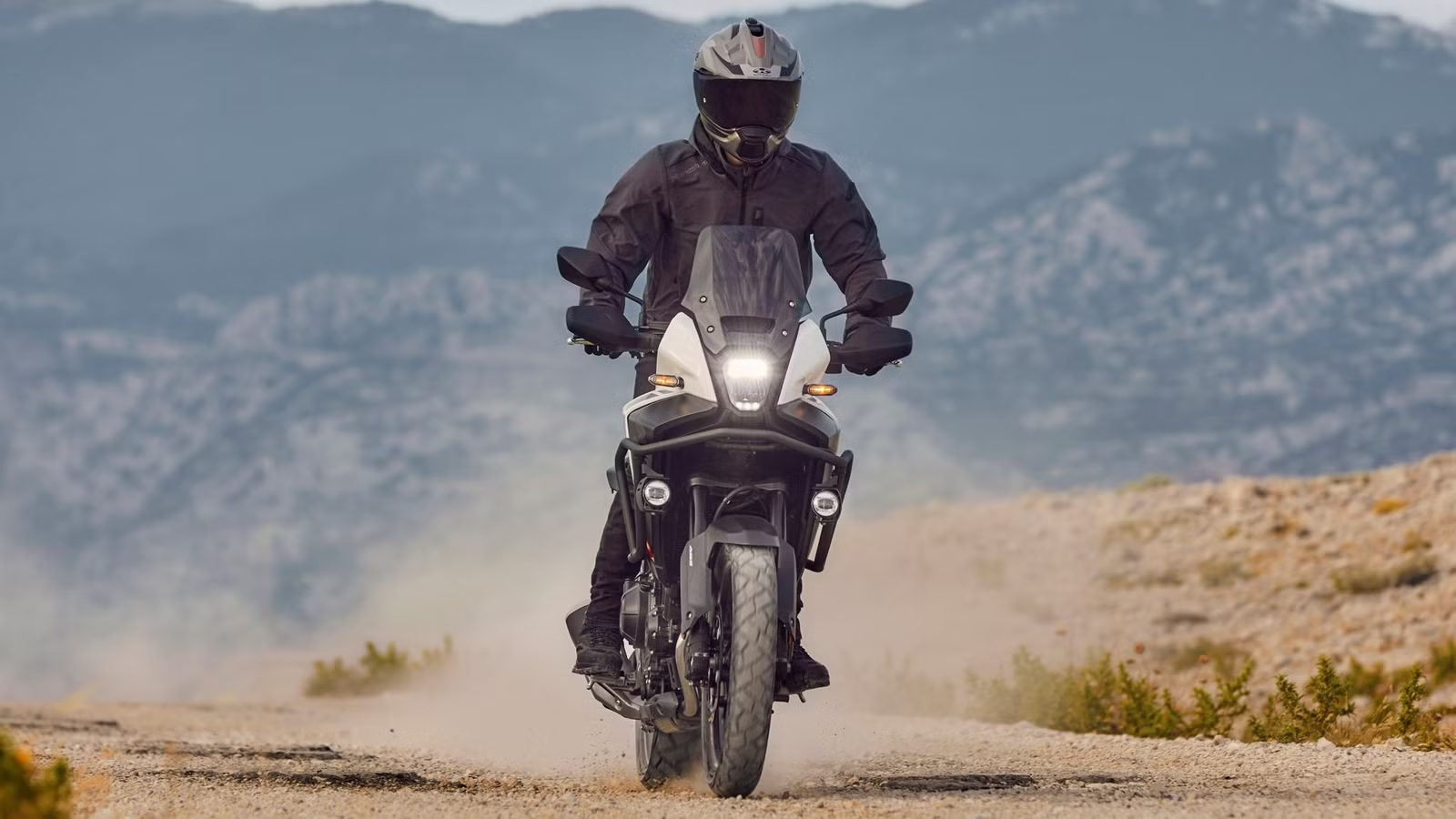
Motorcycles rarely die all at once. Usually, they wear out one piece at a time. Chains stretch, tires square off, brake pads disappear, and fork seals start seeping. Engine wear usually comes much later, particularly if you have a proven package underneath. Built with sensible outputs, proven internals, and years of real-world data behind them, these engines can keep running long after the motorcycle around them has accumulated a long list of replaced parts. We’re talking about one such sub-500cc parallel-twin engine sold across several U.S. models that has even picked up six-figure odometer stories from owners.
Why Most Motorcycles Die In Pieces, Not All At Once

A motorcycle is a collection of systems that age at very different rates. Besides the above-mentioned bits, there are the less obvious aging points. Batteries don’t last forever. Rear shocks can lose their damping performance. Wheel and steering-head bearings eventually need attention. Paint fades, plated hardware loses its shine, and seat foam softens.

None of that necessarily means the engine is close to finished, though. A properly lubricated, cooled, and serviced engine works in a much more controlled environment than a chain or tire. Internal components aren’t directly exposed to road grime, and regular oil changes remove contaminants while maintaining the lubrication that keeps bearings, rings, and camshaft surfaces alive. That is why high-mileage motorcycles can look tired while still starting every morning at the first push of the button.
What Makes An Engine Built To Last

So what separates an engine that goes the distance from one that doesn’t? Usually it’s a moderate state of tune, so the internals aren’t living at the edge of what the metal can take. Add simple, proven architecture like dual overhead cams, liquid cooling, fuel injection and a six-speed gearbox, with nothing exotic waiting to fail. Long service intervals help too, since they show the manufacturer isn’t nervous about what happens between visits. And then there’s time. An engine that’s spent years in production across several models has had its quirks found, fixed, and forgotten. One parallel-twin on US showroom floors checks every one of those boxes.

Honda’s 471cc Is The Ultimate Bulletproof Parallel-Twin Engine

The engine in focus is Honda’s 471cc parallel-twin. It’s been in production since 2013, when it arrived in the CB500F and CBR500R, with the CB500X following a few months later. Today, it powers the CB500 Hornet, the CBR500R, the NX500, and the Rebel 500. This means the engine is now being used in four distinct segments: streetfighter, sport bike, adventure bike, and cruiser. Honda even built a one-make race series around the CBR500R, including cup events in Brazil and France open to amateurs as young as 13. Yet, the engine hasn’t had any major weak spots.
On paper, it’s a liquid-cooled DOHC design with four valves per cylinder, a 2.64-inch bore and 2.63-inch stroke, 10.7:1 compression, and fuel injection through a 1.34-inch throttle body. Honda UK lists 47 horsepower at 8,500 rpm and roughly 32 lb-ft of torque at 6,500 rpm. A 180-degree firing order and a mid-range focus between 3,000 and 7,000 rpm give it a smooth, easygoing character.
The Lineup Starts Under $6,000

The 2026 Honda CB500 Hornet starts at $5,899, plus a $600 destination charge, and that’s $1,000 less than last year’s CB500F. The CBR500R costs $6,399, the Rebel 500 at $6,799, and the NX500 starts at $6,899. On the Hornet, Honda includes a one-year, transferable, unlimited-mileage limited warranty. Honda’s own US product page leans hard on the engine’s reputation, too, describing it as versatile, approachable, and known for dependability.
Engine That Is Built And Performs Conservatively But Gets Serviced Rarely

Nothing here looks stressed. Honda tuned this engine for mid-range pull rather than a high-rev scream, and a 47-horsepower output isn’t asking much of the hardware. A primary couple balancer sits behind the cylinders, with scissor gears keeping gear noise down. Less shaking generally means less wear on everything bolted to the thing. The engine also acts as a stressed member, with four hangers on the cylinder head helping the frame stay rigid, and the silent cam chain gets vanadium-treated pins to cut friction and wear. Honda has even said much of the internal engineering came straight from its CBR600RR and CBR1000RR engines.
A Service Schedule That Signals Confidence

Minor services come every 8,000 miles, with valve clearance checks at 16,000 miles. Compare that with Yamaha’s schedule for the Ténéré 700: oil every 4,000 miles or six months, valves at 26,600 miles. Kawasaki asks for a valve check on the Ninja 650 every 15,000 miles. This matters since every valve cover that stays shut is a shop bill you didn’t pay, and a chance for something to go wrong that never happened. You’ll still need to clean, lube, and adjust the chain, though.
Owners Report Stress-Free Experience After 100,000 Miles

Nothing official promises 100,000 miles. What exists is owners’ testimony, and some of it is compelling. One prominent rider in the forums says he’s covered 96,000 miles on a 2014 Honda CB500X through extremely rough terrain without a single mechanical fault, and he’s taken it through more than 50 countries on six continents. The bike wears off-road upgrades, sure, but the engine inside is the same 471cc twin. The pattern shows up elsewhere too. Hard evidence is thinner than forum swagger suggests. Still, the pattern of owner reports is consistent enough to take seriously.
Small Blemishes Exist

Normal wear still applies. Chains, tires, pads, and seals will all need replacing, same as on any bike, and the hardware around the engine is pretty conventional: a 41mm inverted Showa fork, a single rear shock and twin 296 mm front discs with ABS. Those are the parts that’ll age first. Then there’s the recall. NHTSA campaign 14V-056 covered 6,954 units of the MY2013 CB500F, CB500X and CBR500R because the rocker arm shaft retaining bolts may have been made incorrectly.
A loose bolt would first cause a slow oil leak, and if ignored, it could come out of the cylinder head entirely. Honda fixed it free of charge. It affected bikes built between January and August 2013. Evidence pointed to a non-approved anti-corrosion coating on the bolts. That reads as a first-year manufacturing problem rather than a design flaw.
How It Stacks Up Against Other Twins

Yamaha’s 689cc CP2 twin is the obvious rival. The 2026 MT-07 lists at $8,599 plus a $675 destination charge, which is $2,700 more than the Hornet’s base price. Yamaha has its own longevity story, too. Yamaha Australia profiled a Ténéré 700 with more than 64,000 miles on the clock, and its valve cover and spark plugs went untouched until around 50,000 miles. That’s impressive, but it’s still well short of the 96,000-mile claim mentioned earlier.

Kawasaki’s 649cc twin, found in the Ninja 650 and its siblings, has the longest track record of the three, dating to the Ninja 650’s 2006 launch. Named, documented high-mileage cases are harder to find, though. None of this proves the Honda will outlast the Yamaha or the Kawasaki. Nobody’s run that test. Where Honda’s twin pulls ahead is the combination: a $5,899 sticker price, an 8,000-mile oil interval that tops Yamaha’s 4,000 and the 7,500 miles listed in older Kawasaki schedules, and a 96,000-mile tale that’s hard to wave away. Keep the oil fresh and the chain happy, and it’s easy to picture this engine outlasting everything bolted around it.
Source: Honda Powersports

Related posts



Latest Post


No Comments