
The Overbuilt 4.7L V8 That’s Quietly Outclassing Every Modern Aluminum Truck Engine
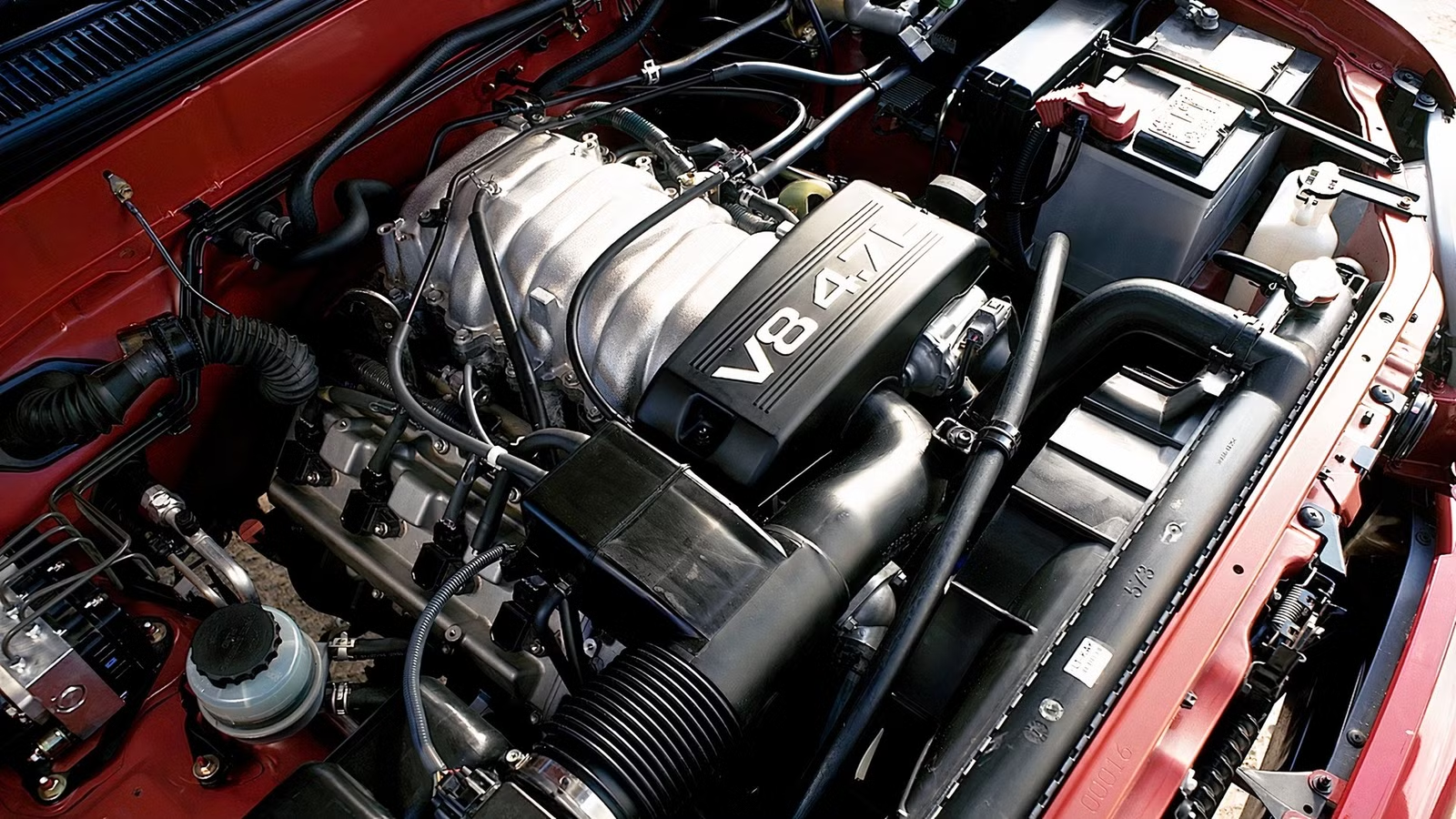
You hear it all the time these days; some automotive manufacturer, even one you might’ve grown to trust over the years, just had to recall every single one of its truck engines for failing well before the warranty expires. It really doesn’t matter which OEM you’re talking about, it feels like every single one’s been involved in some catastrophic engine recall PR disaster in the last few years. Worse still, the problem isn’t getting better nearly fast enough to establish trust again. It’s a pity, really, because it didn’t used to be that way. In the 2000s, one brand in particular made truck engines that lasted a lifetime.
Why Modern Truck Engines Keep Failing

Alright, it’s not like there’s a one size fits all plague across every single OEM’s truck engine lineup. With that said, there are a few common issues that seem to pop up. For starters, modern truck engines need to conform to federal emissions compliance laws and CAFE fuel economy targets that would’ve been all but impossible to hit 20 years ago. Whether forcing a truck engine to hit as many MPGs as a family hatchback is a fool’s errand or not is beside the point, and every OEM’s had to make changes as a result.
For starters, it’s increasingly rare for trucks to leave the factory packing big, burly V8s anymore. Twin-turbo V6s, usually paired with electric motors and batteries, appear to be the standard more and more as each year passes. These turbo motors aren’t anything like engines of old, with thin-walled aluminum blocks to save weight, gasoline direct-injection for peak fuel efficiency, and enough turbo boost pressure to start nuclear fusion. Okay, maybe not quite that much, but it’s a newly established standard that feels almost alien if you’ve observed full-size truck and SUV engines evolve over the years.
This leads to a few “interesting” afflictions that seem to give owners headaches day in and day out. Ailments like shards of aluminum manufacturing debris spinning main bearings like a Dead or Alive hit single, camshaft lobes failing at random and turning them into rubble, and direct-injection carbon buildup that makes the intake valves look like the end of the day at a coal mine. Suffice it to say, these are things our parents and grandparents never had to think twice about when they bought new trucks. And yet, even manufacturers we trust to build bulletproof powertrains aren’t immune these days.

Even Toyota?! Say it Ain’t So!!

Yup, even Toyota themselves have run into major issues with its full-size SUV and truck powertrains lately. Particularly, the 3.4-liter twin-turbo V35A-FTS V6 in the current Sequoia, Tundra, and Lexus LX/GX has been behaving in a markedly un Toyota-like fashion. Reports of metal shavings, debris left over from the block casting process, are reported to not be fully cleaned out by the time the motor is installed in the engine bay. These microscopic pieces of debris, no larger than specks of dust, mix directly with engine oil, eventually finding their way to the crankshaft’s main bearings and causing absolute havoc.
Oftentimes, the problem rears its ugly head at highway speeds, when the engine decides it’s had enough and seizes up when you’re merging on the highway, pulling a heavy trailer, or making your way up a steep hill. To say the voice volume on the phone call to local Toyota dealerships was a few octaves above normal would be putting it lightly. For a company that once prided itself on building engines so reliable they survive battlefields and natural disasters, this is a PR blow that stings extra hard.
Doubly so, because not all that long ago, Toyota used to build a big, old-school V8 so reliable and so competent in its abilities that it didn’t stop building it for more than a decade. Truth be told, Toyota would probably still be making it if the company wasn’t as committed to peak fuel efficiency like they are in the 2020s. Isn’t it a shame, because it really was one of the best engines of the 2000s, and heck, even the 2010s as well.
The 2UZ-FE: 4.7 Liters of Pure Iron Block Perfection

Not all that long ago, the 2UZ-FE V8 served the same purpose as today’s twin-turbo six-pots. As the engine for the Tundra, Sequoia, Lexus’ flagship SUVs, and the 100 Series Land Cruiser to boot, this old-school iron block V8 was the antithesis of a modern truck motor. It was stout, heavy, and cast from heavy-duty iron, closer to an old American muscle car engine than a modern plant. With anywhere between 230 and 280-ish horsepower on tap, a 2UZ was at a 100-ish horsepower disadvantage to a modern Toyota twin-turbo V6. At 300 to 325 lb-ft of torque compared to 479 lb-ft in a non-hybrid modern V6, you do notice the difference in performance.
Still, you’d be hard pressed to find a Toyota faithful who’d trade decades of trouble free driving for that 25 percent boost in power or torque. If anything, a conservative engine tune straight from the factory meant a 2UZ-FE was perpetually understressed as it drove down the road. Paired with a two-bolt main cap and a steel crankshaft, and forged connecting rods, there wasn’t much of anything that bothered Toyota’s most reliable V8 to date. Sure, you couldn’t blast the engine with performance mods and forced induction like you could with earlier 1UZ-FEs. Still, if you’re going to do that to a V8, people just bought Hemis and LS motors instead.
2UZs were engines built to last for 400,000 miles or more before you even have to think about a rebuild. Heck, over-the-road haulers who maintained highway speed day in and day out for a decade or more have managed to turn over the odometer completely at one million miles without doing more than basic fluid changes, a timing belt change, and visually inspecting the exhaust manifold and VVT hardware (post-2004) every now and again. Sure, the fuel economy was bad enough for Toyota to ditch the motor altogether, but it’s fair to say people were willing to make the sacrifice. Many still are in 2026, despite the price of gas these days.
Reliability Like We May Never See Again

This all begs the question, will we ever see engine reliability on the 2UZ’s level from a modern aluminum block truck? Well, to Toyota’s credit, it’s done everything but sit on their butts and ride out the storm while this recall catastrophe unfolded. The company replaced no less than 70,000 long-block engines under federal recall and committed to doubling down on QA items at the factory, long before its trucks and SUVs hit dealership floors. Across several waves of recalls, this applies to as many as 270,000 vehicles Still, high-stress GDI engines leave almost no room for error whatsoever in the manufacturing process. If some other problem arises, not within the purview of the initial recall, don’t be surprised if another one is announced.
Meanwhile, 2UZ-equipped Toyota trucks and SUVs are some of the most sought-after vehicles in America’s used car lots. Even a decade after they were discontinued, they still command prices that could easily be a significant downpayment on a new truck. Only in this messed up universe is a 20-year-old Tundra double cab pushing $30,000 on the used market. Sometimes, that simplicity really is worth big money.
Source: 4wdtalk.com, Toyota

Related posts


Latest Post


No Comments